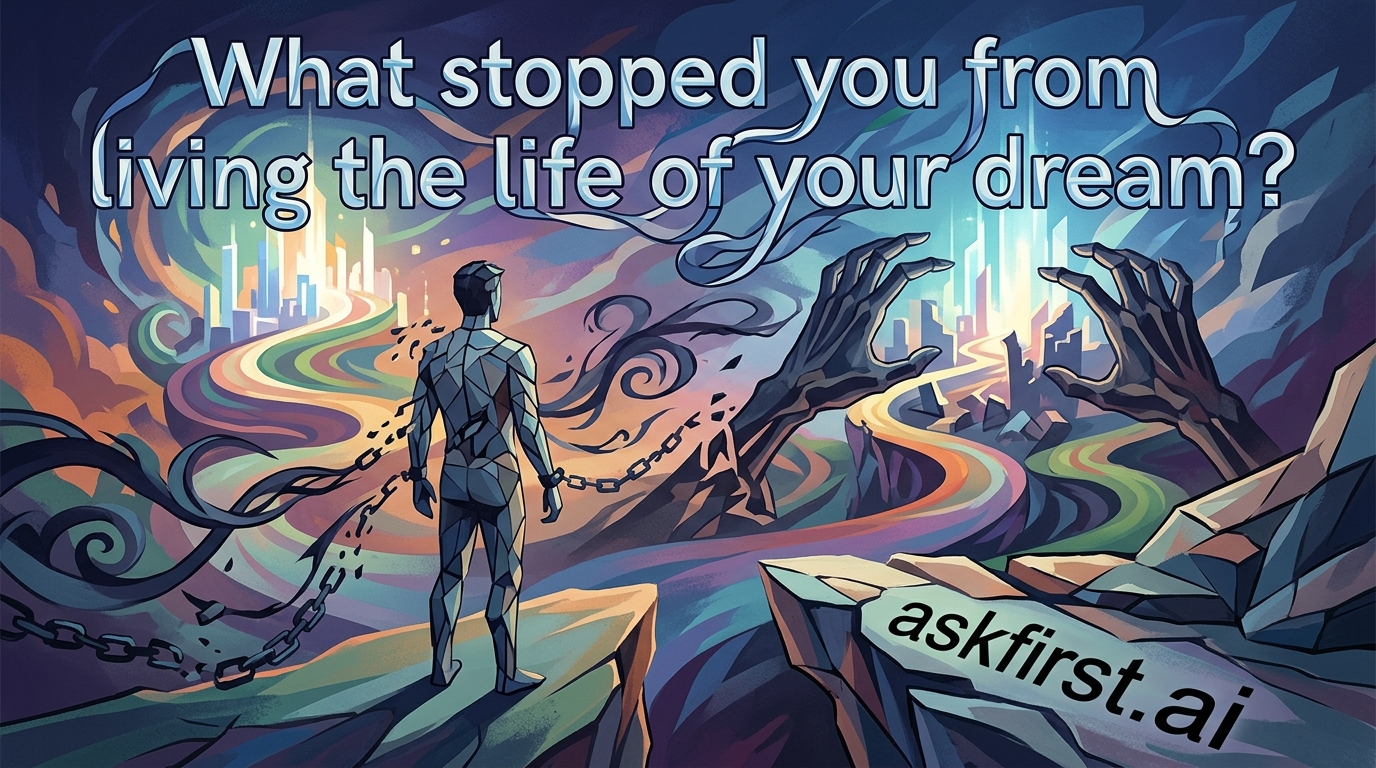
To address the question of what prevents individuals from living the life of their dreams, one must move beyond superficial motivational tropes and examine the intersection of cognitive psychology, systemic socioeconomic constraints, and the biological architecture of the human brain. Many people find themselves stalled not by a lack of desire, but by a complex web of internal mechanisms and external realities that prioritize immediate survival over long-term actualization.
The Biological Anchors: Evolutionary Psychology and Risk Aversion
At the core of human inaction lies the amygdala, the primitive part of the brain designed primarily for threat detection. As noted by Dr. Daniel Kahneman in his seminal work Thinking, Fast and Slow (Farrar, Straus and Giroux, 2011), human beings possess a profound "loss aversion" bias. We feel the pain of a potential loss twice as intensely as we feel the pleasure of a potential gain.
When you contemplate leaving a stable career to pursue a creative passion, your brain does not see "self-actualization"; it sees a threat to your resources, status, and physical safety. This evolutionary holdover often manifests as "analysis paralysis." We spend years researching, planning, and waiting for the "perfect time," which is simply the brain’s way of delaying a high-stakes decision to keep the status quo intact. We are biologically hardwired to choose the certainty of misery over the misery of uncertainty.
The Trap of "Hedonic Adaptation" and Social Comparison
Another significant barrier is the psychological phenomenon known as hedonic adaptation. As defined by psychologists Brickman and Campbell in their 1971 paper Hedonic Relativism and Planning the Good Society, humans have a baseline level of happiness to which they return regardless of positive or negative life events.
If you believe that "if I only had X amount of money" or "if I only lived in Y location" you would be happy, you are falling into a trap. Once you achieve those goals, your brain recalibrates, and you begin to desire the next tier of achievement. Furthermore, in the age of social media, we are constantly engaged in social comparison theory (a concept pioneered by Leon Festinger in 1954). We compare our internal, messy, and complex realities to the curated, highlight-reel lives of others. This comparison creates a sense of "relative deprivation," which paralyzes us because we feel that we have already fallen too far behind to ever reach our dream life.
Systemic Friction and the Myth of Meritocracy
While psychology plays a major role, it is intellectually dishonest to ignore the structural barriers that prevent the pursuit of dreams. In The Meritocracy Myth (Rowman & Littlefield, 2015), authors Stephen McNamee and Robert Miller-Jones argue that the widespread belief that "hard work equals success" ignores the massive disparities in starting positions.
For many, the "dream life" is not prevented by a lack of grit, but by the sheer weight of systemic friction:
- The Debt Cycle: The necessity of servicing student loans or medical debt forces individuals into high-paying but soul-crushing "bullshit jobs" (a term coined by David Graeber in his 2018 book Bullshit Jobs).
- Resource Asymmetry: Access to mentorship, venture capital, or even the luxury of time to fail is not distributed equally. When the cost of failure is homelessness or hunger, the "dream" is effectively off-limits to a large portion of the population.
Breaking the Cycle: Strategic Agency
To overcome these barriers, one must shift from a mindset of "dreaming" to a framework of "strategic agency." This involves several deliberate steps:
- De-romanticizing the Dream: Take the "dream" off the pedestal. Break it down into the most boring, mundane, and repeatable daily tasks. As James Clear illustrates in Atomic Habits (Avery, 2018), progress is rarely about the "big leap" and almost always about the accumulation of small, consistent actions that reduce the cognitive load of change.
- Mitigating Risk Through Asymmetry: Adopt the strategy suggested by Nassim Taleb in Antifragile (Random House, 2012). Instead of going "all in" and risking ruin, engage in small, low-cost experiments. Keep your day job, but dedicate one hour a day to the craft you love. This creates "convexity"—if you fail, the damage is minimal; if you succeed, the upside is uncapped.
- Environmental Design: Your environment dictates your behavior more than your willpower does. If your social circle or physical workspace is designed for comfort and consumption, you will never pursue a high-growth dream.
Conclusion
The factors that stop us from living the life of our dreams are rarely singular. They are a combination of an evolutionary brain that fears change, a psychological tendency to adapt to our current state of dissatisfaction, and a societal structure that penalizes risk-taking for the non-wealthy. Understanding these forces is the first step toward reclaiming agency. We do not stop living our dreams because we are weak; we stop because we are human beings navigating a system that was designed for survival, not for fulfillment. By understanding the mechanics of these barriers, we can begin to dismantle them, one small, calculated, and courageous step at a time.