The Paradox of Stealth Wealth: Decoding the Aesthetics of the Elite
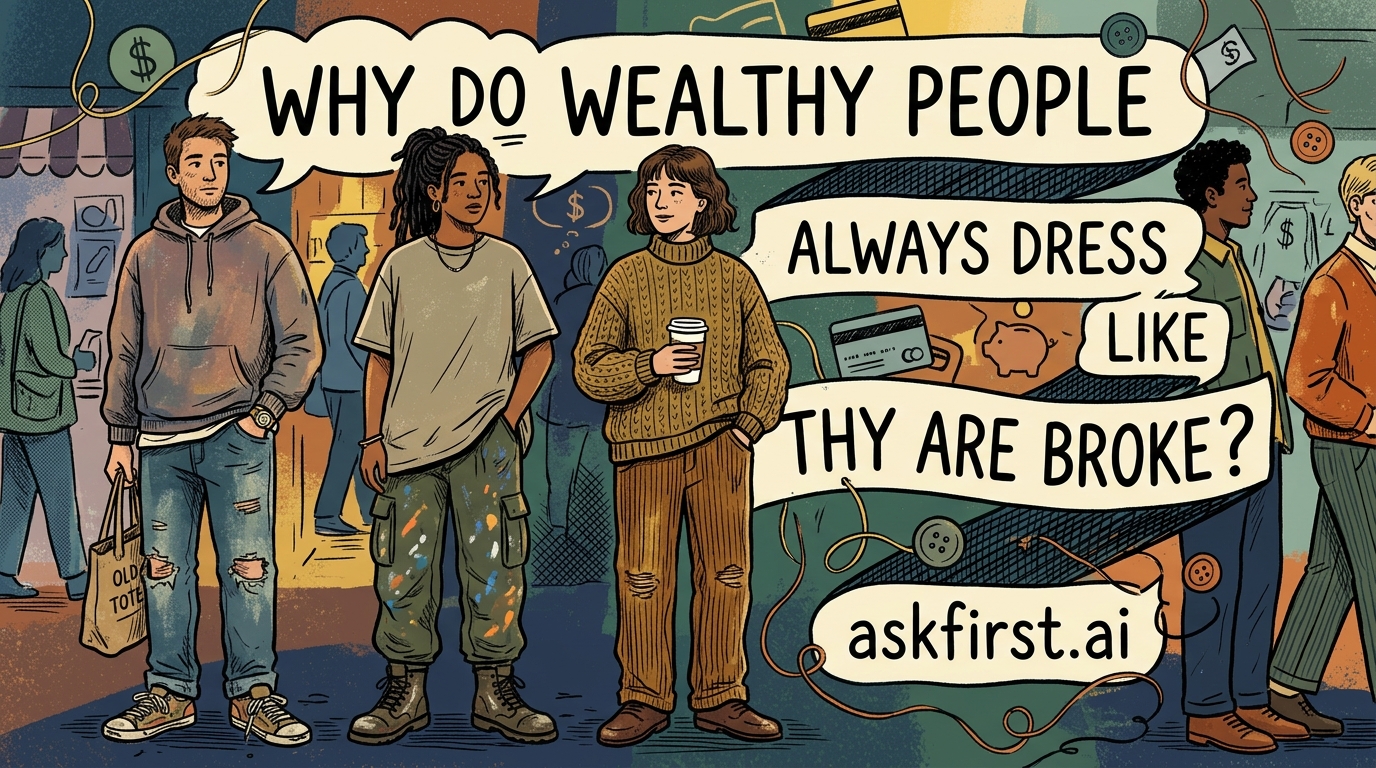
It is a curious psychological phenomenon observed in urban centers and tech hubs worldwide: the billionaire wearing a plain grey t-shirt, the billionaire sporting scuffed sneakers, or the venture capitalist appearing in a hoodie that seems better suited for a college student. This aesthetic choice, often termed 'Stealth Wealth' or 'Quiet Luxury', intentionally rejects the flamboyant displays of opulence once associated with high social status. To understand why those with immense financial resources often dress with deliberate minimalism, one must examine the intersection of sociology, behavioral economics, and the changing definition of prestige.
The Shift from Conspicuous Consumption to Subtle Signaling
Historically, 'conspicuous consumption'—a term coined by economist Thorstein Veblen in his 1899 work The Theory of the Leisure Class—was the primary way the elite signaled their status. By wearing expensive furs, jewels, or ostentatious brand logos, individuals demonstrated their ability to waste resources. However, in the modern digital age, the accessibility of luxury goods via credit, counterfeit markets, and mass-market branding has diluted the status-conferring power of flashy logos. When luxury becomes ubiquitous, it ceases to be a signal of exclusive success.
Consequently, the ultra-wealthy have pivoted toward 'conspicuous modesty'. By wearing understated, non-branded clothing, they signal that their status is so secure that it does not require public validation. The focus shifts from the brand logo to the quality of the fabric, the precision of the cut, and the ethical provenance of the garment—subtle indicators that are only recognizable to others within the same socio-economic echelon. This creates an 'in-group' signaling mechanism where the true cost of an item is known only to the initiated.
Cognitive Load and Decision Fatigue
Beyond social signaling, there is a pragmatic psychological factor at play: decision fatigue. Many highly successful individuals, such as CEOs and high-level innovators, operate under significant cognitive load. Every day, they are required to make high-stakes decisions that affect thousands of employees or billions of dollars in assets. Behavioral psychologists note that human willpower and decision-making capacity are finite resources.
By adopting a 'uniform'—wearing the same or similar simple items every day—these individuals remove a minor, redundant decision from their morning routine. This habit, popularized by icons like Steve Jobs or Mark Zuckerberg, serves to preserve mental energy for professional tasks. Dressing 'like a broke person' is, in this context, a highly strategic maneuver to ensure that peak intellectual capacity is directed toward productivity rather than wardrobe curation.
The Evolution of Social Hierarchy
In contemporary professional environments, particularly within creative and technological industries, the traditional suit-and-tie is increasingly viewed as a relic of old-money corporate structures. Modern prestige is often derived from innovation, technical expertise, and agency. By dressing down, high-net-worth individuals communicate that they are 'doers' rather than 'performers'. Their value is anchored in their output, not their presentation. This style signals a shift in the hierarchy of power: one no longer needs to impress through outward decoration because the power is derived from the ability to create, build, or disrupt.
The Role of Privacy and Security
Finally, the choice to dress in nondescript, 'broke-looking' clothing functions as a privacy and security strategy. In an era of heightened visibility and social scrutiny, flamboyant dressers become immediate targets for public attention, solicitation, or even physical risk. By blending into the crowd, the wealthy can navigate the world with greater anonymity. This 'urban camouflage' allows them to observe society without becoming the focal point of it, maintaining a sense of normalcy in environments where they might otherwise be subject to unwanted scrutiny or demands.
Summary of Factors:
- Cultural Signaling: Shifting from loud brand identity to internal knowledge of quality.
- Cognitive Efficiency: Reducing daily decision fatigue to focus on core productivity.
- Status Security: Demonstrating that one is 'above' the need to impress others.
- Professional Identity: Aligning with values of innovation over traditional corporate optics.
- Personal Privacy: Utilizing non-descript fashion as a form of social camouflage.
In essence, the aesthetic of the modern wealthy is not about being broke, but about being liberated. They have been liberated from the chains of conventional social performance, enabling them to construct a lifestyle centered on function, comfort, and, ultimately, the luxury of being perceived exactly as they choose.