The Fundamental Divide: Monogamy vs. Polyamory in Modern Relationship Structures
Human connection is a complex tapestry woven from cultural expectations, biological predispositions, and personal agency. As we navigate the mid-2020s, the definitions of intimacy have expanded beyond the traditional nuclear model. Understanding the distinction between monogamy and polyamory requires looking past simple dictionary definitions and into the psychological, sociological, and ethical frameworks that support these differing lifestyles.
Understanding Monogamy: The Standard of Exclusivity
Monogamy, derived from the Greek monos (alone) and gamos (marriage), is the practice of maintaining a single romantic or sexual partnership at any given time. This model is deeply embedded in the legal and social fabric of most Western societies.
The Pillars of Monogamy:
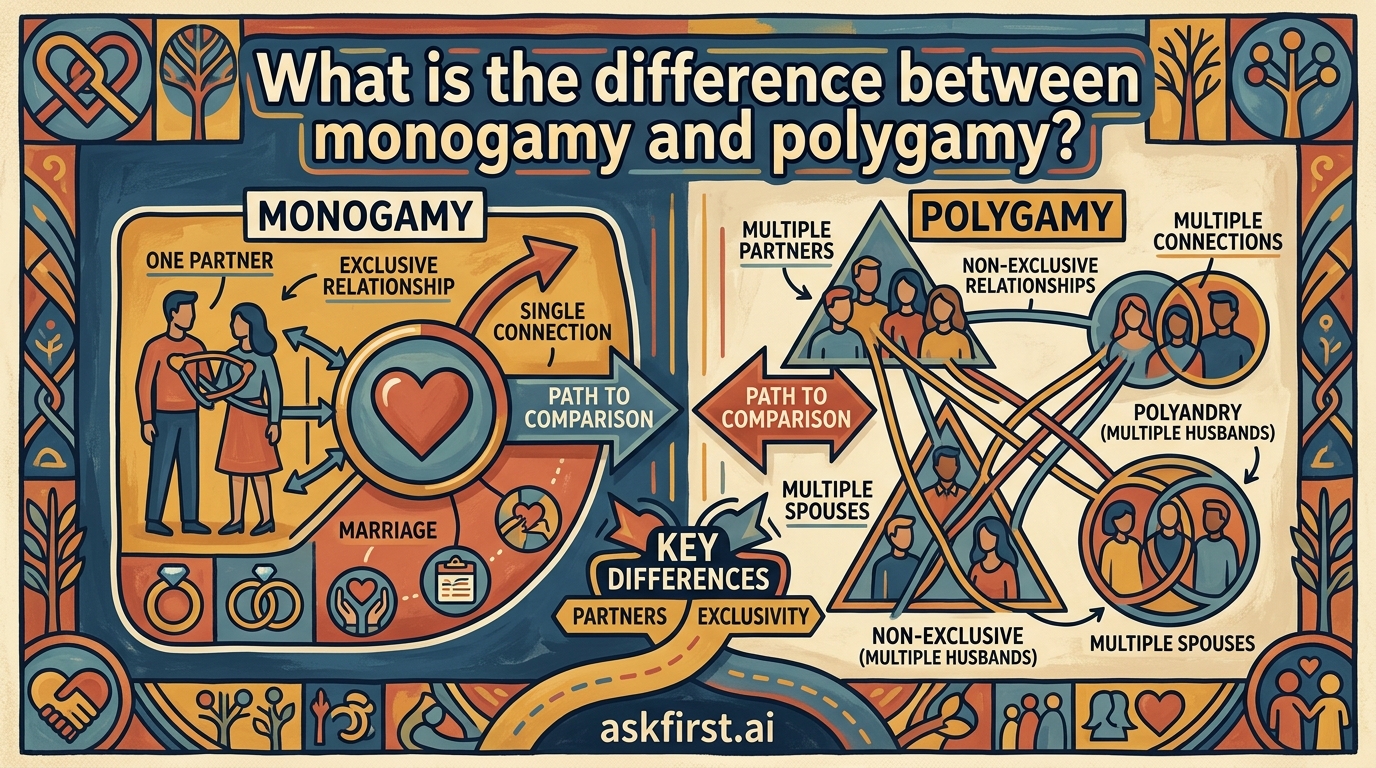
- Sexual and Emotional Exclusivity: Partners agree that romantic and sexual intimacy is reserved solely for one another. This "closed" loop is intended to foster a high degree of attachment and security.
- Social Recognition: Monogamous pairings are the primary unit recognized by law, tax codes, and healthcare systems. In his seminal work Sex at Dawn, authors Christopher Ryan and Cacilda Jethá discuss how monogamy became the "default" setting for civilization, often tied to property inheritance and lineage stability.
- The "One-and-Only" Ideal: This structure relies heavily on the concept of the "soulmate"—the idea that one person should ideally fulfill all of an individual's emotional, physical, and intellectual needs.
While monogamy is often viewed as the "natural" state, anthropologists like Helen Fisher, in her book Why We Love, argue that while humans have evolved for pair-bonding, the rigid enforcement of lifelong monogamy is a relatively recent cultural development designed to manage social order rather than reflect innate biological destiny.
Defining Polyamory: The Architecture of Ethical Non-Monogamy
Polyamory, a portmanteau of the Greek poly (many) and the Latin amor (love), is a form of ethical non-monogamy (ENM). It is the practice of engaging in multiple romantic relationships with the full knowledge and consent of all involved parties. Unlike cheating, which is predicated on deception, polyamory is predicated on radical transparency.
The Mechanics of Polyamory:
- Consensual Non-Monogamy (CNM): The defining feature of polyamory is the explicit agreement between all partners. Everyone involved knows that others are being seen or loved, and this is typically negotiated through boundaries and communication protocols.
- Diversification of Needs: Polyamorous individuals often reject the "soulmate" myth. Instead, they operate under the belief that one person cannot be everything to another. A person might have one partner for intellectual stimulation and another for shared hobbies or physical intimacy.
- Compersion: A central emotional concept in polyamorous communities is "compersion"—the feeling of joy or happiness experienced when one’s partner finds pleasure or love with another person. This is the antithesis of the jealousy that is often cited as the primary obstacle in monogamous social conditioning.
In Opening Up by Tristan Taormino, the author delineates the difference between polyamory and other forms of non-monogamy like "swinging," noting that polyamory is specifically focused on the formation of deep, long-term romantic bonds rather than strictly casual or recreational sexual encounters.
Key Differences: Trust, Communication, and Conflict
The primary differences between these two structures are not just about the number of partners, but the logistical and emotional labor required to sustain them.
- Communication Protocols: In monogamy, communication is often focused on the "us" unit. In polyamory, communication must be highly structured. Because there are more variables, polyamorous individuals often utilize "check-ins" or "relationship agreements" to ensure that everyone feels respected and heard.
- Jealousy Management: Monogamy treats jealousy as a signal that a boundary has been crossed or a relationship is threatened. Polyamory, as outlined by Dossie Easton and Janet Hardy in The Ethical Slut, views jealousy as an emotion to be deconstructed—a tool for self-reflection to understand one's own insecurities rather than a justification for controlling a partner's behavior.
- Time and Energy Allocation: Monogamy assumes a "default" priority where the partner always comes first. Polyamory requires intentional scheduling. One cannot simply assume a partner is available on a Friday night, leading to a more disciplined approach to time management and personal autonomy.
Conclusion: A Spectrum of Choice
The distinction between monogamy and polyamory is ultimately a distinction between two different philosophies of human bonding. Monogamy seeks to deepen intimacy through the intensity of focus and the stability of exclusivity. Polyamory seeks to broaden intimacy through the freedom of connection and the diversification of emotional support networks.
Neither structure is inherently superior; both require significant emotional maturity, self-awareness, and radical honesty to navigate successfully. As society continues to evolve, the conversation is shifting away from which model is "correct" and toward which model allows an individual—and their partners—to live with the greatest degree of authenticity and fulfillment. Whether one chooses the focused intensity of a dyad or the expanded network of a polycule, the success of the relationship is determined not by the number of partners, but by the quality of the communication and the depth of the mutual respect shared between them.