The Science of Decision Fatigue
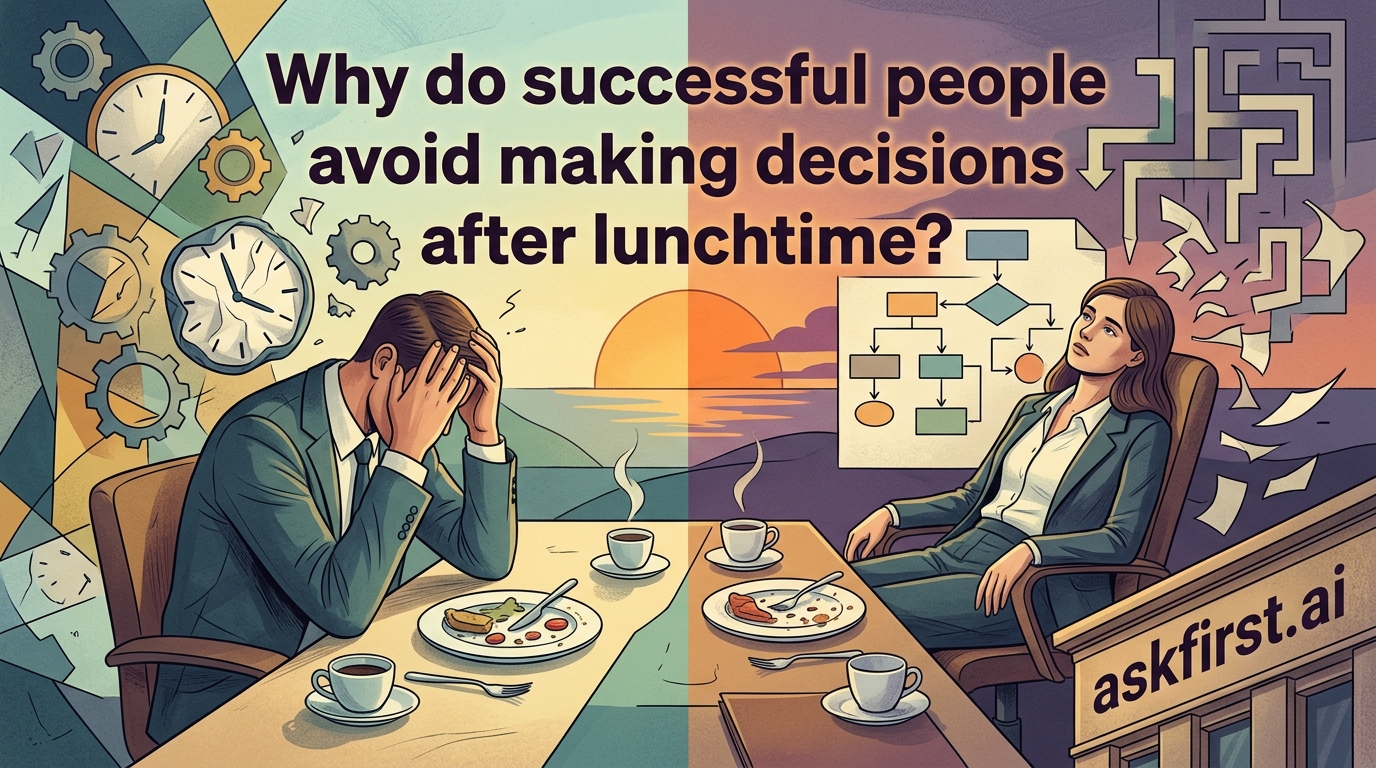
Decision fatigue refers to the deteriorating quality of decisions made by an individual after a long session of decision-making. Research in social psychology suggests that the human brain operates like a finite battery. Every choice, whether minor or monumental, consumes mental glucose and cognitive energy. By the time a person reaches the post-lunch phase of their day, the reservoir of willpower is often significantly depleted. This phenomenon explains why many high-achieving professionals adopt a 'front-loading' strategy for their most critical tasks.
The Biological Mechanism
Cognitive energy is not a bottomless resource. Psychologists like Roy Baumeister have demonstrated through extensive experimentation that willpower acts as a muscle. When this muscle is used repeatedly throughout the morning, it enters a state of exhaustion. This is often referred to as 'ego depletion.' When the brain is depleted, it naturally shifts from a mode of 'optimal analysis' to 'heuristic processing.' In this suboptimal state, the brain seeks the path of least resistance, often leading to procrastination or impulsive choices. This is why CEOs, world leaders, and high-level strategists reserve their early morning hours for their most complex work.
Strategic Scheduling for Peak Performance
Successful individuals understand that the architecture of their day is just as important as the substance of their work. By completing their most demanding cognitive tasks before lunch, they safeguard these vital decisions from the inevitable degradation that occurs as the afternoon progresses. This strategy is known as 'Eat the Frog,' a concept popularized by management experts that encourages tackling the most challenging task first.
- Morning Optimization: Using the highest cognitive clarity for high-stakes negotiations, creative design, or financial analysis.
- Afternoon Simplification: Moving routine tasks, administrative work, and non-critical meetings to the later hours.
- The Power of Boundaries: By protecting the early hours, successful people create a competitive advantage that those who work reactively throughout the day simply cannot match.
Real-World Applications and Examples
Many legendary figures have structured their lives around this biological rhythm. Barack Obama famously limited his wardrobe choices to avoid 'decision fatigue' early in his presidency, noting that he had too many other decisions to make. By automating trivial choices like what to wear or what to eat, high performers preserve their 'choice budget' for the decisions that actually move the needle. When the afternoon arrives, these individuals recognize that their capacity for objective judgment is lower. Consequently, they avoid entering into new agreements or making irreversible commitments during this time. Instead, they pivot to:
- Reflective Planning: Evaluating the day's successes and failures.
- Mentorship: Engaging in low-stakes advisory roles.
- Physical Maintenance: Incorporating exercise or brief movement to refresh neurotransmitters.
How to Reclaim Your Afternoon
If the goal is to improve daily effectiveness, one must first recognize the cycle of their own energy levels. Tracking cognitive energy levels over a two-week period often reveals a distinct 'performance dip' that usually coincides with the late afternoon slump. To mitigate this:
- Batch Processing: Bundle all minor, repetitive emails and logistics into a single hour block.
- Standardized Choices: Develop 'if-then' plans for routine situations to remove the need for active deliberation.
- Restorative Breaks: Incorporate non-stimulant breaks. True cognitive restoration does not involve scrolling through feeds but rather stepping away from digital interfaces entirely.
The Psychological Edge
Ultimately, avoiding significant decisions after lunch is not about laziness; it is a sophisticated method of resource management. It acknowledges that biological constraints are a reality of the human condition. By respecting these limits, high performers maintain a consistent quality of output that is rarely achieved by those who attempt to power through exhaustion. The most successful professionals are those who master the art of working with their brain’s architecture rather than against it. When you prioritize complex decisions in the morning, you ensure that your best self is always in the room for your most important work.