The Psychology of Wealth and Automotive Choice
The image of the billionaire driving a rusted sedan or an aging pickup truck is a persistent cultural trope, yet it rests on a foundation of observable psychological and financial reality. While high-net-worth individuals certainly have the liquidity to purchase the most exotic hypercars on the market, many gravitate toward modest, practical vehicles. This behavior is rarely about a lack of taste; rather, it represents a calculated shift in values, risk management, and the understanding of true net worth.
1. The Principle of Asset Depreciation
Financial literacy plays a massive role in vehicle selection. Wealthy individuals, particularly those who are self-made, often view cars as depreciating assets rather than status symbols. A luxury vehicle can lose up to 50 percent of its value within the first three years of ownership. In contrast, a modest, reliable vehicle—such as a Toyota, Honda, or Subaru—retains its value much longer and incurs lower maintenance costs over its lifespan. For someone with an analytical mindset, the math of 'opportunity cost' is clear: money spent on excessive luxury depreciation is money that is not working in a high-yield investment vehicle or venture capital project.
2. Stealth Wealth and Social Signaling
The concept of 'stealth wealth' is central to this phenomenon. Many affluent people prefer to keep their financial status private to avoid unwanted attention, complex social dynamics, or being viewed as a target for solicitations. By driving a modest car, they are effectively 'cloaking' their wealth in plain sight. This allows them to navigate everyday society without the baggage that comes with overt displays of opulence. It is a form of social engineering that enables individuals to interact with others on a level playing field, where the focus remains on the person rather than their bank account.
3. The Psychology of 'Sufficient' Utility
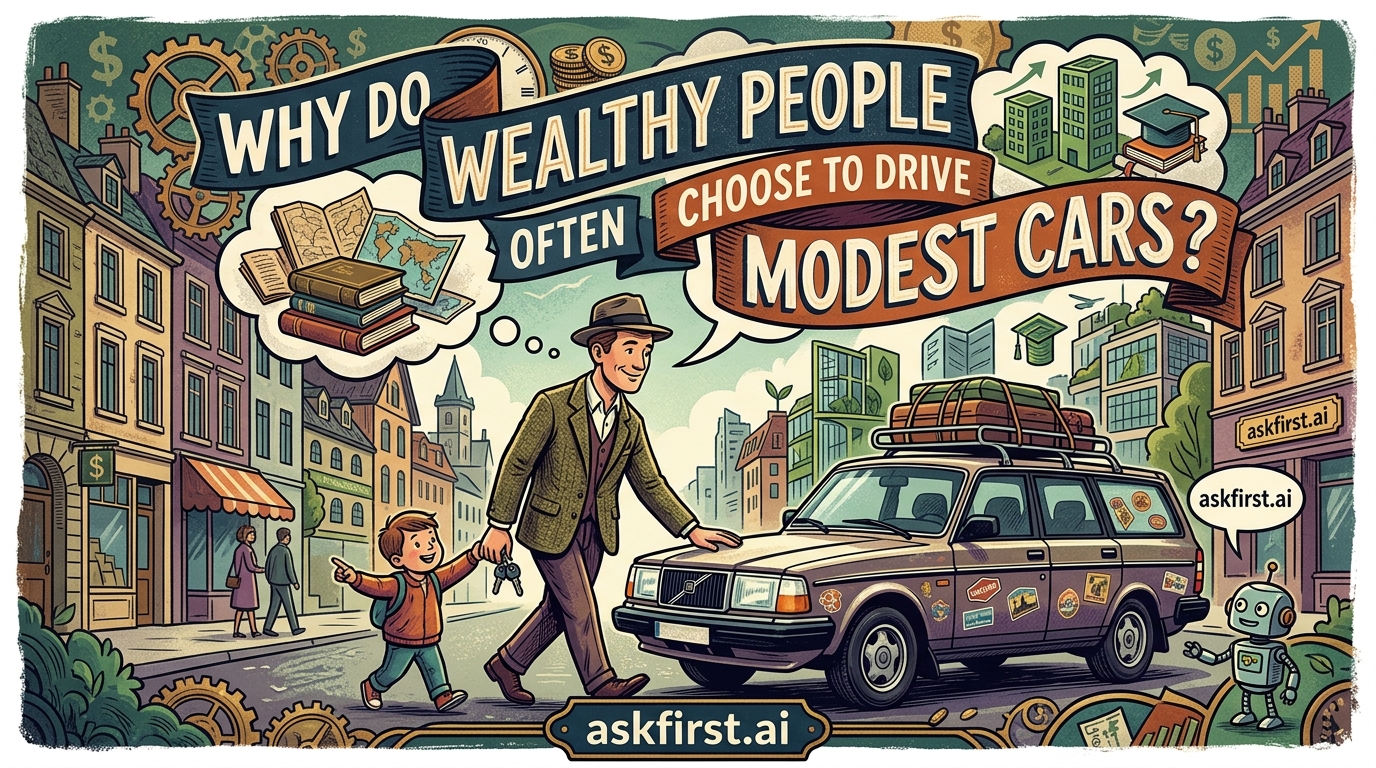
There exists a point of diminishing returns in automotive engineering. Beyond a certain threshold, the added features of a luxury vehicle offer incremental, rather than transformative, benefits. A mid-range sedan provides safety, comfort, reliable transport, and modern connectivity. The wealthiest individuals often prioritize efficiency and utility above all else. They choose vehicles that serve their primary purpose—getting from point A to point B safely and reliably—without the 'luxury tax' associated with premium branding. This mirrors the behavior of figures like Ingvar Kamprad, the founder of IKEA, who famously drove an aging Volvo for decades simply because it worked perfectly well.
4. Avoiding the 'Status Treadmill'
Sociological studies often highlight the 'hedonic treadmill'—the tendency of humans to quickly return to a relatively stable level of happiness despite major positive or negative life events. If a person buys a high-end luxury car to feel successful, they eventually normalize that sensation, requiring an even more expensive car to achieve the same dopamine hit. Wealthy, highly disciplined individuals often recognize this trap early. By intentionally opting for modest cars, they avoid the endless cycle of status-seeking and focus their emotional energy on endeavors that provide long-term fulfillment, such as business innovation, philanthropy, or personal development.
5. Practicality and Emotional Detachment
For many, cars are simply appliances, no different from a dishwasher or a refrigerator. When a person possesses vast wealth, they have already achieved the ultimate form of 'social proof' in their industry or community. They do not need to use a vehicle to validate their existence. Consequently, they feel no internal pressure to engage in 'conspicuous consumption,' a term coined by economist Thorstein Veblen to describe spending intended to display wealth. Their self-worth is internalized, making them immune to the external pressure of modern consumerist culture.
Conclusion: The New Definition of Luxury
Ultimately, the choice of a modest car is often an act of independence. It signals a shift away from needing external validation and toward the freedom to live life according to one's own metrics. By prioritizing financial wisdom, privacy, and utility, those with significant wealth redefine what it means to be successful. To the discerning eye, a modest car in the hands of an exceptionally wealthy person is not a sign of frugality—it is a sign of complete control over one's life, values, and financial future.