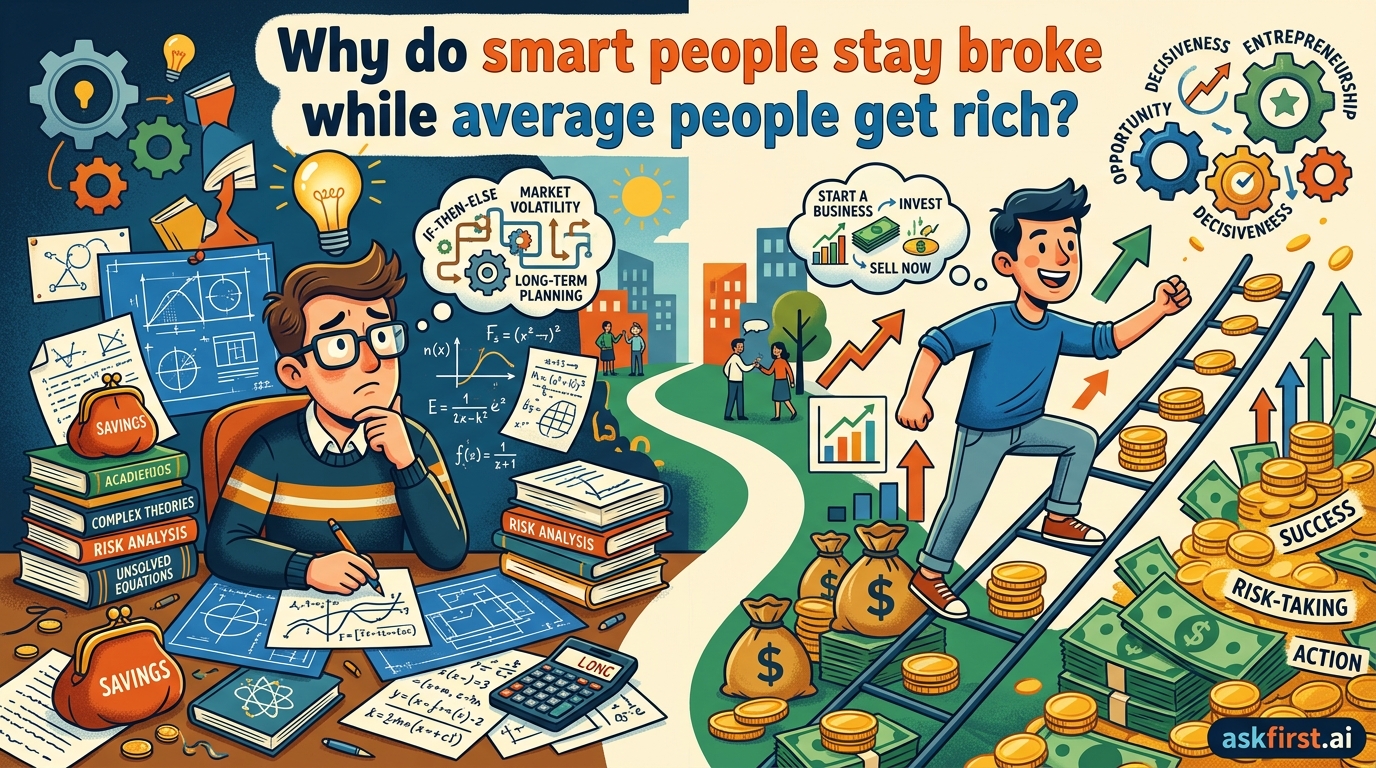
The paradox of high intelligence failing to translate into financial success is one of the most studied phenomena in behavioral economics and psychology. While it seems counterintuitive that individuals with superior cognitive processing power, academic credentials, and analytical capabilities often struggle to accumulate wealth, the reality is rooted in specific psychological traps, behavioral biases, and a fundamental misunderstanding of what wealth actually entails. Conversely, those categorized as "average" often achieve financial stability through discipline, consistency, and the mastery of simple, repetitive systems.
The Trap of Over-Intellectualization
Highly intelligent people are often prone to "analysis paralysis." Because they can see the complexities and potential risks in every financial instrument or business venture, they frequently over-analyze simple opportunities until the window for action has closed. In his seminal book The Psychology of Money, Morgan Housel highlights that financial success is not a hard science, but a soft skill. Where a high-IQ individual might spend months researching the perfect tax-efficient investment vehicle, the person with average intelligence—but high execution speed—simply starts an index fund and lets compounding do the work.
The intellectual often falls for the "complexity bias." They assume that because they are smart, they must find a "smart" way to get rich—something sophisticated, hidden, or intellectually challenging. They look for arbitrage opportunities, complex derivatives, or secret trading algorithms. Meanwhile, the "average" individual builds wealth through boring, predictable methods: high savings rates, long-term real estate holdings, or operating unglamorous but profitable service businesses. As the legendary investor Charlie Munger famously noted in his lectures at the University of Southern California, "It is remarkable how much long-term advantage people like us have gotten by trying to be consistently not stupid, instead of trying to be very intelligent."
The "Smart" Ego and Risk Miscalculation
Intelligence often breeds an inflated sense of control. Many brilliant individuals believe that because they understand systems, they can beat the market or predict economic cycles. This leads to excessive risk-taking, often in the form of concentrated bets or speculative ventures. This is a classic case of the Dunning-Kruger effect in a high-functioning context: the more one knows about a specific field, the more they underestimate the role of randomness and luck.
In Fooled by Randomness, Nassim Nicholas Taleb explains that intelligent people are often the most susceptible to "narrative fallacy"—the human tendency to create stories to explain random events. A smart person will construct a complex, logical framework for why a tech stock will crash or why a specific cryptocurrency will moon. When they are wrong, they use their intelligence to rationalize the failure rather than admitting the role of chance. Average people, often less attached to their own intellectual narratives, are more likely to acknowledge their lack of expertise and rely on proven, low-risk strategies that do not require them to be "right" about the future.
The Social Currency of Intelligence
There is also a social component to this disparity. Highly intelligent people often seek status through professional recognition, academic accolades, or being the "smartest person in the room." This can lead to a lifestyle of over-consumption designed to signal success—expensive degrees, prestigious job titles, and high-status neighborhoods—all of which act as a massive drag on net worth.
Conversely, wealth is often built by those who are comfortable being "under the radar." Thomas J. Stanley and William D. Danko, in their foundational study The Millionaire Next Door, discovered that a significant portion of America’s wealthy live in modest neighborhoods and drive used cars. They prioritize financial independence over the social signaling that often consumes the income of the highly educated. The "average" person who focuses on wealth accumulation often lacks the ego-driven need to prove their brilliance to their peers, allowing them to allocate capital toward assets rather than liabilities.
The Power of Emotional Regulation over Cognitive Power
Financial success is 20% knowledge and 80% behavior. Intelligence is a measure of cognitive capacity, but wealth is a measure of emotional regulation. The ability to delay gratification, stay the course during a market crash, and avoid the temptation of "keeping up with the Joneses" is not a function of IQ.
Consider the example of the "Coffee Shop Millionaire." A person with average intelligence who saves 20% of their income, invests it in low-cost S&P 500 funds, and waits thirty years will almost always outperform the brilliant academic who spends their high salary on interest payments and depreciating assets. The former has mastered the habit of patience; the latter is often a slave to the need for immediate, high-status gratification.
Conclusion
The disparity between the "smart and broke" and the "average and rich" is rarely about the ability to solve equations or understand macroeconomic theory. It is about the ability to prioritize long-term systems over short-term intellectual stimulation. Wealth is built through the boring, repetitive application of basic principles: living below your means, investing early, and avoiding the urge to over-complicate the process. As the history of finance demonstrates, the most successful investors are rarely the ones with the highest test scores, but the ones with the most disciplined temperaments. To break the cycle of being "smart but broke," one must stop trying to outsmart the market and start out-disciplining oneself.