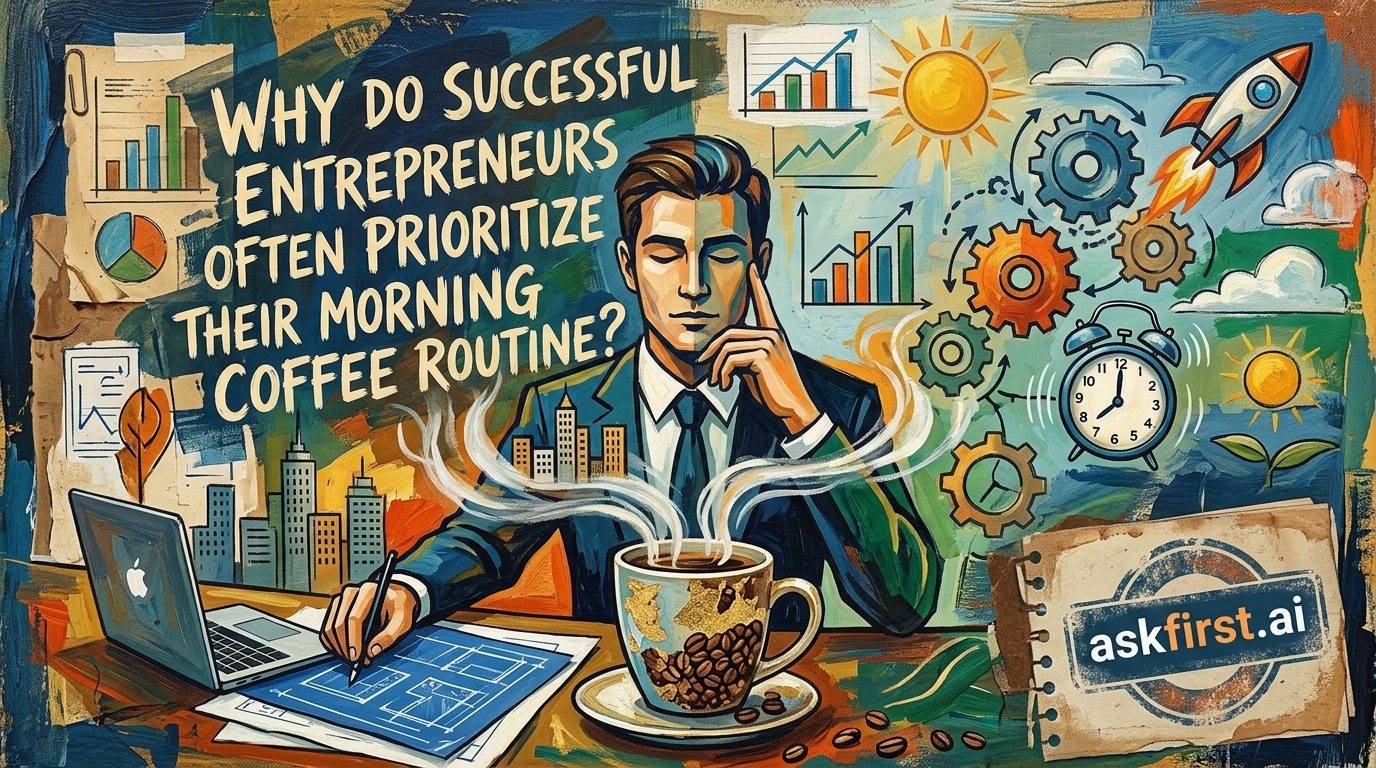
The ritual of the morning coffee is far more than a simple caffeine delivery mechanism for the world’s most successful entrepreneurs. It is a psychological anchor, a strategic reset, and a fundamental component of "deep work" preparation. When leaders like Howard Schultz of Starbucks or Arianna Huffington discuss their mornings, they are not merely talking about a beverage; they are describing a deliberate architectural framework for the day ahead. By prioritizing this routine, entrepreneurs leverage biology, psychology, and habit formation to gain a competitive edge before the rest of the world has even logged into their emails.
The Neurochemistry of Cognitive Priming
At the most fundamental level, the morning coffee acts as a neurochemical catalyst. Caffeine is a central nervous system stimulant that primarily works by blocking adenosine receptors in the brain. Adenosine is the neurotransmitter responsible for signaling sleepiness and fatigue. By inhibiting this signal, entrepreneurs achieve a state of heightened alertness and improved executive function.
However, the "success" aspect of this routine lies in the intentionality of the timing. According to Dr. Andrew Huberman, a neurobiologist at Stanford University School of Medicine, delaying caffeine intake by 90 to 120 minutes after waking allows the body’s natural cortisol spike to perform its job of waking the system up. Many elite entrepreneurs have adopted this practice to avoid the "afternoon crash." By aligning the caffeine intake with the body’s natural rhythm, they ensure sustained focus throughout the day rather than a fleeting burst of energy followed by cognitive decline.
Creating a Ritual of "Decision Minimalism"
The concept of "decision fatigue"—popularized by social psychologist Roy Baumeister in his book Willpower: Rediscovering the Greatest Human Strength—suggests that our ability to make high-quality decisions is a finite resource. Every choice, from what to wear to what to eat, consumes a portion of this "mental fuel."
Successful entrepreneurs prioritize their coffee routine because it is a predictable, low-stakes, high-reward ritual that requires zero decision-making energy. Whether it is a pour-over method or a specific espresso blend, the repetition acts as a meditative "warm-up." By automating the start of the day, they preserve their mental bandwidth for the complex, high-stakes decisions that define their businesses. This is the same principle behind why figures like Steve Jobs famously wore the same style of clothing—it is about removing friction from the morning to preserve willpower for the work that matters.
The "Third Space" for Strategic Thinking
Beyond the biochemistry, the coffee ritual often serves as a "third space"—a mental environment that is neither the chaos of the home nor the demands of the office. This is often the only time in an entrepreneur’s day where they are completely uncoupled from external stimuli.
In his seminal work Deep Work, Cal Newport argues that the ability to concentrate without distraction is a superpower in the modern economy. The morning coffee ritual is the primary vehicle for this deep work state. Many entrepreneurs use this time to engage in "monk mode," where they review their primary objective for the day, engage in journaling, or tackle the single most difficult task on their to-do list before the "urgent" demands of employees and clients arrive. This proactive approach—as opposed to a reactive one—is what separates those who lead industries from those who merely manage them.
Cultivating Mindful Presence
The ritual also provides a necessary grounding exercise. In an era of constant connectivity, the sensory experience of brewing coffee—the aroma, the temperature, the tactile nature of the cup—serves as a grounding technique. This is a form of mindfulness that helps lower cortisol levels and stabilizes the nervous system.
Take, for instance, the habit of many Silicon Valley leaders who utilize this time for "analog" thinking. By stepping away from the screen during their morning coffee, they allow their default mode network (DMN) to activate. As described by researchers like Marcus Raichle, the DMN is responsible for creative problem-solving and long-term planning. When the brain is not focused on a specific task, it begins to make connections between seemingly unrelated ideas. This is why many entrepreneurs claim their best breakthroughs happen during their morning coffee—they are giving their minds the space to synthesize information in the background.
Conclusion: The Strategic Foundation
The morning coffee routine is a microcosm of entrepreneurial success: it combines biological optimization, the conservation of mental energy, and the intentional carving out of time for deep thought. It is not about the caffeine, but rather the discipline required to control one’s environment and internal state before the external world exerts its pressure. By prioritizing this ritual, successful entrepreneurs are essentially building a fortress of focus around the first few hours of their day. They understand that if they can win the morning, they have already secured a significant strategic advantage over the competition. It is a commitment to excellence that begins before the first meeting, proving that the most important work of the day is often done in the quiet moments before the office lights go on.