The Psychology of "Norman Doors": Why We Fail at Intuitive Design
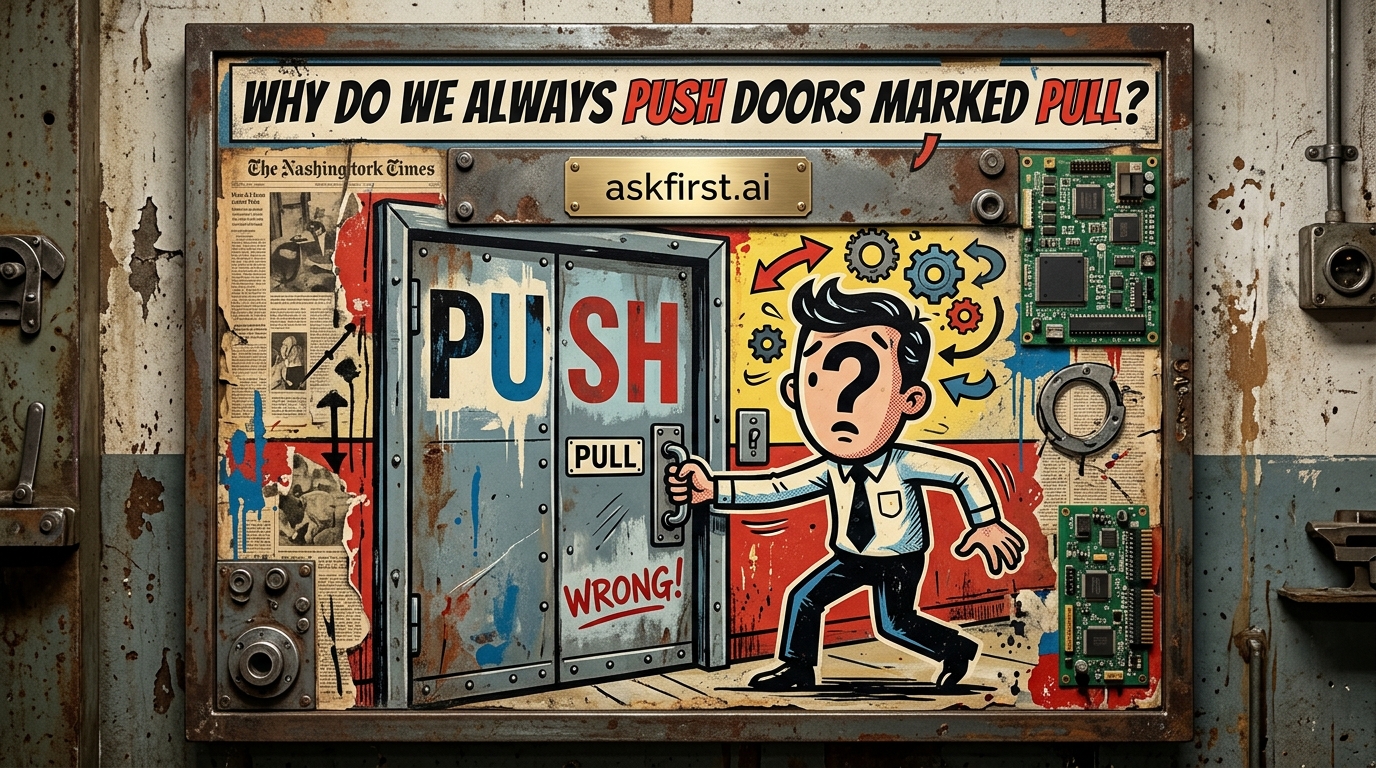
It is a familiar, often embarrassing scenario: you approach a glass-paneled door, see a handle or a flat metal plate, and instinctively push. The door does not budge. You look up, perhaps feeling the gaze of onlookers, to see a small sticker that commands "PULL." You pull, and the door swings open easily. Why does this happen? Is it a lack of intelligence, a lapse in focus, or something more fundamental about human cognition?
The answer lies not in human error, but in the field of cognitive ergonomics. The doors you are struggling with have earned a specific, infamous nickname in the design world: "Norman Doors."
The Anatomy of the Norman Door
The term "Norman Door" was coined by cognitive scientist and usability engineer Don Norman in his seminal 1988 book, The Design of Everyday Things. Norman, who served as a professor at UC San Diego and later as a vice president at Apple, argued that many everyday objects fail because they do not communicate their function clearly.
When a designer places a vertical metal handle on a door, they are providing a "signifier"—a cue that tells the user how to interact with the object. In the Western world, a vertical handle is a universal signifier for "pull." If the door is actually designed to be pushed, the designer has created a conflict between the physical signifier (the handle) and the operational requirement (pushing).
According to Norman, when the physical appearance of an object suggests an action that contradicts its actual function, the user will almost always follow the visual suggestion. We do not "push" because we are inattentive; we push because our brains are hardwired to interpret environmental cues before we consciously process written instructions.
The Cognitive Load of "Affordances"
To understand why we default to the wrong action, we must look at the concept of "affordances," a term popularized by psychologist James J. Gibson in his work The Ecological Approach to Visual Perception (1979). An affordance is a property of an object that suggests how it can be used. A chair "affords" sitting; a button "affords" pushing.
When you see a flat metal plate on a door, it affords pushing. When you see a handle, it affords pulling. When a designer puts a handle on a door that must be pushed, they are creating a "clash of affordances." Your brain performs a rapid, subconscious calculation. You see a handle, your motor cortex prepares for a pulling motion, and you execute that motion before your conscious mind has time to read the tiny, often obscured "PULL" sign.
This is a classic example of System 1 thinking, a concept described by Nobel laureate Daniel Kahneman in his book Thinking, Fast and Slow. System 1 is our fast, instinctive, and emotional mode of thought. It is responsible for our immediate reactions to the world. Reading a sign requires System 2—our slower, more deliberate, and analytical mode. Because System 1 is significantly faster and more energy-efficient, it wins the race, leading us to push the handle every single time.
Real-World Consequences and Design Solutions
The failure to account for these psychological triggers has real-world consequences. In emergency situations, such as a fire or a panicked crowd, a "Norman Door" can become a significant safety hazard. If a door is designed to open outward for safety but features a "pull" handle that confuses users, the resulting delay in egress can lead to tragedy.
Designers who understand human-centered design avoid these pitfalls through several strategies:
- Eliminating the Signifier: If a door must be pushed, the designer should replace the handle with a flat, vertical push plate. This removes the "pull" affordance entirely, leaving the user with no choice but to push.
- Mapping: In design, mapping refers to the relationship between controls and their effects. If you must use a handle, the door should be designed so that the handle only exists on the side where the pulling motion is required.
- Visible Feedback: If a door must be pushed, the hinges and the frame should be designed to make the direction of movement obvious.
A famous example of success in this field can be found in the "Push Bar" exit devices commonly seen in public buildings. These bars span the width of the door, providing a clear, unambiguous affordance for pushing. They are highly effective because they align the visual signifier with the physical operation.
Conclusion
The frustration of pushing a door marked "pull" is a testament to the power of design over human behavior. We are not failing to read; we are successfully interpreting the visual language provided to us by the environment. When the environment lies to us—by putting a handle on a push-door—our brains choose the physical cue over the written command.
As Don Norman emphasized throughout his career, the blame for these errors lies with the designer, not the user. If you find yourself pushing a door that says "pull," take comfort in knowing that you are merely a victim of poor cognitive engineering. The next time you encounter such a door, remember that your brain is working exactly as it should—it is simply waiting for the world to provide it with the correct signals.