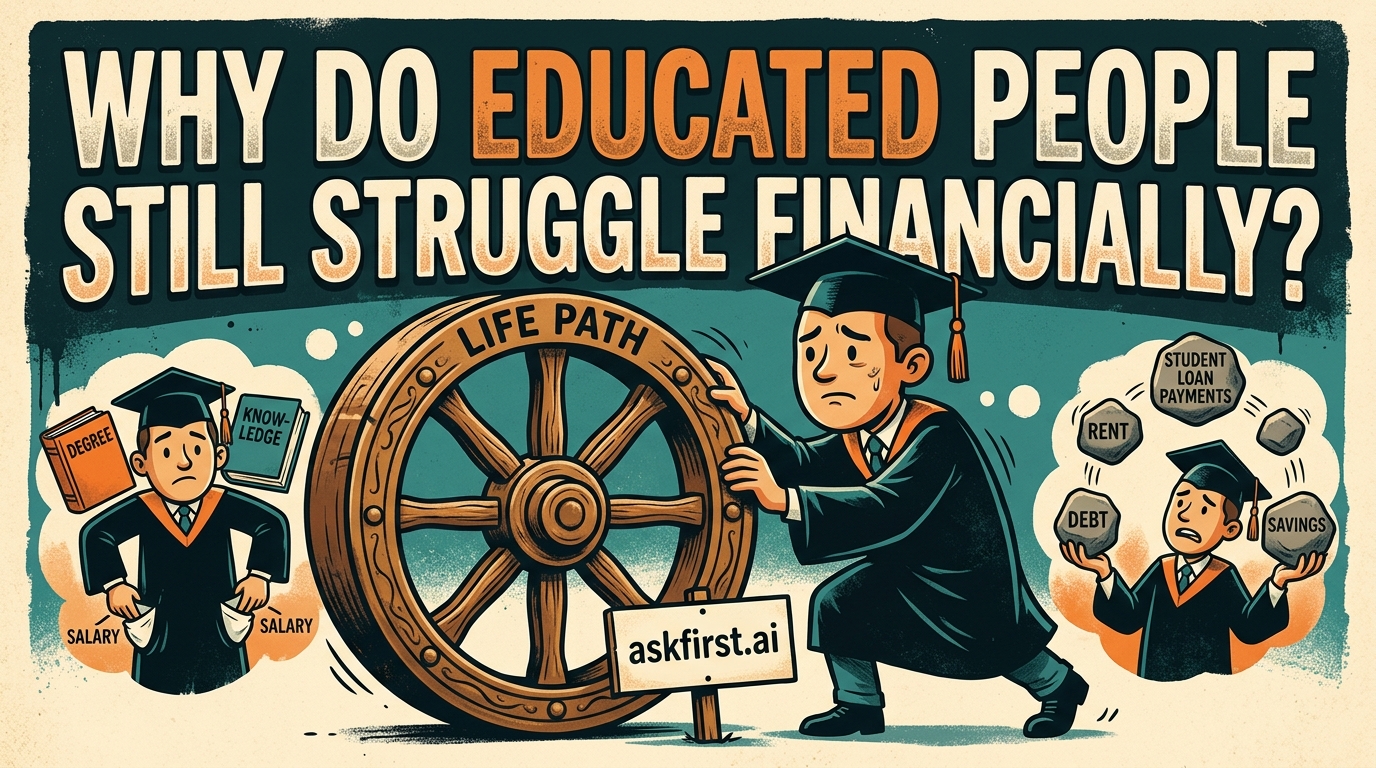
The paradox of the highly educated individual struggling financially is a pervasive phenomenon in modern society. We often operate under the assumption that academic credentials—degrees, certifications, and advanced training—serve as a guaranteed hedge against economic instability. However, historical data and contemporary economic research suggest that the correlation between formal education and net worth is far more nuanced than a simple linear progression. To understand why individuals with significant intellectual capital often find themselves in financial distress, we must examine the intersection of structural economic shifts, behavioral psychology, and the fundamental differences between "academic intelligence" and "financial literacy."
The Illusion of the "Credential Premium"
For decades, the standard narrative promoted by educational institutions was that higher education acts as the ultimate equalizer. However, as economist Bryan Caplan argues in his seminal work, The Case Against Education: Why the Education System Is a Waste of Time and Money, much of the value of a degree lies in "signaling" rather than the acquisition of high-demand, marketable skills.
When an individual spends four to ten years in academia, they are often training for a specific, often narrow, professional track. If the labor market shifts—due to automation, artificial intelligence, or outsourcing—the highly educated worker may find their specialized skills obsolete. Furthermore, the "credential premium" has been eroded by credential inflation. As more people attain advanced degrees, the market value of those degrees decreases, leading to a situation where individuals are over-qualified for entry-level positions but lack the practical experience or entrepreneurial training to navigate the gig economy effectively.
The Debt Trap and Delayed Wealth Accumulation
One of the most significant inhibitors of financial freedom for the educated is the "debt-to-income" ratio. In the United States, the cost of higher education has outpaced inflation for several decades. According to data provided by the Federal Reserve Bank of New York, student loan debt has become a structural barrier to wealth creation.
When a professional enters the workforce with six figures of debt, their "financial runway" is significantly shortened. While a high school graduate might begin investing in index funds or real estate at age 18, a doctor or lawyer may not begin meaningful wealth accumulation until their mid-30s. This loss of "time in the market"—the most powerful force in compounding interest—is a mathematical disadvantage that high salaries often struggle to overcome. By the time the educated individual pays off their loans, they have missed the critical window for early-stage capital growth.
The "Lifestyle Creep" Phenomenon
Financial struggle is not always a matter of low income; often, it is a matter of high burn rates. Sociologist Thomas J. Stanley, in his classic research presented in The Millionaire Next Door, identified a critical distinction between "income" and "wealth." Income is what you earn; wealth is what you keep.
Educated professionals are frequently subjected to immense social pressure to maintain a specific lifestyle—often referred to as "keeping up with the Joneses." This includes living in high-cost-of-living metropolitan areas, financing luxury vehicles, and prioritizing status symbols over high-yield assets. Because their professional identity is tied to their status, they often prioritize the appearance of wealth over the reality of it. When an unexpected economic downturn occurs, those with high overhead costs but low liquid assets are the first to experience financial fragility.
The Literacy Gap: Academia vs. Finance
The traditional education system is designed to produce specialized employees, not autonomous investors. Academic curricula prioritize analytical writing, theoretical research, and domain-specific technical knowledge, yet they almost universally neglect the mechanics of personal finance.
As Robert Kiyosaki highlights in Rich Dad Poor Dad, there is a profound difference between being "academically smart" and "financially smart." The former teaches you how to work for money, while the latter teaches you how to make money work for you. Educated individuals often fall into the trap of believing that their high salary is a substitute for financial strategy. They may understand complex tax codes or corporate law but fail to grasp the fundamental concepts of asset allocation, tax-efficient investing, or the difference between a liability and an asset. If you earn $200,000 a year but spend $195,000 on depreciating assets and debt service, you are financially poorer than an individual who earns $60,000 but invests 20% of their income into cash-flowing assets.
Conclusion: Reframing Success
The struggle of the educated is rarely due to a lack of capacity, but rather a misalignment of priorities and a failure to distinguish between professional prestige and financial independence. To escape this trap, the highly educated must undergo a process of "unlearning." They must recognize that their degree is merely a tool for income generation, not a substitute for financial literacy.
True financial stability requires a shift in mindset: moving from being a passive participant in the traditional labor market to becoming an active architect of one's own capital. By prioritizing the acquisition of assets over the display of status, and by viewing financial education as a lifelong pursuit—much like their academic training—the educated can bridge the gap between their intellectual potential and their actual net worth. The solution lies in realizing that while education opens doors, only disciplined financial management keeps them open.