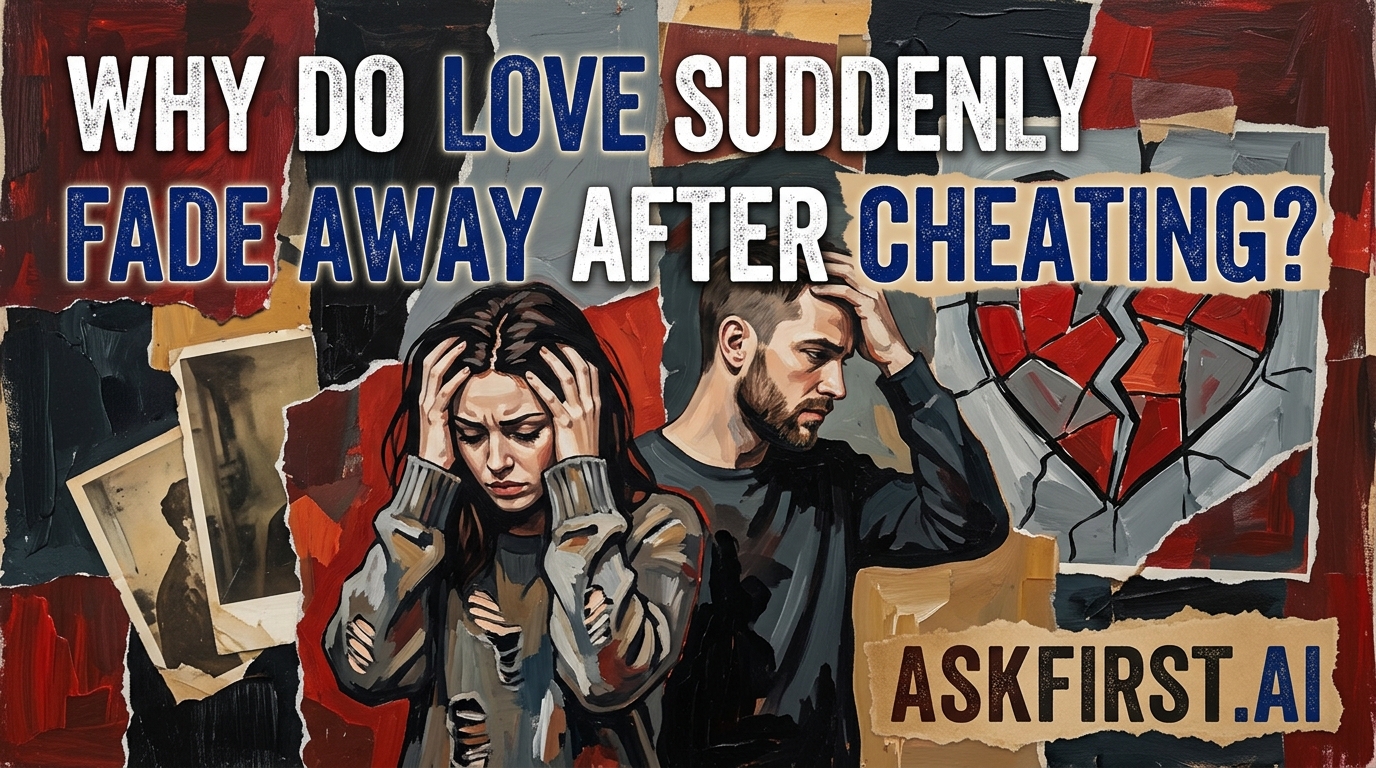
The phenomenon of love "fading away" following an act of infidelity is one of the most complex psychological ruptures a human being can experience. It is rarely a singular event; rather, it is a cascading collapse of the foundational pillars that support a romantic partnership: trust, emotional safety, and shared identity. When a partner cheats, they are not merely breaking a social contract; they are dismantling the internal reality the other person has constructed about their life.
The Erosion of Psychological Safety
At the core of romantic love is the concept of "secure attachment." As noted by psychologists Dr. Sue Johnson in her seminal work Hold Me Tight: Seven Conversations for a Lifetime of Love, human beings are biologically wired to seek proximity and safety in their partners. When infidelity occurs, the betrayed partner experiences what is often described as "betrayal trauma."
This trauma triggers a physiological state of hyper-arousal and hyper-vigilance. The brain, which once viewed the partner as a "safe haven," suddenly reclassifies them as a source of danger. This shift is not a conscious choice; it is a survival mechanism. Because the brain can no longer distinguish between the "safe partner" and the "source of pain," the emotional reward centers that previously released dopamine and oxytocin in the partner’s presence begin to shut down. The "fading" of love is, in many ways, the heart’s attempt to protect itself from further injury.
The Collapse of the Narrative Identity
In their book The Meaning of Marriage, Timothy and Kathy Keller argue that marriage is a process of two people weaving their lives into a single narrative. When one person cheats, they unilaterally rewrite that history. The betrayed partner looks back at vacations, intimate conversations, and shared milestones, suddenly wondering which ones were authentic and which were colored by the deception.
This cognitive dissonance is exhausting. To maintain love, one must be able to view their partner with clarity and admiration. After cheating, the partner is forced to view the other through a lens of suspicion and cynicism. This process, known as "cognitive reframing," strips the partner of their idealized image. Once the pedestal is shattered, it is nearly impossible to reconstruct it, because the memory of the betrayal acts as a filter that prevents the betrayed from seeing the partner’s positive traits as genuine.
The Death of Vulnerability
Love requires radical vulnerability—the willingness to be seen completely without the fear of judgment or abandonment. Brené Brown, in her research on shame and vulnerability (detailed in Daring Greatly), explains that vulnerability is the birthplace of love, belonging, and joy. However, infidelity is the ultimate weaponization of vulnerability.
When a partner cheats, they take the most vulnerable parts of their spouse—their trust, their secrets, and their devotion—and violate them. For the betrayed individual, the natural response is to "armor up." They build emotional walls to prevent further pain. Love cannot survive behind these walls. As the betrayed person becomes more guarded to protect their self-esteem, the emotional intimacy that once fueled the relationship evaporates. They are no longer "in love" because they have effectively closed off the channels through which love flows to prevent the agony of being hurt again.
The Illusion of "Suddenly"
It is important to address the perception that love fades "suddenly." In reality, most infidelity is the symptom of a long-standing disconnect, not the cause of the initial dissatisfaction. Esther Perel, in her profound study on infidelity The State of Affairs: Rethinking Infidelity, argues that many people cheat not because they hate their partners, but because they are mourning the versions of themselves they lost within the relationship.
The "fading" feels sudden to the betrayed partner because they were operating under the assumption that the relationship was stable. The discovery of the affair acts as a catalyst that suddenly illuminates all the cracks that were previously ignored. The love doesn't necessarily disappear in a vacuum; it is replaced by a tidal wave of grief, anger, and disillusionment. These emotions are incompatible with the soft, nurturing feelings associated with romantic love.
Conclusion: Can the Foundation Be Rebuilt?
The fading of love after cheating is an adaptive, albeit painful, response to a breach of the most intimate trust. It is the psyche’s way of acknowledging that the previous iteration of the relationship is dead. Whether that love can be resurrected—or whether a new, different kind of relationship can be built from the ashes—depends entirely on the radical honesty of the betrayer and the capacity for the betrayed to process their trauma.
Love is not a static state; it is a discipline. When that discipline is broken by infidelity, the "fading" is the natural consequence of a world turned upside down. It is not necessarily a failure of character, but a profound shift in the reality of the emotional landscape, requiring immense work, time, and, in many cases, professional guidance to ever find equilibrium again.