The Paradox of Affluence: Why Wealth Doesn't Always Buy Joy
It is a common human intuition that wealth provides an escape from mundane, frustrating, or unpleasant obligations. However, sociologists and behavioral economists have long observed a counter-intuitive phenomenon: individuals with significant financial resources frequently allocate substantial capital toward services, items, and lifestyle maintenance routines that they actively dislike. This behavior, while seemingly irrational at a glance, is rooted in complex psychological structures, social signaling, and the high opportunity cost of time.
The Opportunity Cost of Time
At the highest levels of net worth, the most limited commodity is not money, but time. The wealthy often outsource tasks they despise—such as deep cleaning a house, managing complex administrative paperwork, or coordinating logistics—because their hourly capacity to generate value, social capital, or strategic influence far outweighs the cost of hiring someone else to handle these burdens. When a billionaire spends money on a task they loathe, they are not paying for the object or service itself; they are purchasing the preservation of their own hours. Economists refer to this as the 'substitution effect.' Essentially, the agony of performing the disliked task is greater than the financial loss incurred by paying someone else to perform it.
Social Signaling and Conspicuous Consumption
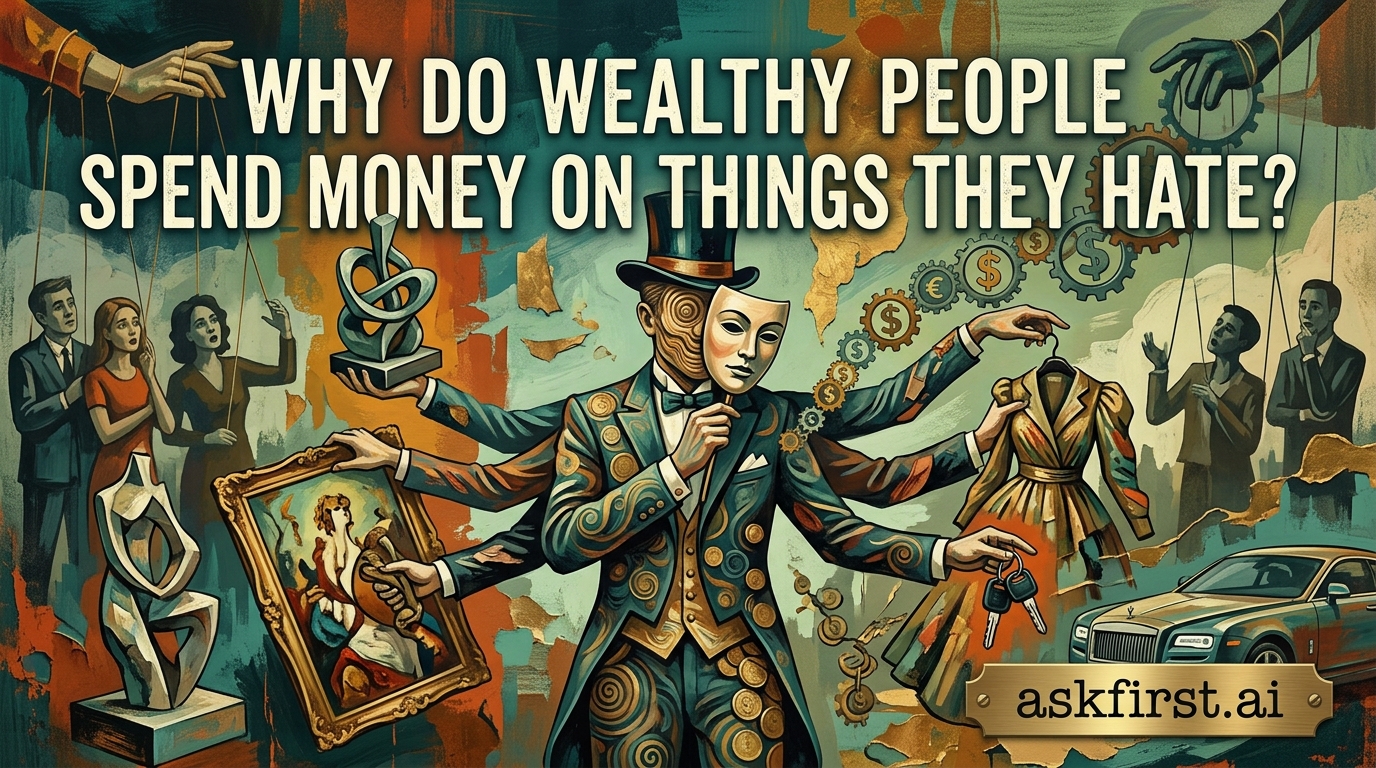
Thorstein Veblen, in his seminal work The Theory of the Leisure Class, introduced the concept of conspicuous consumption. This theory suggests that wealth is often displayed through the purchase of items that serve no functional purpose other than to signal status. In this context, a wealthy person might spend millions on a piece of avant-garde art they find ugly or a gala event they find exhausting. The motivation here is not personal enjoyment but social positioning. In elite circles, participation in certain events, charities, or collections is a 'membership fee.' To opt out of these activities would risk social alienation, loss of professional networking opportunities, or a decline in perceived stature. The distaste for the activity becomes irrelevant when compared to the structural necessity of maintaining one's social status.
The Maintenance of Complexity
Wealth creates its own form of complexity. Owning multiple international properties, managing private aviation, or overseeing large-scale philanthropic foundations brings a suite of mandatory, often tedious tasks. Many wealthy individuals express intense frustration with the bureaucracy of their own lives—the endless legal reviews, the maintenance of complex tax structures, and the management of household staff. These are not hobbies; they are burdens created by wealth. The money spent here is 'defensive expenditure.' Just as a business spends money on compliance and maintenance—things no CEO loves—the wealthy individual must fund the infrastructure that keeps their financial ecosystem from collapsing.
Psychological Anchoring and Habituation
Human beings are subject to hedonic adaptation, the tendency to return to a baseline level of happiness despite positive life events. When an individual achieves a certain tier of wealth, they often feel pressured to adopt the lifestyle standards of their peer group. This process creates a psychological 'trap' where one continues to spend on things—yachts, exclusive club memberships, or high-end social obligations—because those items have become the 'new normal.' Even when the joy of these acquisitions fades or transforms into a mild resentment of their upkeep, the habit remains. Breaking away from these patterns requires a social and psychological effort that many find daunting.
The Role of Outsourcing and Delegation
There is a profound distinction between spending and experiencing. Many wealthy individuals delegate the procurement of goods and services to personal assistants or family offices. In this arrangement, the wealthy person might complain about the 'things they hate' while continuing to pay for them, because those things are deeply integrated into the operational reality of their daily life. The disconnection between the expense and the experience allows the resentment toward the 'thing' to exist alongside the rational acceptance of its necessity.
Summary of Motivations
To synthesize, the expenditure on disliked assets or services is driven by:
- Efficiency: Buying back time to focus on higher-leverage activities.
- Signaling: Paying a 'social tax' to maintain status and influence.
- Defensive Maintenance: Funding the complex infrastructure that wealth requires.
- Societal Pressure: succumbing to the inertia of a predefined high-net-worth lifestyle.
Ultimately, the wealthy do not always purchase items for personal utility. They purchase them for systemic reasons. Understanding this clarifies that money, in its highest forms, often shifts from being a tool for individual pleasure to a tool for the management of one's own existence. The frustration they feel toward these expenditures is, in many ways, the psychological tax paid for living at the apex of the global economic pyramid.