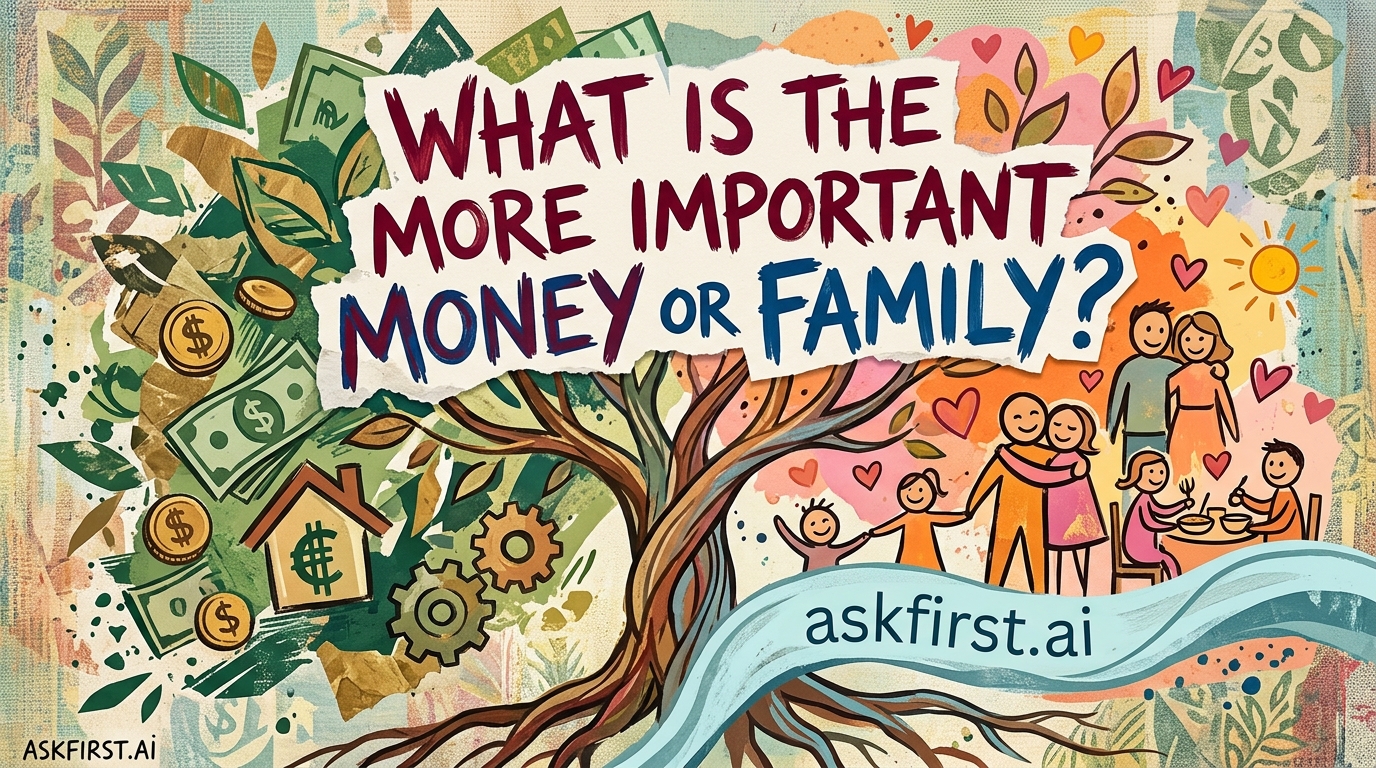
The Eternal Dichotomy: Assessing the Value of Wealth and Kinship
The debate between the importance of financial security and the value of familial bonds is perhaps the oldest philosophical tension in human history. To categorize one as "more important" than the other is to ignore the complex, symbiotic relationship they share within the structure of a meaningful life. While money serves as the infrastructure of survival and agency, family provides the emotional architecture that makes survival worth the effort. Understanding this dynamic requires moving beyond binary choices and instead examining the specific roles each plays in the human experience.
The Utility and Limitations of Capital
Money is, fundamentally, a tool of empowerment. In The Psychology of Money, author Morgan Housel argues that the greatest intrinsic value of wealth is not the accumulation of luxury goods, but the ability to control one’s time. Financial stability acts as a buffer against the unpredictability of the world. When one has sufficient capital, they are granted the autonomy to make choices—to leave an abusive workplace, to pursue education, or to provide medical care for a loved one.
However, historical and psychological data consistently demonstrate the "diminishing marginal utility" of wealth. Once an individual moves from a state of poverty—where money is a matter of life and death—to a state of middle-class comfort, the correlation between additional income and subjective well-being drops significantly. This phenomenon is famously explored in the work of Nobel laureate Daniel Kahneman and Angus Deaton, who noted in their studies for the Proceedings of the National Academy of Sciences that while money can buy life satisfaction, it is remarkably ineffective at buying emotional well-being beyond a certain threshold. Wealth without a foundation of human connection often leads to what social psychologists describe as the "hedonic treadmill," where the pursuit of more money becomes a hollow endeavor meant to mask the absence of deep, interpersonal fulfillment.
The Architecture of Human Connection
If money is the tool, family is the environment. Biological and sociological research emphasizes that humans are inherently social animals. In his seminal work Bowling Alone, political scientist Robert Putnam highlights the concept of "social capital"—the networks of relationships that provide the primary support system for individuals. Family, in its various modern manifestations, serves as the primary source of identity, emotional regulation, and resilience.
Consider the concept of "attachment theory," pioneered by British psychologist John Bowlby. Bowlby’s research, documented in Attachment and Loss, posits that the quality of early family bonds dictates an individual's ability to navigate stress and intimacy throughout their life. When a person faces a crisis—a job loss, a health diagnosis, or a global catastrophe—money can pay the bills, but it cannot provide the empathy, the witness to one’s life, or the unconditional support that family provides. Family is the "safety net" that exists when the financial net fails. Without these bonds, even the wealthiest individuals often report profound feelings of isolation and existential dread.
The Symbiosis: Why the Question is a False Dilemma
The most successful lives are not those that choose between money and family, but those that understand the subordination of the former to the latter. Money should be treated as a resource to be managed in service of the family’s well-being. For example, a parent who works eighty hours a week to provide a luxurious lifestyle for their children but never has time to attend their school performances or engage in meaningful conversation is failing to recognize that money is a means to an end, not the end itself.
Conversely, the "starving artist" trope that suggests family can survive on love alone is equally flawed. Financial stress is one of the leading causes of divorce and familial discord. As noted in the book The Millionaire Next Door by Thomas J. Stanley and William D. Danko, financial discipline is not about greed; it is about protecting the family unit from the destabilizing influence of debt and poverty. By managing finances wisely, one buys the freedom to be present for the family, thus creating a feedback loop where financial health strengthens the family, and a strong family provides the motivation for productive financial habits.
Conclusion: The Hierarchy of Significance
Ultimately, the importance of money versus family is a matter of hierarchy. Money is a secondary good; it is instrumental, external, and replaceable. Family is a primary good; it is constitutive of the human self, internal, and irreplaceable.
If forced to choose, family must always take precedence, because money is only valuable insofar as it serves the flourishing of the human beings we love. A life rich in capital but devoid of family is a life of solitary management, whereas a life rich in family—even if modest in capital—contains the essential ingredients for resilience and joy. We should pursue financial stability with rigor, but we must do so with the clear-eyed understanding that the balance sheet of our life will ultimately be measured not by the currency we accumulated, but by the strength of the bonds we forged along the way.