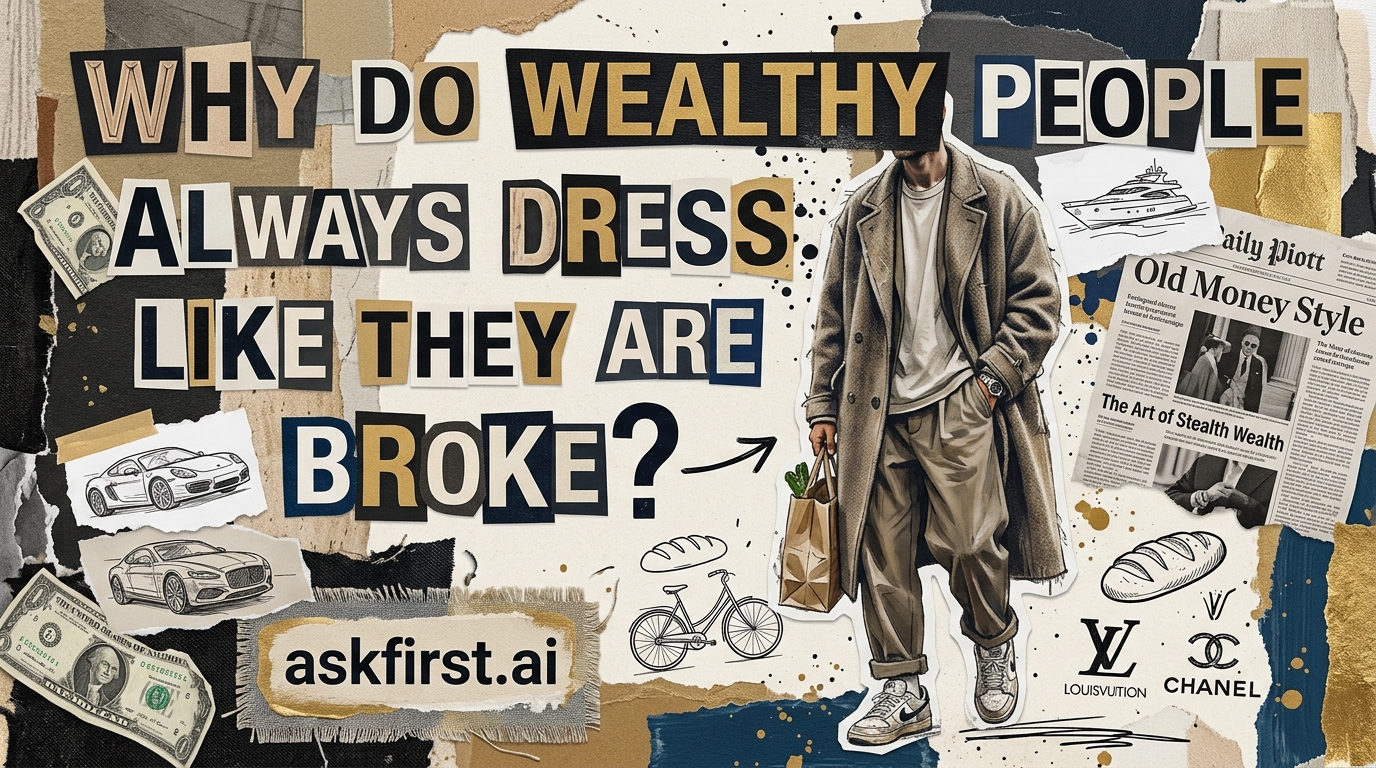
The Psychology of Stealth Wealth
The phenomenon of high-net-worth individuals choosing understated, modest, or even 'shabby' clothing is a well-documented aspect of human sociology known as 'stealth wealth' or 'quiet luxury.' This strategy serves several distinct functions that go far beyond mere aesthetics, rooting itself in deep psychological, social, and practical layers of human behavior.
1. Signaling and Social Capital
In sociological theory, particularly that of Pierre Bourdieu, individuals use 'cultural capital' to distinguish their social standing. While the newly affluent often seek 'conspicuous consumption'—wearing branded logos and flashy jewelry to broadcast success—those from generational wealth or established professional circles often prioritize 'in-group signaling.' By dressing in non-descript, high-quality, but unbranded clothing, the truly wealthy signal to other wealthy individuals that they do not need to prove their status through mass-market labels. It is a subtle display of confidence that says, 'I am secure enough that I do not need the approval of those who judge by retail prices.'
2. The Desire for Anonymity and Safety
Wealth brings unique pressures, including unsolicited solicitations, security concerns, and the fear of being targeted for exploitation. Dressing down acts as a social camouflage, allowing individuals to navigate public spaces, airports, and commercial centers without attracting the attention that accompanies overt displays of wealth. By blending in, wealthy individuals reclaim a sense of normalcy and psychological freedom. They effectively remove the 'wealth tax'—a phenomenon where service providers, street vendors, or strangers increase prices or expectations simply because they perceive a target to be wealthy.
3. Efficiency and Decision Fatigue
Many successful individuals practice 'choice minimalism.' This is the same logic that led figures like Steve Jobs to wear a consistent 'uniform' every day. When an individual spends their mental energy managing massive portfolios, complex organizations, or high-stakes projects, they often experience 'decision fatigue.' By adopting a simplified, repetitive, or understated style, they eliminate the need to expend cognitive bandwidth on mundane fashion choices. This allows them to allocate that mental energy to higher-level strategic thinking.
4. The Value of 'Quality over Brand'
Often, the clothing that appears 'broke' is actually extraordinarily expensive, albeit in a way that requires a discerning eye to detect. This is the hallmark of quiet luxury. A hoodie or plain sweater may cost thousands of dollars, made from the finest Vicuña wool or bespoke cashmere, but lack a prominent logo. To the untrained eye, it looks like a cheap department store purchase. To the expert, the silhouette, drape, and material quality are unmistakable status markers. Wealthy individuals frequently prefer clothes that emphasize longevity and tactile comfort over the ephemeral trends pushed by seasonal fashion houses.
5. Freedom from the 'Keeping Up' Mentality
Social psychology highlights the trap of 'hedonic adaptation,' where individuals constantly chase new material markers to feel a sense of progress. Many self-made wealthy individuals have reached a psychological state where they have detached their self-worth from external aesthetics. When one is no longer trying to climb the social ladder, the performative aspect of dressing becomes obsolete. This transition from 'external validation' to 'internal contentment' is a significant psychological milestone for those who have achieved massive success.
6. Cultural Alignment and Authenticity
In sectors like the tech industry or academia, dressing in highly polished, formal attire can actually be a liability. It suggests that one is 'trying too hard' or does not belong to the meritocratic culture of the group. In Silicon Valley, for example, a hoodie and jeans signify that the person is an engineer, a creator, or a founder who is focused on building things rather than performing business. Dressing casually serves as an alignment with the professional values of innovation and pragmatism.
Conclusion
The perception that the wealthy dress like they are 'broke' is fundamentally a conflict of semiotics. The observer sees a lack of traditional luxury branding, while the wearer is prioritizing functionality, psychological peace, and in-group recognition. This habit is not merely a stylistic choice; it is a manifestation of a mindset that values substance over appearance. Ultimately, the ability to forgo the need for validation through clothing is one of the most accurate markers of true, lasting, and comfortable financial independence.