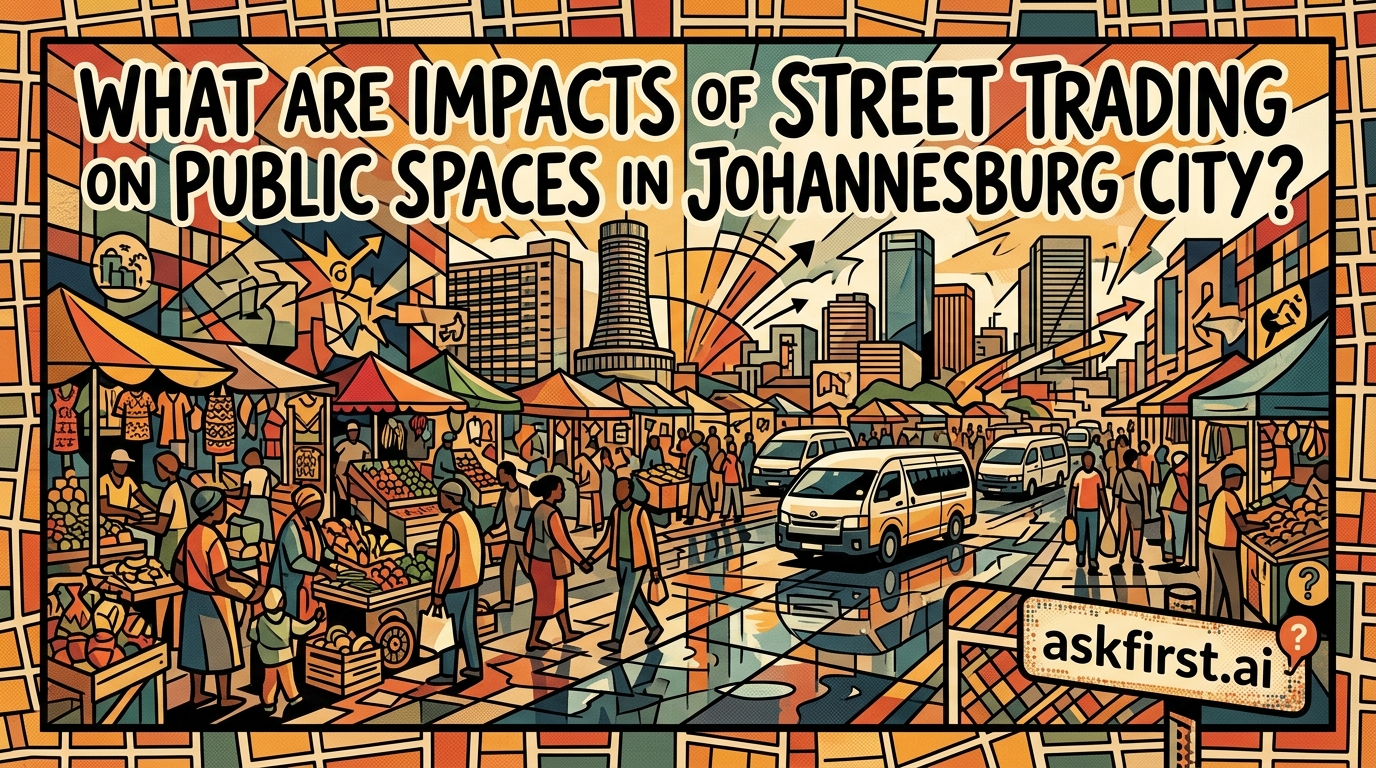
The Dual Nature of Street Trading in Johannesburg’s Public Realm
Johannesburg, often referred to as the "City of Gold," functions as the economic heartbeat of Southern Africa. Its urban fabric is inextricably linked to the vibrant, chaotic, and essential phenomenon of street trading. From the bustling corners of Bree Street to the dense pedestrian flows of Noord Street, informal trade serves as the primary livelihood for thousands. However, the integration of these activities into the formal public space of the inner city presents a complex dichotomy: it is simultaneously a mechanism for poverty alleviation and a significant challenge to urban management, infrastructure, and public order.
Economic Vitality and Social Resilience
Street trading in Johannesburg is not merely a survivalist strategy; it is a sophisticated economic ecosystem. According to Caroline Skinner, a leading researcher at the African Centre for Cities (University of Cape Town), informal traders contribute significantly to the city's economy by providing affordable goods and services to the working-class population. By occupying public spaces, traders activate "dead" urban zones, creating what urbanist Jane Jacobs famously termed "eyes on the street" in The Death and Life of Great American Cities.
When traders occupy sidewalks, they increase foot traffic, which in turn enhances the safety of these public spaces through natural surveillance. In areas like the Faraday Market or the taxi ranks near Park Station, the presence of traders creates a constant human flow that discourages criminal activity. For millions of commuters, these traders are the essential providers of fresh produce, clothing, and mobile accessories, effectively bridging the gap where formal retail outlets fail to reach.
Infrastructure Strain and Environmental Challenges
Despite the economic benefits, the impact on public space infrastructure is profound. Johannesburg’s inner-city sidewalks, originally designed for pedestrian movement, were never intended to host permanent or semi-permanent commercial structures. The high density of stalls often leads to "sidewalk congestion," forcing pedestrians into the road, which increases the risk of accidents.
Furthermore, the lack of adequate waste management infrastructure for informal traders results in significant environmental degradation. As noted by academic research published in the Journal of Urban Affairs, the accumulation of organic waste and packaging materials in high-traffic zones often clogs drainage systems. During the summer rainfall season, this contributes directly to localized flooding in low-lying areas like the CBD’s southern corridor. The city’s Department of Economic Development has struggled to balance the provision of waste disposal services with the transient nature of these trading spots, leading to a recurring cycle of sanitation crises.
Regulatory Conflict and the "Right to the City"
The conflict between municipal authorities and street traders is a defining feature of Johannesburg's urban politics. The City of Johannesburg’s Informal Trading Policy often prioritizes the formalization of trade through designated demarcated zones. However, this top-down approach frequently clashes with the reality of trader mobility.
Legal scholar and activist Stuart Wilson, in his work regarding the Socio-Economic Rights Institute of South Africa (SERI), has argued that the aggressive removal of traders—often characterized by confiscations and raids—frequently violates the constitutional rights of the poor to earn a living. The struggle for public space is, at its core, a struggle for the "Right to the City," a concept popularized by Henri Lefebvre. In Johannesburg, the public space is contested: the city views it as a regulated asset to be managed, while traders view it as a necessary platform for survival. The resulting tension often manifests as visual clutter, where makeshift stalls using corrugated iron, plastic sheeting, and wooden pallets obscure heritage architecture and diminish the aesthetic value of the city’s historic facades.
Spatial Integration: A Path Forward
To mitigate the negative impacts while preserving the vibrancy of street trade, urban planners are increasingly looking toward "spatial integration." This involves designing public infrastructure that incorporates trading bays, storage facilities, and water points directly into the streetscape. A prime example of successful intervention is the redevelopment of the area surrounding the Johannesburg Art Gallery, where thoughtful urban design allowed for the coexistence of pedestrian movement and formalised trading zones.
By transitioning from a policy of "clearance" to a policy of "co-management," the city can reduce the friction between stakeholders. This requires the formal recognition of trader associations, which can act as intermediaries to ensure that public spaces remain clean, accessible, and safe. Without such collaboration, the degradation of public space will continue to drive away investment, ironically hurting the very traders who rely on the city’s economic vitality.
Conclusion
The impact of street trading on Johannesburg’s public spaces is a testament to the city's unique socio-economic landscape. While the strain on infrastructure, pedestrian mobility, and sanitation is undeniable, these challenges are symptoms of a deeper structural inequality. Street trading is not a temporary nuisance to be cleared; it is a permanent, essential element of Johannesburg’s urban metabolism. Moving forward, the city must move beyond punitive measures and adopt a model of inclusive urban design that views the street trader as a partner in the creation of a dynamic, equitable, and functional public realm. Only through integration—rather than exclusion—can Johannesburg fully harness the energy of its informal economy while restoring the dignity and utility of its public spaces.