The Ethical Dilemma: Loyalty Versus Rectitude
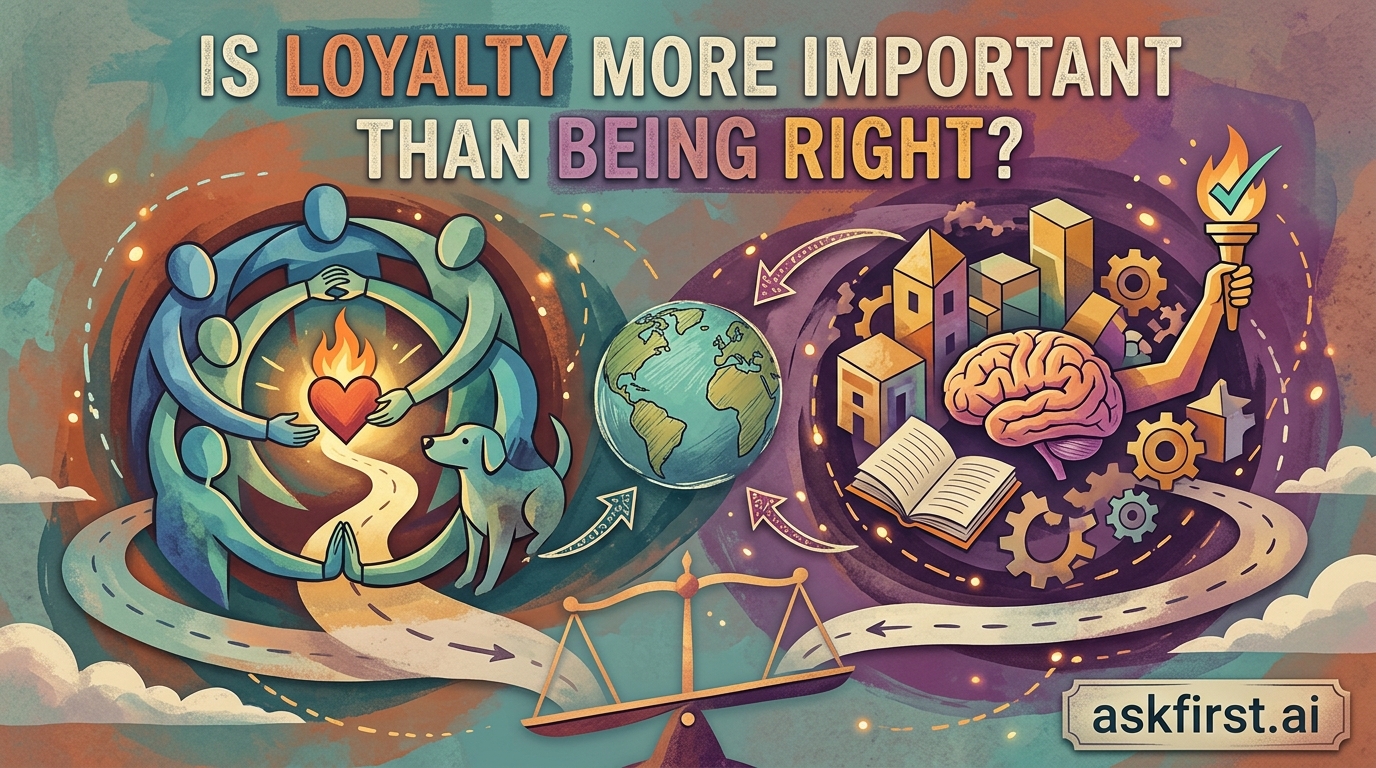
The tension between loyalty and being "right" is one of the oldest and most persistent conflicts in human ethics. It pits our social instincts—the desire to belong, support, and protect our in-group—against our cognitive and moral imperatives to uphold objective truth, justice, and logical consistency. Whether in the boardroom, the political arena, or the family unit, the choice between these two values rarely results in a clean victory. Instead, it creates a friction that defines the character of an individual and the stability of the institutions they inhabit.
The Evolutionary and Psychological Basis of Loyalty
Loyalty is fundamentally an evolutionary adaptation. In his seminal work The Righteous Mind: Why Good People Are Divided by Politics and Religion, social psychologist Jonathan Haidt argues that humans are "groupish" creatures. We evolved to thrive in tribes where survival depended on cooperation and mutual defense. In this context, loyalty acts as the "social glue" that keeps the group cohesive. If a member of a tribe constantly prioritized being "right" over the solidarity of the group, they risked ostracization, which, in our ancestral environment, was a death sentence.
Loyalty provides a sense of psychological safety. It signals to others that you are reliable and that you prioritize the collective good over personal ego. When we are loyal, we are often rewarded with status, protection, and deep interpersonal bonds. However, this biological imperative often operates beneath our conscious awareness, leading us to defend our "own" even when they are clearly in the wrong.
The Primacy of Being "Right": The Case for Integrity
Conversely, the drive to be "right"—or more accurately, to adhere to truth and moral correctness—is the bedrock of intellectual and civil progress. If individuals always prioritized loyalty to their leaders or peers over objective reality, society would stagnate in error. Science, law, and justice depend entirely on the willingness of individuals to dissent when the facts demand it.
In his classic essay On Liberty, John Stuart Mill argues that the suppression of dissenting opinions (even those that may be unpopular or uncomfortable) is a "peculiar evil." If you prioritize loyalty to a prevailing opinion or a specific group over the search for truth, you effectively silence the very mechanisms that allow for progress. Being "right" in this sense is not about intellectual vanity; it is about accountability. When a whistleblower exposes corruption within a company or a scientist challenges a consensus, they are choosing the abstract value of "truth" over the concrete value of "loyalty."
The Conflict: When Loyalties Collide with Morality
The conflict becomes most acute when loyalty is weaponized. Leaders often demand loyalty as a shield against criticism. In the corporate world, this is often rebranded as "culture fit" or "team spirit." When an organization demands loyalty above all else, it creates an echo chamber where mistakes are hidden, ethics are compromised, and long-term viability is sacrificed for short-term group cohesion.
Consider the example of the Enron scandal. Many employees and executives were "loyal" to the company and their peers, which prevented them from blowing the whistle on fraudulent accounting practices. Their loyalty to the organizational structure essentially blinded them to the reality of their moral and legal obligations. Here, the pursuit of being "right"—following the law and reporting the truth—was sacrificed on the altar of corporate loyalty, leading to catastrophic consequences for thousands of stakeholders.
Finding the Synthesis: "Loyal Opposition"
Is it possible to balance these two? The concept of "loyal opposition," rooted in parliamentary democracy, suggests a pathway. It is the idea that one can be deeply committed to an institution while simultaneously being its harshest critic. This requires a shift in how we define loyalty. Instead of viewing loyalty as blind obedience, we should view it as a commitment to the long-term well-being of the group.
If you are truly loyal to a person or an organization, you owe them the truth. If a friend is making a mistake that will ruin their life, the most "loyal" action is not to support them in that mistake, but to confront them with the truth, even if it causes a temporary rift. This is what Aristotle described in Nicomachean Ethics as the highest form of friendship: one that is based on the pursuit of the good. True loyalty is not about being a sycophant; it is about holding those you care about to a standard that is worthy of them.
Conclusion
The question of whether loyalty is more important than being right is a false dichotomy if we define our terms correctly. Blind loyalty is a vice that leads to corruption and stagnation, while cold, unfeeling adherence to being "right" can lead to isolation and a lack of human connection. The ideal approach is to practice "principled loyalty." This means being loyal to individuals and groups while maintaining the intellectual integrity to dissent when necessary. By anchoring our loyalty in shared values rather than blind allegiance, we can ensure that our commitments serve the truth, rather than obscuring it. Ultimately, the most valuable person in any room is the one who is loyal enough to care, but honest enough to speak the truth when it matters most.