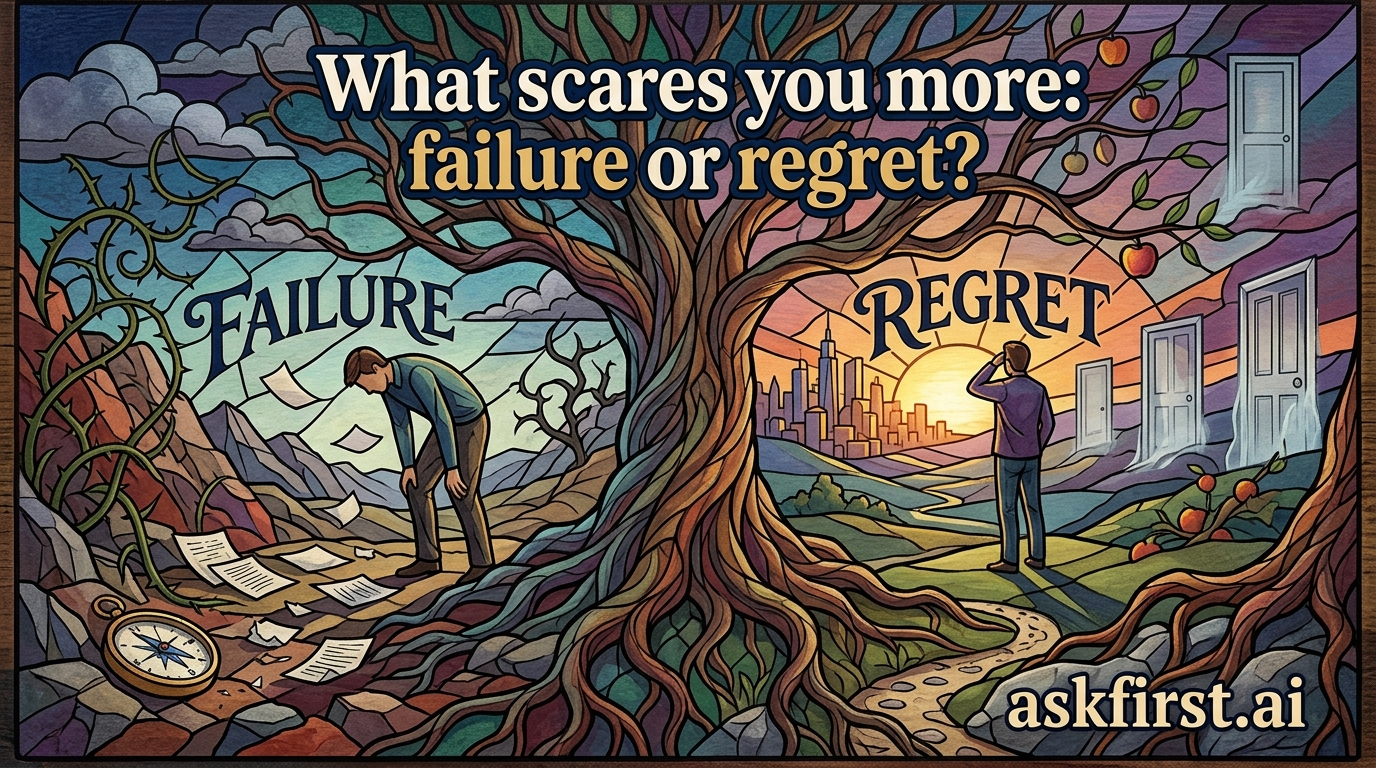
The philosophical dichotomy between the fear of failure and the fear of regret is a central pillar of human existential psychology. While failure is an objective outcome—a measurable shortfall in achieving a specific goal—regret is a subjective, internal state of mourning for a life unlived or a path not taken. When analyzing these two forces, it becomes clear that regret is the more formidable adversary, as it is infinite in its scope and impossible to rectify once the window of opportunity has closed.
The Anatomy of Failure: A Necessary Friction
Failure is often misunderstood as the antithesis of success, when in reality, it is a fundamental component of the process. In his seminal work Black Box Thinking, author Matthew Syed explores how high-performing individuals and industries—from aviation safety boards to medical surgeons—treat failure not as a moral failing, but as a diagnostic tool. Failure provides data. If an engineer designs a bridge that collapses under a specific weight, the collapse offers precise, empirical evidence of where the structural integrity failed.
Failure is external. It has a beginning and an end. Once a project fails, the individual is often left with the lessons learned and the ability to pivot. As noted by Carol Dweck in her book Mindset: The New Psychology of Success, those who adopt a "growth mindset" view failure as a temporary state rather than an identity. Because failure is tangible, it can be mitigated, analyzed, and overcome. It is a hurdle that sits in front of you, visible and surmountable.
The Insidious Nature of Regret
Regret, by contrast, is an internal, haunting specter. It does not exist in the world of data or physical outcomes; it exists in the realm of "what if." Regret is the psychological weight of potential energy that was never converted into kinetic action.
In the widely cited research conducted by Bronnie Ware, a palliative care nurse who recorded the most common deathbed confessions in her book The Top Five Regrets of the Dying, the number one regret was: "I wish I'd had the courage to live a life true to myself, not the life others expected of me." Notice that the people surveyed did not lament their failures—they did not cry over the business that went bankrupt or the book that received poor reviews. They cried over the things they were too afraid to attempt.
Regret is more frightening than failure because it is essentially a form of self-betrayal. While failure occurs when the world rejects your efforts, regret occurs when you reject yourself. You cannot "fix" a decision you never made. You cannot "iterate" on a path you were too paralyzed by fear to pursue. Regret accumulates over time, turning into a chronic state of dissatisfaction that erodes one's sense of agency.
The Asymmetry of Risk
The asymmetry between these two fears is captured perfectly by the concept of "Loss Aversion," a principle in behavioral economics popularized by Daniel Kahneman and Amos Tversky in their book Thinking, Fast and Slow. Humans are biologically wired to fear the pain of a loss more than they value the pleasure of a gain. This evolutionary trap makes us prioritize safety—thereby avoiding failure—at the cost of long-term fulfillment.
Consider the entrepreneur who refuses to launch a startup for fear of losing their savings. They avoid the "failure" of bankruptcy, but they live with the gnawing regret of never having tested their vision. The fear of failure is a short-term survival mechanism; the fear of regret is a long-term existential realization. The former is a momentary sting; the latter is a lifetime of "ghost lives"—the versions of ourselves that never came to be because we chose the comfort of inaction.
Concrete Examples of the Trade-off
Look at the history of innovation. Steve Jobs, in his famous 2005 Stanford Commencement Address, spoke about the necessity of embracing death and failure as the ultimate tools for decision-making. He argued that remembering you are going to die is the best way to avoid the trap of thinking you have something to lose.
If you choose the path of least resistance to avoid failure, you are effectively choosing a path of guaranteed regret. If you choose the path of high risk, you might experience failure, but you gain the knowledge that you acted. In the context of a professional career or personal pursuit, the "successful" person is not the one who never failed, but the one who has the fewest "what ifs" remaining at the end of their journey.
Conclusion
Ultimately, the fear of regret is far more dangerous than the fear of failure. Failure is a teacher; regret is a prison. Failure is an event in your past that you can learn from, while regret is a shadow in your future that grows larger the longer you avoid taking risks. To live a full life, one must actively court failure in order to starve the possibility of regret. By shifting our perspective to see failure as a necessary investment in experience, we can move past the paralyzing fear of "what if" and embrace the reality of "what is."