The Psychology of Over-Apologizing
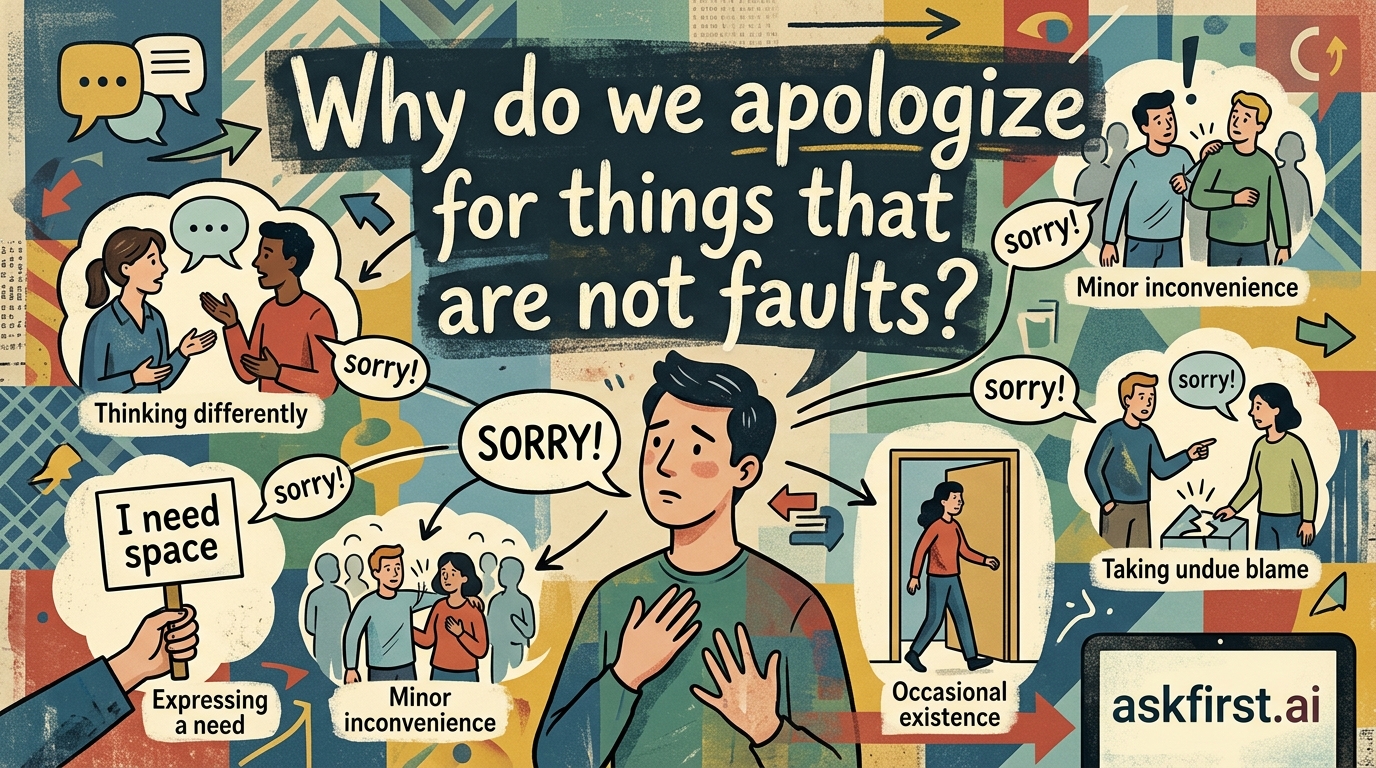
Human beings frequently find themselves uttering the word 'sorry' for events entirely outside their control, such as the weather, a colleague's delay, or simply taking up space in a crowded room. This reflexive habit often serves a social function rather than a literal admission of error. Psychologists suggest that over-apologizing functions as a social glue, designed to mitigate perceived friction and maintain harmony in interpersonal hierarchies. By assuming culpability for minor inconveniences, an individual signals submissiveness and a desire to avoid conflict, effectively lowering the defensive barriers of others. This is often termed 'social smoothing,' where the apology acts as an emotional buffer rather than an objective declaration of fault.
The Social Lubricant Theory
In various social dynamics, the apology acts as a mechanism to signal empathy. If a friend misses a train, one might say, 'I'm sorry you missed your ride.' While the speaker did nothing to hinder the train's departure, the phrase expresses an alignment with the other person’s frustration. This is a crucial element of high-functioning empathy, yet it often blurs the line between expressing sympathy and accepting blame. Researchers have identified that this pattern is deeply embedded in socialization processes, particularly among individuals taught to prioritize group cohesion over individual boundary setting. The internal belief often operates on the assumption that being 'nice' necessitates being 'responsible' for the emotional state of others.
Gender Dynamics and Conditioning
Extensive research has indicated that social conditioning plays a monumental role in the frequency of apologies. A landmark study published in Psychological Science highlighted that women are more likely to apologize than men, not because they commit more errors, but because they have a lower threshold for what they define as an 'offensive' action. This reflects a societal expectation that women should serve as the peacekeepers of the household and office. When an individual is conditioned to believe that their mere existence or needs might be burdensome, the apology becomes a prophylactic measure—a way to preemptively strike against potential criticism before it can occur.
The Negative Impact on Personal Authority
While the impulse is often rooted in kindness, persistent apologizing can have corrosive effects on one's personal authority and self-perception. Over-apologizing may inadvertently communicate a lack of confidence or a tendency to feel like an impostor. When one constantly frames their requests, opinions, or presence as an imposition, they inadvertently train others to view them as a person who lacks boundaries. This creates a feedback loop where the speaker feels less competent and others begin to trust the speaker’s expertise less. It is a psychological trap: by attempting to stay 'small' to keep the peace, one diminishes their capacity for leadership and genuine self-expression.
Re-framing Language for Professional Growth
To break the cycle of unnecessary apologies, communication experts suggest shifting toward appreciative language. Instead of saying, 'I'm sorry I'm late,' consider saying, 'Thank you for your patience.' Instead of 'Sorry to bother you,' use 'Do you have a moment to discuss this?' This transition changes the interaction from an admission of deficit to an acknowledgement of the other person’s time and effort. This simple linguistic switch alters the power dynamic: it transforms an apologetic stance into a collaborative one. By focusing on gratitude rather than guilt, individuals can cultivate stronger connections and project greater confidence.
Strategies to Stop the Reflexive Apology
- The Pause Technique: Before speaking, take a three-second pause to evaluate if the action truly requires an apology. If no harm was caused, refrain.
- Auditing Your Triggers: Note the moments throughout the day when 'sorry' slips out. Are they moments of discomfort, or are you actually in the wrong?
- Adopt 'Thank-You' Language: Actively replace the word 'sorry' with 'thank you' in situations involving time delays or asking for assistance.
- Self-Compassion Practices: Understand that taking up space, asking questions, or existing in a workspace is not a mistake. You are a participant, not an interloper.
Conclusion
Understanding why we apologize for events beyond our control is the first step toward reclaiming our agency. While empathy is a vital human quality, it should not be confused with culpability. By recognizing that constant apologizing is often an subconscious effort to mitigate social anxiety, we can make conscious choices to stop undermining our value. Building confidence requires us to accept that we do not need to be 'sorry' for simply being present or human. Empathy remains, but guilt is reserved only for true transgressions, allowing us to exist in the world with dignity and clear, intentional communication.