The Ubiquitous Deception: "I’m Fine" and the Architecture of Social Lubrication
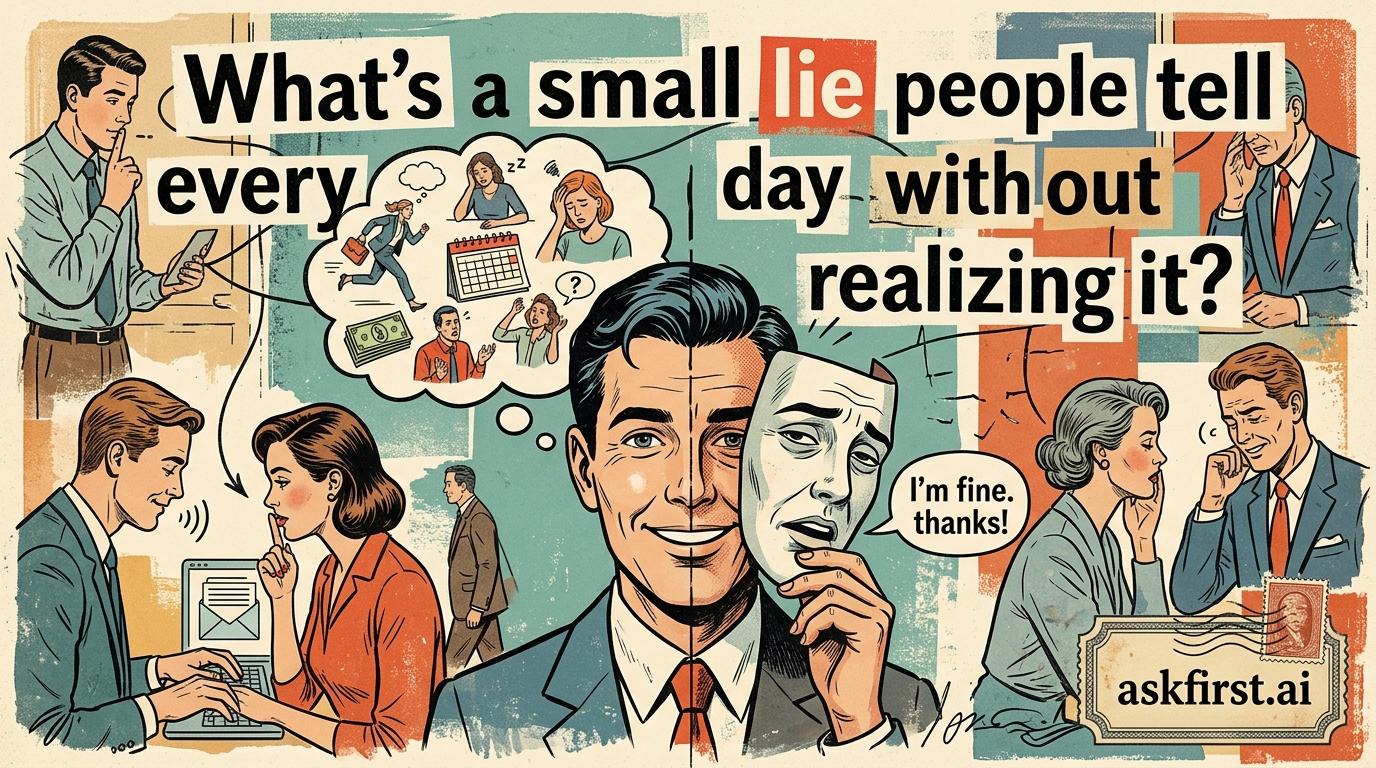
In the complex tapestry of human interaction, there exists a peculiar, almost automated response that permeates our daily discourse across every culture and social strata. It is a phrase so common that it has lost its literal meaning, functioning less as a statement of fact and more as a ritualized social protocol. When someone asks, "How are you?" the standard, reflexive reply—"I’m fine"—is perhaps the most pervasive, unconscious lie told in the modern world.
While we often pride ourselves on our honesty, this specific untruth serves a vital function in maintaining the equilibrium of our social environment. By examining the psychology behind this phrase, we can uncover why we sacrifice accuracy for comfort and what this reveals about the nature of human connectivity.
The Social Contract of Superficiality
The primary reason we lie about our well-being is the implicit social contract of brevity. In his seminal work, The Presentation of Self in Everyday Life, sociologist Erving Goffman argues that social interaction is a performance. We are constantly managing the impressions we leave on others. When a colleague passes you in the hallway and asks how you are, they are rarely conducting a clinical inquiry into your mental or physical health. Instead, they are engaging in what linguists call "phatic communication"—speech designed to maintain social bonds rather than exchange information.
If you were to respond with a detailed, honest accounting of your current stressors—a looming deadline, a restless night of sleep, or a mild existential crisis—you would effectively violate the implicit rules of the encounter. You would be "over-sharing," forcing the other person into an emotional labor for which they did not sign up. Thus, "I’m fine" acts as a protective buffer, signaling to the other person that you are willing to maintain the status quo and move on with the day.
The Cognitive Efficiency of the "Small Lie"
From a cognitive perspective, providing an honest answer to "How are you?" is an incredibly expensive process. To answer truthfully, one must perform a rapid, internal audit of their emotional state, physical sensations, and current circumstances. This requires a level of introspection that is incompatible with the fast-paced, fragmented nature of modern life.
In Thinking, Fast and Slow, Nobel laureate Daniel Kahneman explains the dichotomy between "System 1" (fast, instinctive, and emotional) and "System 2" (slower, more deliberative, and logical) thinking. The "I'm fine" response is a classic System 1 output. It is an automatic heuristic—a mental shortcut—designed to save energy. We lie because it is the path of least resistance. It requires zero cognitive load to utter, whereas an honest answer requires complex processing and potential vulnerability. We essentially automate our social responses to reserve our limited brainpower for more pressing tasks.
Cultural Conditioning and the "Smile Mask"
The pressure to report that one is "fine" is heavily reinforced by cultural expectations. In many Western corporate cultures, there is an unspoken mandate to project positivity or, at the very least, neutrality. This phenomenon is often referred to as "emotional labor," a term coined by sociologist Arlie Hochschild in her book The Managed Heart. Hochschild discusses how employees are often required to suppress their true feelings to satisfy the emotional requirements of their jobs.
Even outside the workplace, we are conditioned to view "being fine" as a sign of competence and stability. To admit otherwise is often perceived as a weakness or a "burdening" of others. Think of the last time you felt overwhelmed, yet when a friend asked how you were doing, you instinctively smiled and said, "Doing well, just busy!" This is a concrete example of the "Smile Mask." We believe that by projecting wellness, we are being polite, when in reality, we are simply participating in a collective delusion that keeps us from forming deeper, more authentic connections.
The Hidden Cost of the Daily Lie
While "I’m fine" is a harmless social lubricant in short bursts, it comes with a cumulative cost. When we consistently mask our reality, we create a gap between our internal experience and our external presentation. Psychologists often note that this "incongruence" can lead to feelings of isolation. If everyone is telling the same small lie, we each walk around believing that we are the only ones struggling, while everyone else is perfectly "fine."
This creates a paradox of loneliness: we are surrounded by people, yet we are all performing a script that prevents us from seeing the humanity in one another. By defaulting to this lie, we miss the opportunity to foster the very empathy and support that we often crave.
Conclusion: Reclaiming Authenticity
The lie of "I’m fine" is not a malicious act of deception; it is a structural necessity of our current social architecture. It allows us to navigate crowded elevators, busy office floors, and passing conversations without emotional friction. However, recognizing this lie for what it is—an automated social shortcut—is the first step toward reclaiming genuine connection.
We do not need to share our deepest traumas with every acquaintance, but we can begin to replace the robotic "I'm fine" with more nuanced, honest assessments, such as "I'm holding up," "I'm a bit tired today," or "I'm navigating a few challenges." By doing so, we might find that the people around us are not just waiting for the next "I'm fine," but are actually relieved to engage in a moment of true human honesty. We tell the lie every day, but we also have the power to break the script, one conversation at a time.