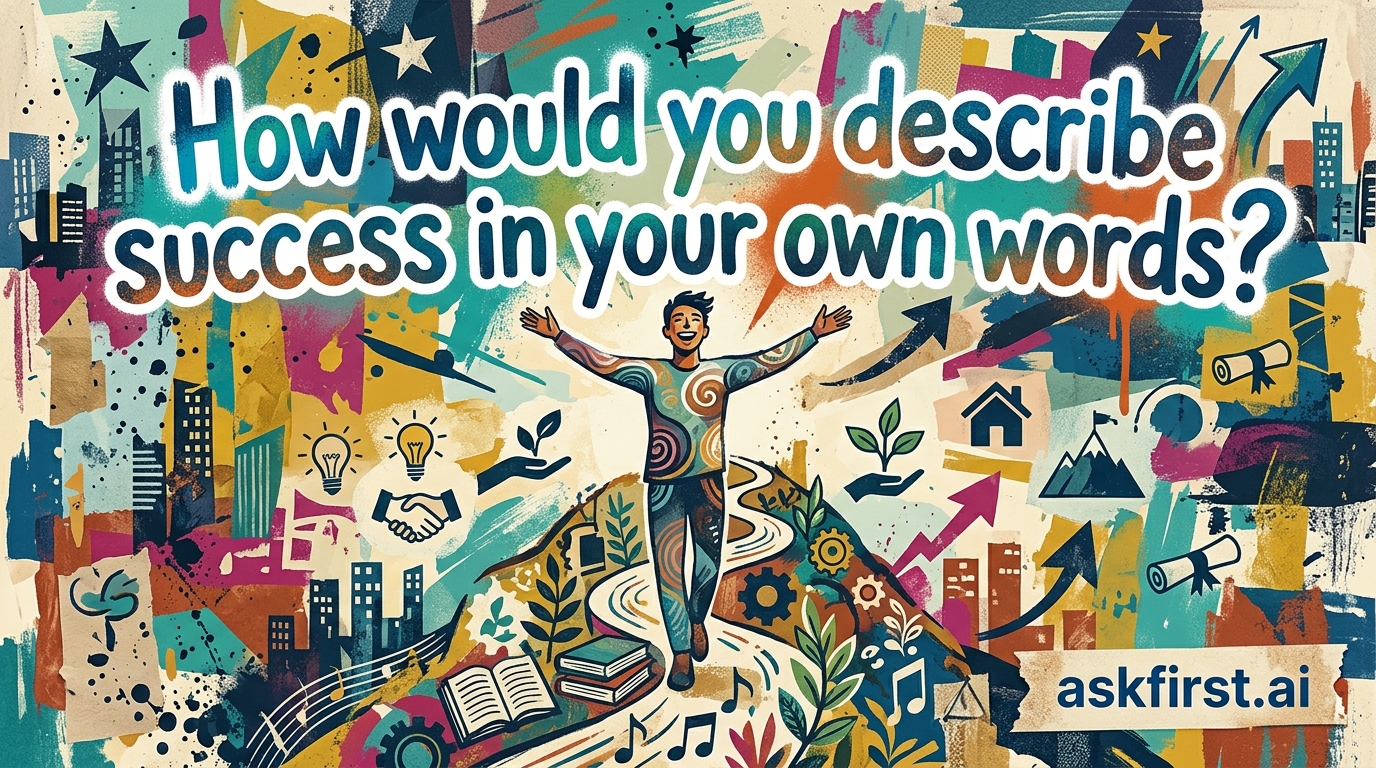
Success is one of the most elusive concepts in the human experience, often misidentified as a destination rather than a process. In my professional view, success is best defined as the alignment of one’s internal values with their external manifestations. It is the state of equilibrium achieved when your daily actions, professional contributions, and personal milestones mirror the core principles you hold in highest regard. It is not merely the accumulation of wealth or accolades, but the optimization of potential toward a meaningful objective.
The Architecture of Purposeful Achievement
To understand success, one must first dismantle the modern obsession with vanity metrics. In his seminal work, Man’s Search for Meaning, psychiatrist and Holocaust survivor Viktor Frankl argues that the primary human drive is not pleasure or power, but the discovery and pursuit of what we personally find meaningful. From this perspective, success is the degree to which an individual successfully bridges the gap between their innate capabilities and their contribution to the collective.
A concrete example of this is the career trajectory of a master craftsman. If an individual spends forty years perfecting the art of joinery, finding deep satisfaction in the structural integrity and aesthetic beauty of their work, they are successful regardless of whether they become a global household name. Success, here, is defined by mastery and autonomy. It is the ability to exert influence over one’s environment and produce results that stand the test of time.
Success as a Dynamic Equilibrium
Success is rarely static. It functions much like a high-performance engine: it requires constant calibration. In the book Deep Work, Cal Newport posits that the ability to focus without distraction on cognitively demanding tasks is a "superpower" in the 21st century. Those who achieve this state are successful because they have mastered the scarcity of their own attention.
To describe success, we must look at the three pillars of sustainable achievement:
- Competence: The ongoing acquisition of skill. You cannot be successful if you are not improving. This requires a "growth mindset," a concept popularized by psychologist Carol Dweck in her book Mindset: The New Psychology of Success. She demonstrates that those who view their abilities as malleable are significantly more likely to overcome obstacles and reach elite levels of performance.
- Agency: The capacity to make autonomous decisions. True success is often thwarted by a lack of control. If you are successful in your career but have no agency over your time or creative output, you are essentially a high-functioning cog in a machine, not a successful individual.
- Resilience: The ability to endure the "dip." Seth Godin, in his book The Dip, defines this as the long, grueling stretch between starting a project and achieving mastery. Successful people are those who understand that the struggle is not a sign of failure, but a necessary condition of the process.
The Myth of the Zero-Sum Game
One of the greatest fallacies regarding success is the belief that it is a zero-sum game—that for one person to win, another must lose. On the contrary, the most profound forms of success are generative. When a scientist develops a life-saving vaccine or an entrepreneur builds a platform that facilitates global commerce, their success expands the "pie" for everyone else.
Consider the work of Jim Collins in Good to Great. Through extensive research, he discovered that the most successful leaders—those who took companies from mediocrity to excellence—possessed a paradoxical mix of personal humility and professional will. They were not driven by ego, but by a "hedgehog concept": a deep understanding of what they could be the best at, what drove their economic engine, and what they were deeply passionate about. Success, therefore, is the intersection of these three circles.
Measuring the Intangible
How does one quantify success? The answer lies in the quality of one’s regrets. If you find that your regrets are focused on things you didn't try, rather than things you did and failed at, you are on the right path. Success is the minimization of the "what-if" scenario. It is the realization that the cost of inaction is almost always higher than the cost of failure.
In the final analysis, success is a highly personal metric. It is the peace of mind that comes from knowing you have exhausted your resources to build something that reflects your truth. It is not found in the headlines or the bank balance, but in the quiet moments of reflection where you recognize that your current reality is a direct, honest reflection of the intentions you set years prior. It is the culmination of discipline, the byproduct of courage, and the ultimate reward for those who refuse to settle for the path of least resistance.