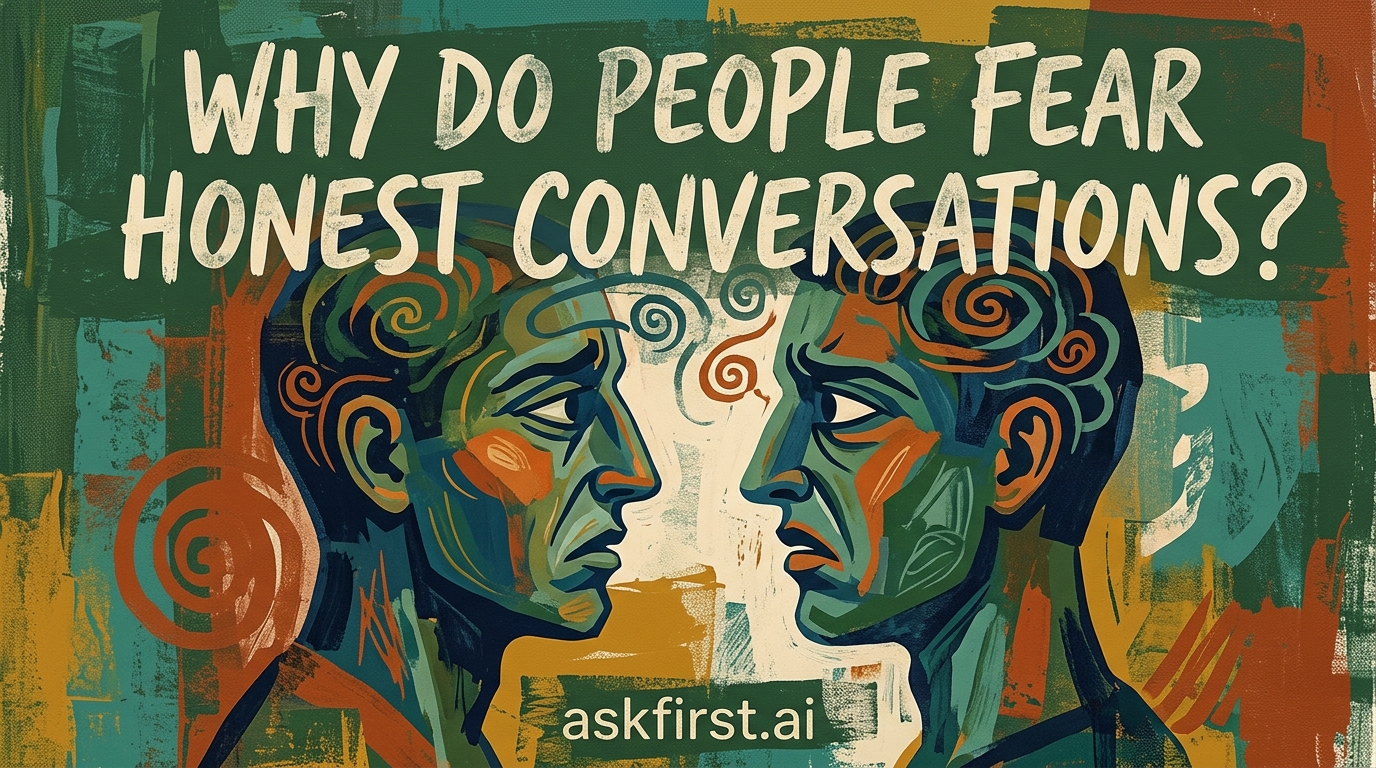
The Architecture of Avoidance: Why Honest Conversations Provoke Fear
In the landscape of human relationships, few phenomena are as pervasive or as paralyzing as the fear of honest conversation. While we intellectually value transparency, authenticity, and "truth-telling," our emotional responses often betray us, triggering a physiological and psychological flight response when faced with the prospect of a difficult, unfiltered dialogue. This avoidance is not merely a sign of weakness; it is a complex evolutionary and social adaptation that serves to protect our fragile egos and our standing within our communities.
The Evolutionary Biology of Social Risk
To understand why we fear honesty, we must first look at the evolutionary cost of social friction. As noted by evolutionary psychologist Robin Dunbar in his seminal work, Grooming, Gossip, and the Evolution of Language, humans are fundamentally social creatures whose survival historically depended on group cohesion. In our ancestral past, being ostracized from the tribe was effectively a death sentence.
When we engage in a conversation that threatens to expose a hidden truth, reveal a flaw, or challenge a long-held belief, our brain’s amygdala interprets this as a threat to our social safety. The fear of being "voted off the island"—even if that island is just a modern workplace or a romantic partnership—triggers a stress response that prioritizes self-preservation over clarity. We aren't just afraid of the words; we are afraid of the potential for rejection, abandonment, or the destruction of the social harmony that keeps us secure.
The Fragility of the Self-Concept
A significant portion of our resistance to honest discourse stems from the "Self-Verification Theory," a concept refined by psychologist William Swann in his research on identity. We spend a lifetime curating a specific narrative about who we are—competent, kind, rational, or moral. Honest conversations often act as a mirror that reflects a version of us we would rather hide.
If a colleague points out that your project failed due to your lack of preparation, they are not just criticizing your work; they are challenging your self-concept as a "competent professional." This cognitive dissonance creates profound psychological discomfort. To avoid the pain of updating our self-image, we instinctively deflect, minimize, or shut down the conversation. As Brené Brown articulates in Daring Greatly, we armor ourselves with perfectionism and defensiveness to avoid the "shame" of being truly seen. Honesty requires vulnerability, and vulnerability, by its very nature, demands that we lower our defenses—something the human ego is biologically programmed to resist.
The Illusion of Control and the Fear of Outcome
Many people fear honest conversations because they cannot predict the outcome. In a society that prizes efficiency and predictability, the unpredictable nature of an authentic exchange is inherently terrifying. When we hold back, we maintain control over the narrative. We choose what to reveal and what to conceal, ensuring that we remain in the driver’s seat of the interaction.
Once we initiate a truly honest conversation, we lose that control. We cannot dictate how the other person will react, what truths they will counter with, or how the relationship will change as a result. This loss of agency is a primary source of anxiety. In Crucial Conversations: Tools for Talking When Stakes Are High by Patterson, Grenny, McMillan, and Switzler, the authors note that people tend to move toward silence or violence (aggression) because they believe that these are the only ways to maintain safety when the outcome is uncertain. We prefer the safety of a comfortable lie to the volatility of a productive truth.
The Cultural Conditioning of "Politeness"
Beyond our biology and psychology, we are often culturally conditioned to view honesty as synonymous with cruelty. From childhood, many of us are taught that "if you can't say something nice, don't say anything at all." This social conditioning conflates kindness with silence. We learn to suppress our true thoughts to preserve the comfort of others, which leads to the "mum effect"—a psychological phenomenon where people withhold negative information to avoid being the bearer of bad news.
This creates a culture of superficiality where we mistake silence for agreement and politeness for genuine care. When we finally attempt to have an honest conversation, we lack the linguistic tools and the emotional regulation skills to do so constructively. Because we have spent years avoiding conflict, we view the act of speaking truth as an act of aggression, further fueling our fear.
Conclusion: The Necessity of Courage
The fear of honest conversation is a multifaceted barrier constructed of evolutionary survival instincts, the need to protect our self-concept, a desire for control, and a lifetime of social conditioning. However, the cost of this avoidance is high: stagnation in our relationships, lack of growth in our careers, and a profound sense of isolation.
True connection is impossible without the risk of discomfort. By recognizing that this fear is a natural, albeit outdated, defense mechanism, we can begin to practice "radical candor"—a term popularized by Kim Scott. Radical candor involves caring personally while challenging directly. It requires the courage to move past the immediate impulse to protect the ego and toward the long-term benefit of authentic human connection. Honesty is not the absence of fear; it is the decision that the truth is more valuable than the comfort of the illusion.