The Intersection of Wealth and Social Capital: An Analysis
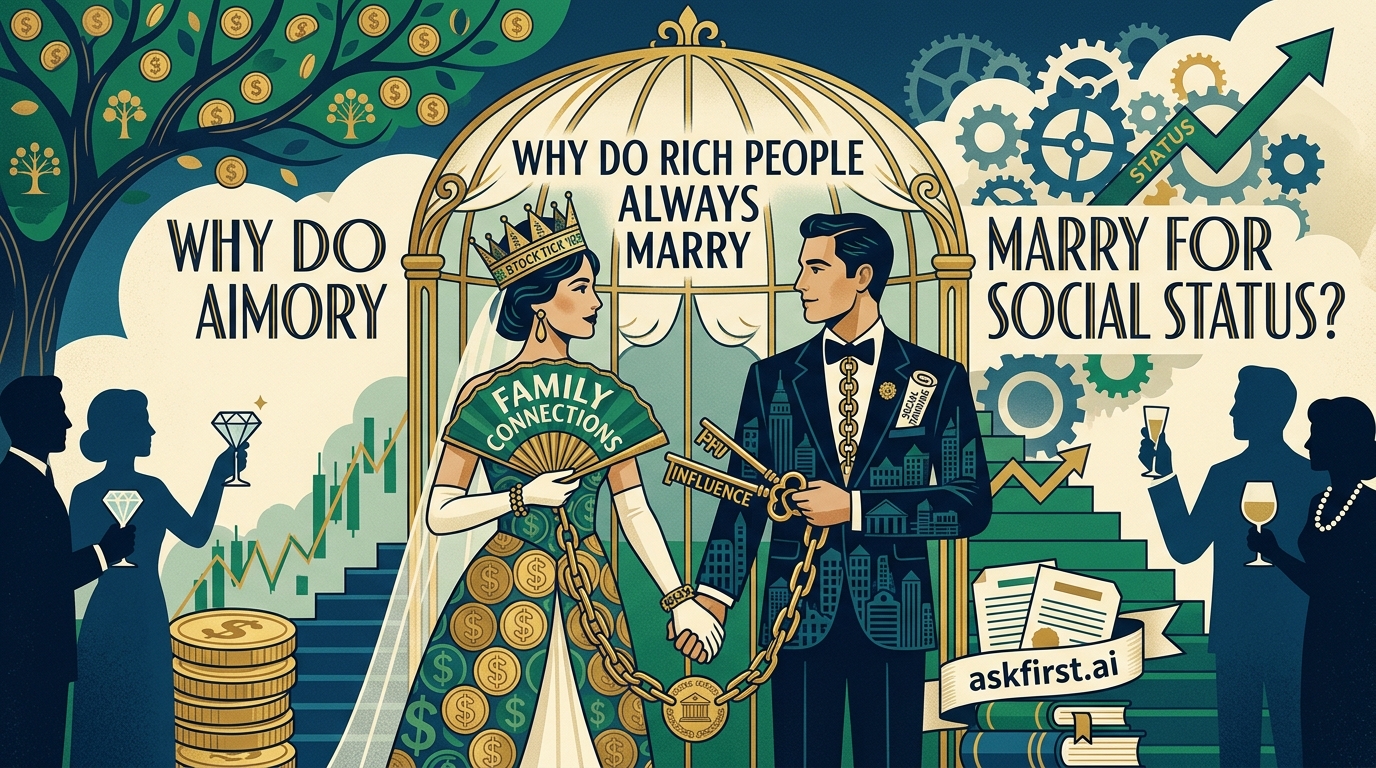
The perception that wealthy individuals prioritize social status in marriage is rooted in the socioeconomic concept of assortative mating. While romantic love remains a primary driver for many, historical and sociological data suggest that for those at the highest levels of economic stratification, marriage serves as a critical mechanism for preserving, aggregating, and transferring capital—not just financial, but social and cultural as well.
The Mechanics of Assortative Mating
Sociologists define assortative mating as the tendency for individuals to marry those with similar backgrounds, education, and socioeconomic status. In the context of the ultra-wealthy, this is rarely accidental. It is a calculated alignment of resources. When two individuals from similarly high-status families marry, they essentially merge their social networks, influence, and educational pedigrees. This synergy creates a protected ecosystem where generational wealth is insulated from external economic volatility.
- Network Aggregation: Wealthy families often view marriage as a bridge between powerful corporate entities or influential political circles.
- Cultural Capital: Beyond money, there is the concept of 'cultural capital'—the specific tastes, language, education, and manners that define high-status groups. Marrying within this stratum ensures that this capital remains intact and is passed to the next generation.
- Risk Mitigation: Wealthy individuals face unique pressures regarding the protection of assets. Marriage to a peer minimizes the risk of 'marrying down,' which could potentially jeopardize the cohesion of a family estate or corporate legacy.
The Evolution of 'Strategic' Unions
Throughout history, the strategic nature of elite marriage was explicit. Royal houses and aristocratic families historically utilized arranged marriages to secure borders and consolidate power. While modern democratic and capitalist structures have moved toward individualism, the 'status' motivation remains prevalent, albeit rebranded as 'compatibility.' The argument is often made that sharing a similar social class ensures a shared understanding of the lifestyle, expectations, and professional burdens inherent in high-net-worth environments.
The Psychology of Elite Circles
It is not merely a cynical desire for power; it is also a psychological reality of the 'bubble' effect. Elite social circles are often gated, whether physically or through exclusive educational institutions (the 'Ivy League' pipeline). When an individual spends their formative years in environments limited to their own economic class, their pool of potential partners is naturally restricted. This proximity breeds familiarity, and eventually, the perception that status-based unions are the 'natural' order of things.
- Shared Worldview: Partners from the same status often share an upbringing that includes expectations of public service, philanthropy, and corporate stewardship.
- Prestige Maintenance: In competitive social hierarchies, one's partner acts as a signal of one's own standing. Choosing a partner with high status serves as a validation of one's own value in the eyes of the peer group.
Is Status Always the Primary Factor?
While the narrative suggests wealth dictates these choices entirely, modern economic mobility does occur. However, when 'status' seems to take precedence, it is often because of the high stakes involved in wealth management. Studies on 'The Millionaire Next Door' types suggest that while mass-affluent individuals marry for various reasons, the 'ultra-high-net-worth' (UHNW) population behaves more akin to a distinct social class with rigid social boundaries. For them, a spouse is a life partner who must navigate a life of immense scrutiny, philanthropy, and management of legacy.
Conclusion: The Strategic Partnership Model
Ultimately, viewing marriage through a purely transactional lens misses the nuance of the 'partnership' model common among the elite. To the wealthy, marriage is frequently treated as a long-term strategic alliance. By aligning themselves with individuals of equivalent social and economic status, they create a formidable foundation that sustains their lifestyle across generations. While the terminology has shifted from 'arranged alliances' to 'social compatibility,' the underlying drive—the consolidation of influence and the preservation of status—remains a fundamental component of elite human behavior. It is a system built on the principle that like attracts like, and for those at the top, maintaining that status is the ultimate priority.