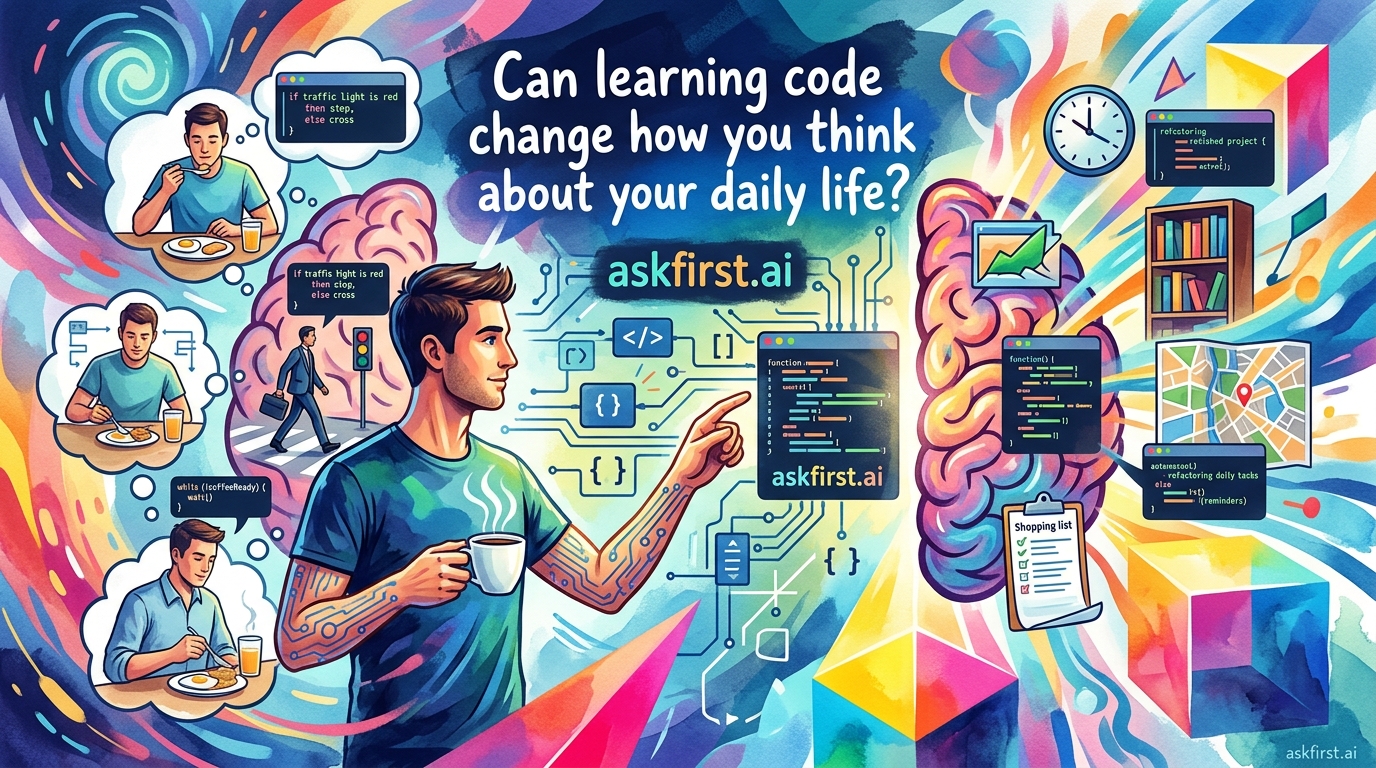
The Cognitive Revolution of Computational Thinking
Learning to program is often misconstrued as a purely technical endeavor focused on syntax and hardware interaction. However, the true transformation occurs within the neural architecture of the learner. When one engages with the formal logic of programming, the brain undergoes a profound shift in how it processes information, prioritizes tasks, and approaches problem-solving. This cognitive framework, often referred to as computational thinking, acts as a mental lens that recalibrates how daily life is navigated, structured, and understood.
Decomposition: The Art of Breaking Down Complexity
At the heart of coding lies the process of decomposition. Complex software systems are rarely built in one go; they are systematically broken into manageable functions, modules, and sub-routines. This methodology is incredibly potent when applied to personal and professional life. When faced with an overwhelming life challenge—such as organizing a cross-country move or managing a multi-month creative project—the mind trained in code does not see a monolithic monster. It sees a sequence of executable blocks.
- Granularity: Tasks are segmented into the smallest possible actionable units.
- Abstraction: Irrelevant details are discarded, allowing the focus to remain on the core logic of the situation.
- Dependency Mapping: Understanding which tasks must be completed before others can begin (a concept akin to build-order dependencies in software) significantly reduces frustration and idle waiting periods.
Algorithmic Optimization and Routine Efficiency
Daily life is essentially a series of recurring loops and conditional statements. An individual who writes code begins to perceive these repetitive actions as processes that can be optimized. If an action is repeated more than three times, the 'programmer's mindset' naturally seeks to automate it or create a template to minimize cognitive load.
Consider the concept of 'Refactoring.' In software development, refactoring is the process of restructuring existing code without changing its external behavior to improve performance. Applying this to daily life means constantly auditing habits and routines. Why does a specific grocery trip take two hours? Is there a more efficient route? Can the list be organized to match the physical layout of the store? This pursuit of efficiency is not about being robotic; it is about reclaiming time by reducing unnecessary friction in the 'operating system' of one's day.
Pattern Recognition and Predictive Analysis
Programming demands an acute awareness of patterns. Whether it is identifying a memory leak or recognizing recurring logic flaws, programmers are trained to spot trends before they become catastrophic errors. In daily life, this manifests as an enhanced ability to read social cues, project outcomes, and identify recurring cycles in personal health or workplace dynamics.
When a pattern is identified, it becomes possible to write a 'patch.' If a person notices that they are consistently prone to mood slumps on Thursday afternoons, they can preemptively adjust their schedule, fuel intake, or workload to mitigate the 'bug.' This predictive capability transforms life from a reactive experience—where one is constantly being hit by unexpected events—to a proactive experience, where one effectively manages variables to achieve a desired output.
Debugging the Human Experience
Perhaps the most significant shift is in the tolerance for failure. In coding, bugs are not moral failings; they are simply pieces of information. They are expected, inevitable, and essential to the iteration process. This mindset creates emotional resilience. When a life project fails, a person trained in logic is less likely to engage in self-blame and more likely to enter a 'debugging' state.
- Isolate the variable: What specific action caused this outcome?
- Test the hypothesis: What change might fix this?
- Deploy the fix: Implement the solution and observe the new outcome.
This scientific approach to life events removes the sting of failure and replaces it with the curiosity of experimentation. The focus shifts from 'Why did this happen to me?' to 'What is the system flaw here, and how can I iterate on it?'
The Long-Term Impact
As the world becomes increasingly complex and data-driven, the ability to think computationally is becoming a essential literacy. It provides a toolkit for navigating ambiguity. By treating life as a project that requires clear input, logical processing, and persistent testing, one develops a form of mental clarity that is both stable and adaptable. The language of code—logic, structure, and systematic improvement—becomes a universal language through which reality itself can be interpreted and optimized. Ultimately, learning to code is not about the screen; it is about upgrading the machine behind the eyes to handle the challenges of the future with precision, patience, and profound insight.