The Paradox of Prosperity: Analyzing the Wealth-Happiness Trade-off
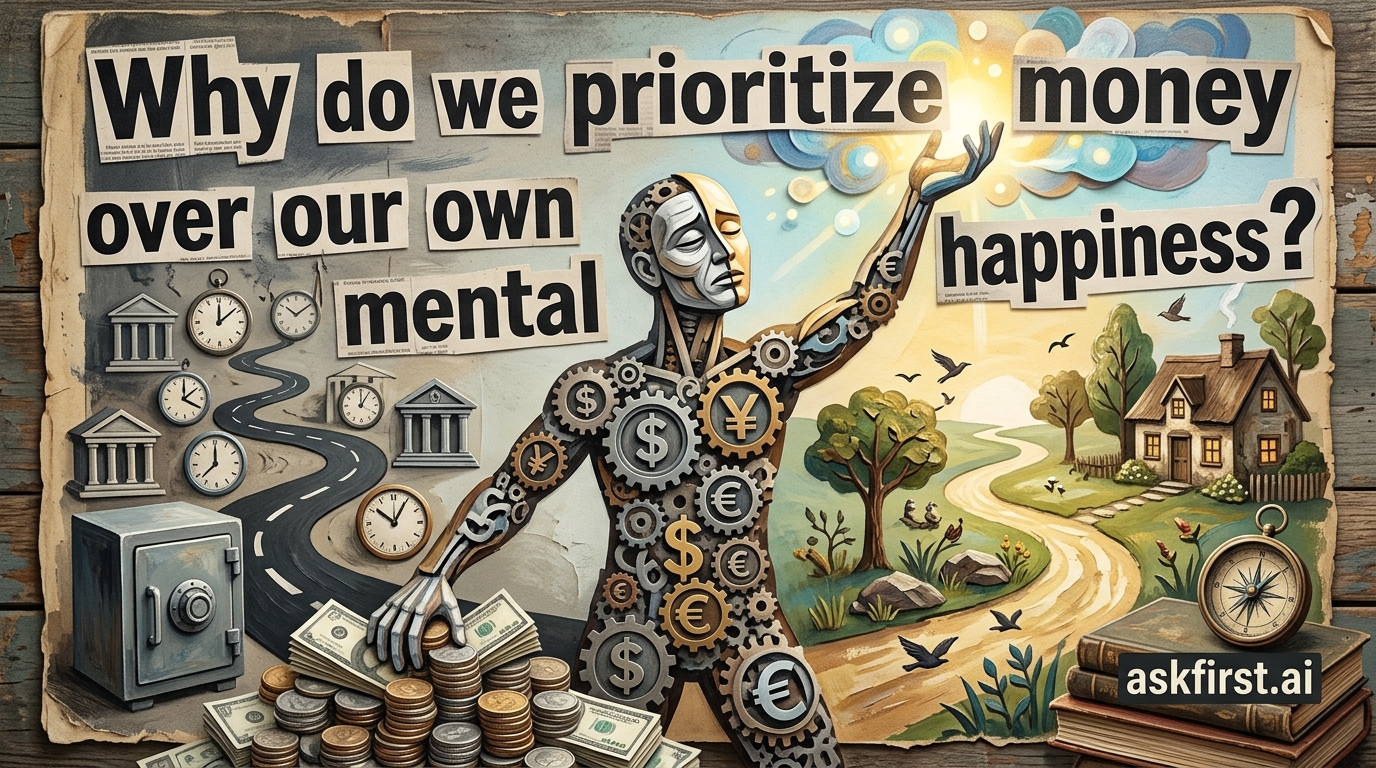
Modern society is built upon a fundamental tension: the relentless pursuit of financial stability versus the innate human requirement for psychological well-being. Despite decades of economic growth, the disconnect between fiscal success and internal satisfaction remains a psychological mystery that defines the human experience. Understanding this phenomenon requires examining evolutionary biology, societal conditioning, and the specific cognitive traps that keep humanity trapped in a cycle of accumulation.
The Evolutionary Root of Accumulation
From a biological standpoint, the human brain was not designed to maximize happiness; it was designed to maximize survival. In our ancestral environment, resources were finite and unpredictable. Storing food, acquiring tools, and maintaining social status within a tribe were direct prerequisites for longevity. Today, money serves as the modern equivalent of those vital resources. The amygdala—the brain's emotional center—frequently interprets a shrinking bank account as a genuine threat to life, triggering a fight-or-flight response. Consequently, individuals prioritize money not necessarily out of greed, but because the primitive brain views financial accumulation as an insurance policy against existential danger.
Hedonic Adaptation: The Moving Finish Line
One of the primary reasons financial gains fail to deliver sustained happiness is the phenomenon of hedonic adaptation. This psychological principle dictates that humans return to a baseline level of satisfaction regardless of positive or negative events. When salary increases occur, lifestyle inflation follows almost immediately. The new car, the larger home, or the luxury upgrade quickly becomes the new 'normal,' resetting the internal reward system. This forces individuals to perpetually seek more income to maintain the same level of relative excitement, a process often referred to as the 'hedonic treadmill.'
Cultural Conditioning and Social Comparison
Social comparison theory, popularized by Leon Festinger, posits that human beings define their own success by measuring it against the achievements of others. In a globalized digital era, this comparison has expanded from immediate peers to include celebrities, influencers, and distant global elites. This constant exposure creates a state of relative deprivation. Even those who are objectively well-off often feel impoverished because they look 'upward' at the top one percent. Societal structures reinforce this by tying individual value to net worth, creating a powerful cultural pressure to choose high-paying, high-stress roles over positions that offer better work-life balance or intrinsic creative satisfaction.
The Scarcity Mindset vs. Psychological Abundance
Research on the 'scarcity mindset' suggests that when individuals focus intensely on money, their cognitive bandwidth decreases. The constant mental effort required to track finances, negotiate salaries, or manage investments consumes executive functions that would otherwise be used for emotional regulation, meaningful social interaction, and personal creative output. This leads to a vicious cycle: as people worry more about money, they have fewer cognitive resources available to cultivate the very happiness they are working to afford.
Breaking the Cycle: Strategies for Realignment
To transcend the trap of prioritizing money over health, individuals must consciously adopt evidence-based practices:
- Value-Based Spending: Focus spending on experiences rather than material goods. Research consistently shows that the 'happiness dividend' of experiences—travel, education, or social gatherings—far outlasts the fleeting joy of a physical purchase.
- Mindful Consumption: Audit the sources of social comparison. Unfollowing platforms or influencers that trigger feelings of inadequacy can stabilize internal metrics of success.
- Defining 'Enough': Establish a clear financial goal that defines 'enough' for your specific needs. Without a clear ceiling, the drive for money becomes an infinite, unsatisfying loop.
- Prioritizing Autonomy: Seek work that provides autonomy and mastery, as psychological studies indicate that having control over one's time is a greater predictor of happiness than raw income levels beyond a certain safety threshold.
The Long-Term Perspective
Ultimately, money is a tool for facilitation, not a destination for the human spirit. The most successful individuals are those who learn to separate their self-worth from their net worth. By understanding the evolutionary impulses and cultural pressures at play, humans can regain control over their focus, shifting from the narrow pursuit of wealth to the broader, more sustainable pursuit of a meaningful and mentally fulfilling existence. True wealth is rarely found in the bank; it is found in the richness of the lived experience and the capacity to derive joy from the present moment.