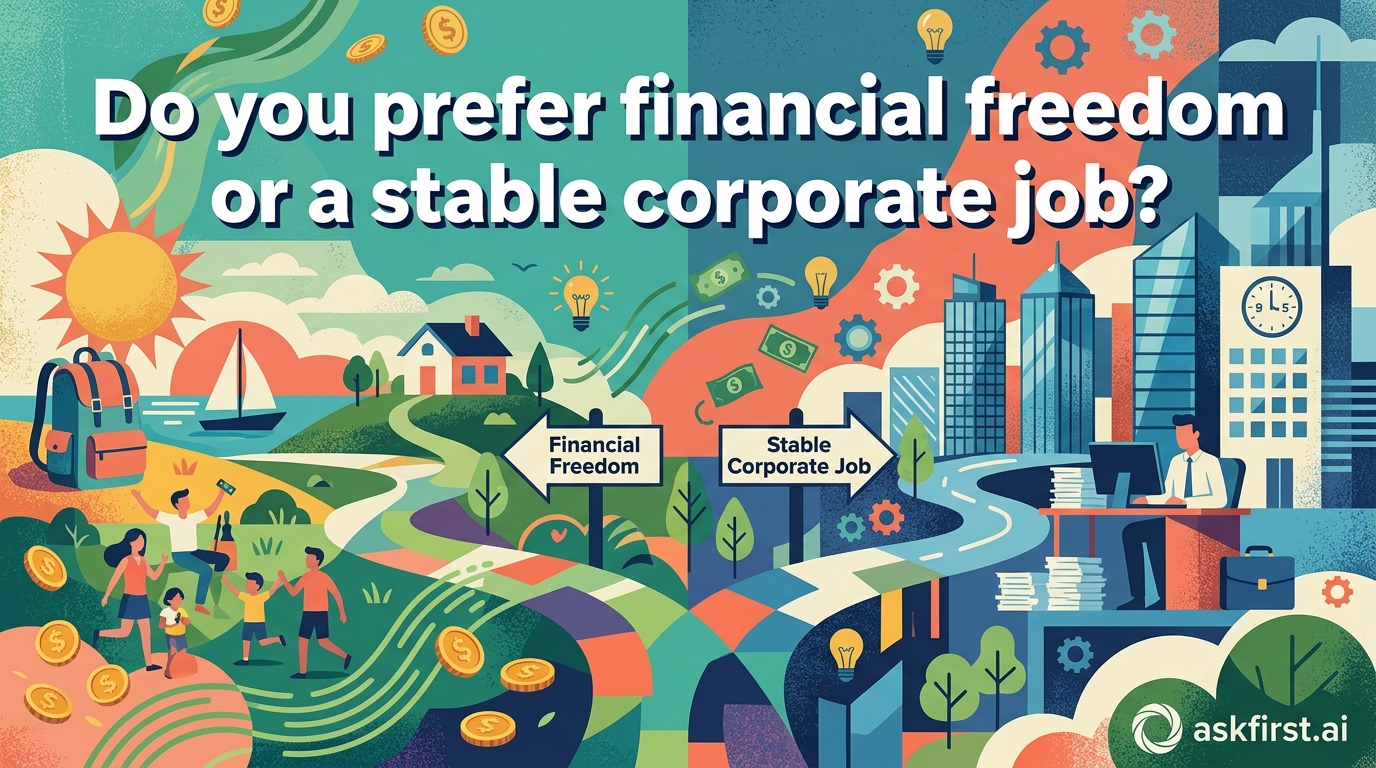
The Great Dichotomy: Financial Freedom Versus Corporate Security
Choosing between financial freedom and a stable corporate career is one of the most significant life dilemmas individuals face. This decision is not merely a choice of employment; it is a fundamental choice regarding one's philosophy of risk, time, and autonomy. Understanding the nuances of these two paths requires a deep analysis of psychological drivers, economic structures, and long-term utility.
The Anatomy of a Stable Corporate Job
Corporate stability is often viewed as the bedrock of middle-class society. It provides predictable cash flow, institutional benefits, and a structured social environment. From an economic perspective, this represents a lower-risk profile. The enterprise absorbs the primary risks—such as market volatility, supply chain failures, and regulatory shifts—while the employee acts as a specialized unit within a broader machine.
- Psychological Safety: Predictable income triggers a sense of psychological security, which is a fundamental human need according to Maslow’s Hierarchy. Knowing that mortgage payments and healthcare costs are covered allows for a reduction in cognitive load regarding basic survival.
- Compound Social Capital: In a corporate environment, one gains access to networking, mentorship, and institutional branding. These assets are often underestimated. A resume backed by recognized firms provides 'institutional signaling' that makes future professional transitions significantly smoother.
- Structural Efficiency: Many individuals thrive under external deadlines and KPIs. The corporate structure offers a clear blueprint for success, which reduces the anxiety of decision-making that often plagues entrepreneurs.
The Pursuit of Financial Freedom
Financial freedom, conversely, is defined as the state where passive income exceeds living expenses. It is not necessarily synonymous with wealth; rather, it is synonymous with sovereignty over one's time. This path is often characterized by high initial risk and intensive labor, which gradually shifts toward an asset-based existence.
- The Power of Asset Accumulation: The core of financial freedom is the transition from trading time for money to owning assets that generate value (such as equities, real estate, or intellectual property). As documented by financial experts like Robert Kiyosaki, this shift is the primary divider between the 'worker' class and the 'owner' class.
- Temporal Autonomy: The most profound benefit of financial freedom is the ability to dictate how one’s hours are spent. In an era where digital connectivity leads to burnout, the capacity to disconnect without risking a career is the ultimate luxury.
- Risk Mitigation through Diversification: While corporate jobs are often fragile (relying on a single employer), financial freedom is built on the opposite principle. By holding multiple income streams or assets, an individual becomes 'anti-fragile,' a concept popularized by Nassim Taleb, where one actually benefits from systemic stressors rather than being harmed by them.
Analyzing the Trade-offs
The fundamental conflict lies in the 'Time-Money-Risk' triangle. Corporate roles minimize risk but also cap the return on one's effort. Financial freedom maximizes the potential return on effort but introduces significant uncertainty, especially in the early stages.
| Feature | Corporate Job | Financial Freedom |
|---|---|---|
| Primary Risk | Job redundancy/Market shifts | Business failure/Market volatility |
| Primary Reward | Stability and predictability | Sovereignty and scalability |
| Time Requirement | Structured (40+ hours) | Unstructured/Asynchronous |
The Hybrid Path: A Realistic Synthesis
For many, the dichotomy is a false one. Modern professionals increasingly favor the 'Barista FIRE' model or the 'Side-Hustle' approach, where individuals maintain a corporate career while aggressively building an asset base on the side. This strategy leverages the liquidity and institutional benefits of corporate work to fund the capital requirements of financial freedom.
This synthesis effectively creates a hedge. The corporate income pays the bills and covers health insurance, while the business income contributes to a portfolio that will eventually grant autonomy. By the time the threshold for financial freedom is reached, the transition becomes a tactical choice rather than a leap of faith.
Conclusion: Defining Personal Utility
Ultimately, the 'right' choice depends on one's tolerance for ambiguity. If an individual derives purpose from institutional impact and structured growth, the corporate path offers a high level of life satisfaction. If an individual values personal autonomy above all else and possesses the discipline to navigate self-directed work, financial freedom is the superior destination.
History shows that the most successful individuals often treat their personal finances with the same rigor that a CEO treats a corporation. Whether one opts for the safety of the office or the freedom of the entrepreneur, the key lies in understanding the mechanism of wealth creation—the movement of value through labor or the movement of value through ownership. In the final analysis, freedom is not the absence of work; it is the presence of choice.