The Paradox of Availability: Understanding Human Neglect
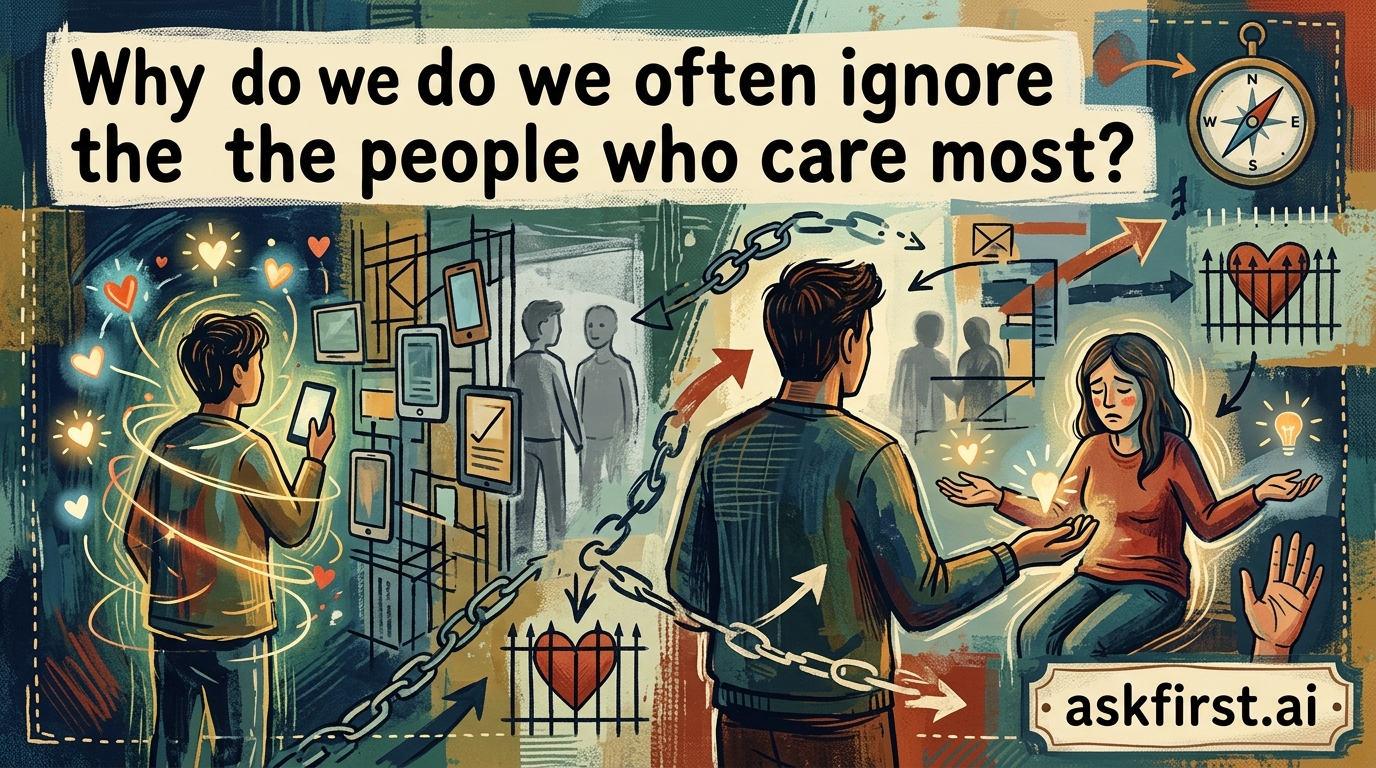
Human nature frequently exhibits a confounding psychological pattern: the tendency to overlook, undervalue, or neglect those individuals who demonstrate the most consistent care and affection. This phenomenon, often referred to as the 'paradox of availability,' suggests that when an individual feels the love and support of another is guaranteed, they inadvertently lower the priority level of that person in their social hierarchy. This is not necessarily an act of malice; rather, it is a byproduct of human cognitive biases.
The Role of Hedonic Adaptation
At the root of this behavior lies hedonic adaptation, a psychological theory proposing that humans quickly return to a relatively stable level of happiness despite major positive or negative events. In relationships, consistent care provides a baseline of emotional stability. Because this affection is constant, the brain ceases to register it as a novelty or a reward that requires active pursuit. The presence of a caring person becomes the 'status quo,' causing the individual to take that support for granted.
- The Baseline Effect: When emotional nourishment is always available, it loses its perceived value.
- The Pursuit Incentive: Humans are neurologically wired to pursue goals that seem challenging or scarce. Because people who care deeply are 'accessible,' they are often prioritized less than those who represent an 'unknown' or a social challenge.
Cognitive Biases and Emotional Security
There are several cognitive biases that contribute to this phenomenon. The Availability Heuristic plays a significant role, where individuals make judgments based on the most immediate or dramatic stimuli. A person who cares deeply is often calm, stable, and supportive—attributes that are less 'noisy' than the erratic or dramatic behavior of those who do not prioritize the individual.
Furthermore, Attachment Theory suggests that secure individuals—those who consistently provide care—often become the 'secure base' from which others explore the world. Paradoxically, the safety provided by these individuals allows the recipient to focus their cognitive resources on external challenges or people they are trying to 'win over.' The internal logic, albeit subconscious, functions like this: 'I do not need to worry about this person, so I will dedicate my energy to someone who is currently uncertain.'
The Danger of the 'Taken-for-Granted' Trap
When care is perceived as an infinite resource, the recipient often stops performing the essential maintenance required for a healthy relationship. This includes reciprocity, gratitude, and active engagement.
- Diminished Reciprocity: Without active conscious effort, the balance of energy shifts. The caring individual exhausts their resources, while the recipient remains in a state of emotional inertia.
- The Mirror Principle: Relationships thrive on the feedback loop of mutual appreciation. When one side ceases to 'see' the other, the invisible strings of connection begin to fray.
How to Re-Center Focus and Value
To overcome this ingrained bias, one must employ conscious cognitive re-framing. This involves shifting from a state of 'implicit acceptance' to 'explicit gratitude.'
- Intentional Noticing: Make a conscious effort to identify the small, everyday acts of care provided by significant others. Acknowledge these acts aloud.
- The Scarcity Exercise: Occasionally perform a mental experiment. Imagine the daily life and the emotional support network without that specific individual. This technique is known in positive psychology as 'mental subtraction' and is highly effective at increasing appreciation.
- Prioritizing Reciprocity: Actively schedule time and energy for those who care, ensuring the relationship is not viewed as a passive backdrop to daily life.
The Long-Term Perspective
Ultimately, neglecting those who care most is a failure to recognize the 'emotional infrastructure' of life. While the allure of the new or the difficult is tempting, the individuals who remain steadfast are the ones providing the foundation for everything else. By understanding these psychological triggers, one can transition from a state of passive neglect to active, intentional connection. Deep relationships are not gifts that sustain themselves; they are gardens that require daily watering, even if they look healthy enough to survive on their own. Recognizing this truth is the first step toward building more profound, enduring, and reciprocal connections in the long term. Focusing on what one already has, rather than what one lacks, is perhaps the ultimate secret to sustaining human fulfillment.