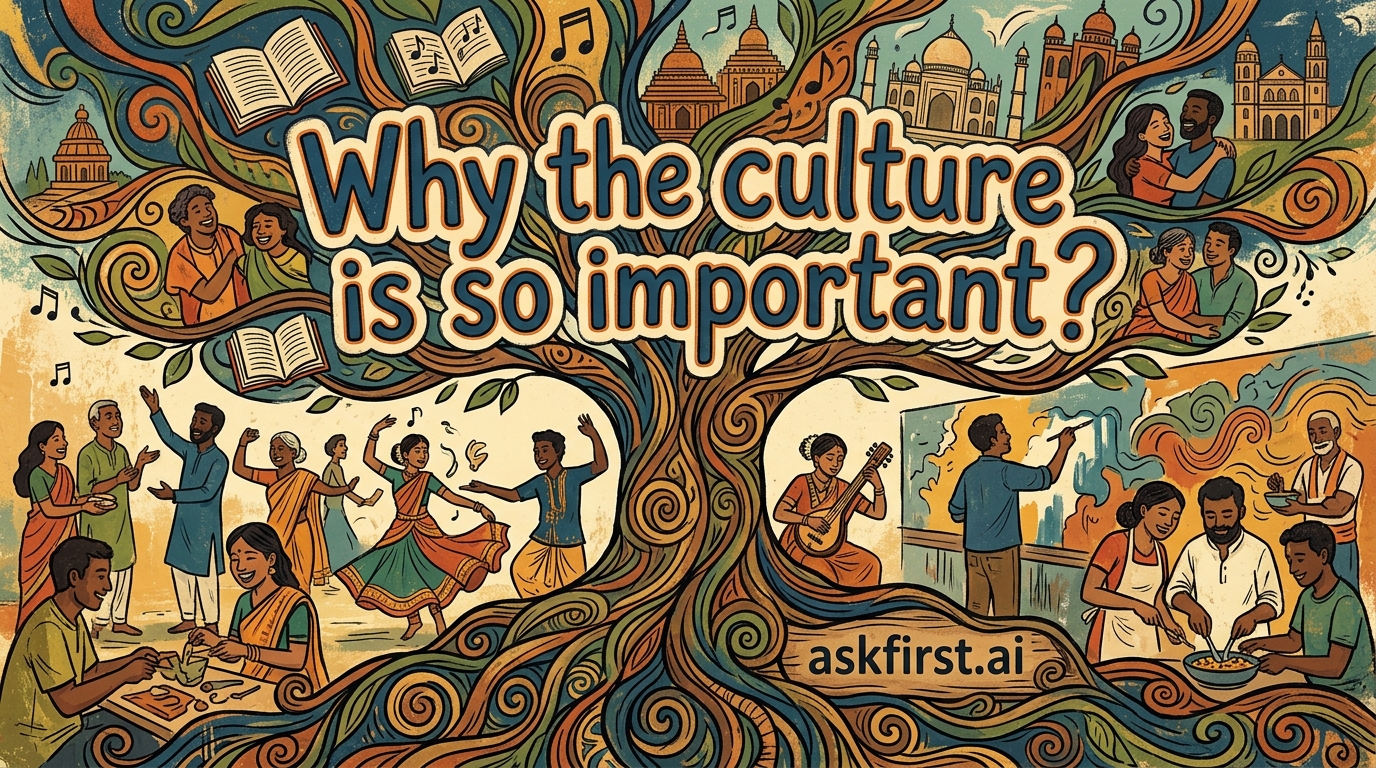
Culture is the invisible architecture of human civilization. It serves as the collective programming of the mind—a complex web of beliefs, values, customs, and artifacts that distinguish one group of people from another. To understand why culture is fundamentally important, one must look beyond superficial traditions and recognize it as the primary survival mechanism for the human species. Without culture, human existence would be reduced to mere biological instinct; with it, we create meaning, social cohesion, and the legacy of our species.
The Foundation of Identity and Belonging
At the individual level, culture provides the framework for identity. It answers the existential questions of "who am I?" and "where do I belong?" By participating in a shared set of norms, individuals gain a sense of security and validation. According to Geert Hofstede in his seminal work, Culture's Consequences: Comparing Values, Behaviors, Institutions and Organizations Across Nations, culture acts as "mental software." This software dictates how we interpret reality, how we communicate, and how we relate to authority.
When an individual is grounded in their cultural identity, they possess a psychological anchor. This is particularly vital in a globalized world where the homogenization of experience can lead to alienation. For example, the Japanese concept of ikigai (a reason for being) provides a cultural structure that fosters longevity and purpose, illustrating how deeply cultural values can influence individual well-being and life satisfaction.
Social Cohesion and Collective Stability
On a societal level, culture is the "social glue" that prevents anarchy. It establishes the rules of engagement—what is considered polite, what is taboo, and what is worthy of celebration. Émile Durkheim, one of the founding fathers of sociology, argued in The Division of Labour in Society that culture creates "collective consciousness." This shared belief system allows large groups of strangers to cooperate effectively.
Consider the role of rituals. Whether it is the communal breaking of bread in Mediterranean cultures or the rigorous tea ceremonies in East Asia, these acts reinforce social bonds and mitigate conflict. When a culture is healthy, it provides a predictable environment where citizens know what to expect from one another, thereby lowering the transaction costs of social interaction and reducing the need for constant, heavy-handed legal enforcement.
Transmission of Knowledge and Innovation
Culture is the primary vehicle for the transmission of knowledge across generations. Unlike other species that rely largely on genetic evolution to adapt, humans utilize "cultural evolution." By passing down stories, scientific discoveries, and artistic techniques, we do not have to reinvent the wheel every generation.
This cumulative nature of culture is precisely what drives innovation. As Joseph Henrich outlines in his book, The Secret of Our Success, human intelligence is not primarily an individual trait but a collective one. We thrive because we can "download" the accumulated wisdom of our ancestors. For instance, the scientific method itself is a cultural construct—a set of shared values regarding evidence and skepticism—that has allowed humanity to progress from the Stone Age to the Space Age in a relatively blink-of-an-eye timeframe.
The Economic and Political Dimension
Culture also dictates the economic trajectory of nations. Max Weber, in The Protestant Ethic and the Spirit of Capitalism, famously posited that cultural values—specifically the emphasis on hard work, frugality, and deferred gratification—were the catalysts for the rise of modern industrial capitalism. This demonstrates that culture is not just an abstract concept; it has tangible, material consequences.
In the political sphere, culture determines the viability of governance. Democracy, for example, is not merely a set of voting procedures; it is a culture of compromise, tolerance, and civic participation. If the underlying cultural fabric does not support these values, democratic institutions often fail or become corrupted. Therefore, when experts analyze the success or failure of international development projects, they look at "cultural fit." A policy that ignores the existing cultural landscape is almost destined to fail because it ignores the human motivations that drive behavior.
Conclusion: The Lens Through Which We See
Culture is the lens through which we view the world. It colors our perceptions of beauty, justice, time, and truth. It is the repository of our deepest anxieties and our highest aspirations. To ignore the importance of culture is to ignore the very essence of what it means to be human.
Ultimately, culture is not a static relic of the past; it is a living, breathing entity that we actively participate in creating and refining every single day. By understanding the profound impact of our cultural environment, we gain the agency to preserve what is valuable, discard what is harmful, and evolve into a more cohesive and sophisticated global society. It is the ultimate repository of our history and the primary architect of our future.