The Psychology of the Unnecessary Apology
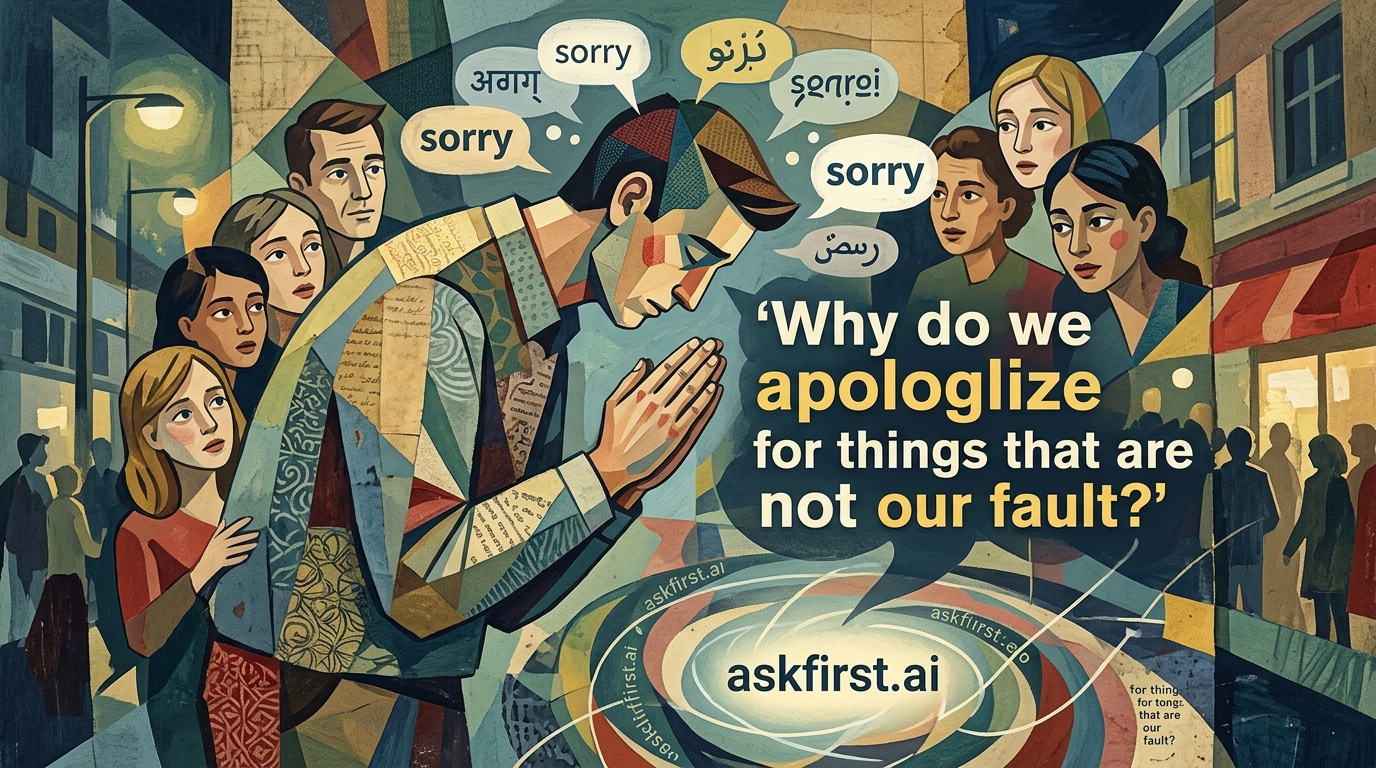
Apologizing for actions outside one’s control is a pervasive human behavior often categorized as 'over-apologizing.' While a sincere apology serves to repair a relationship after a genuine mistake, excessive apologizing functions as a complex social mechanism. It is rooted in a blend of evolutionary biology, social conditioning, and emotional regulation strategies that serve to navigate the complexities of human hierarchies and interpersonal harmony.
The Social Lubricant Hypothesis
Sociologists often describe the unnecessary apology as a form of 'social lubricant.' Humans are inherently social animals driven by the need for belonging and the avoidance of rejection. By saying 'I'm sorry' for minor inconveniences—such as someone else bumping into you or a delay caused by a system error—individuals signal a submissive, non-threatening stance. This behavior effectively lowers the defenses of others, fostering an environment of perceived cooperation. In essence, it is an act of preemptive peace-making designed to prevent conflict before it even begins.
The Role of High Agreeableness and Empathy
Personality psychology highlights that individuals with high levels of 'agreeableness' are statistically more likely to over-apologize. High agreeableness is characterized by a natural predisposition toward compassion, cooperation, and a strong desire to maintain social cohesion. These individuals tend to be hypersensitive to the emotional states of others. When a negative situation arises, even one they did not cause, they feel a secondary emotional burden—an empathetic distress—that necessitates an apology as a tool to alleviate the perceived discomfort of everyone involved. This is not weakness; rather, it is an overactive manifestation of emotional intelligence gone into overdrive.
Learned Behavior and Social Conditioning
Culture and upbringing play a massive role in shaping the propensity to apologize. In many cultures, particularly those that prioritize collective harmony over individual expression, apologizing is seen as a sign of maturity and emotional regulation. Children are often taught to apologize to resolve conflicts quickly, regardless of who is at fault, simply to keep the peace. As these children transition into adulthood, the pattern is reinforced. Furthermore, gender expectations have historically played a role, with social studies suggesting that women are often socialized to focus more on relational maintenance, leading to more frequent apologies as a way to preserve harmony in mixed-gender environments.
Anxiety and the Need for Reassurance
At a deeper, individual level, the unnecessary apology acts as a defensive strategy against rejection. For those struggling with social anxiety or a deep-seated fear of judgment, an apology functions as a 'safety behavior.' It serves to proactively head off any criticism. If one apologizes first, they perceive themselves as having more control over the situation, essentially beating the other person to the punch. It is an attempt to manage perceptions and ensure that the individual is viewed as responsible, kind, and self-aware, thereby minimizing the chance of an antagonistic reaction from others.
The Negative Trade-offs: When Apologizing Becomes Detrimental
While the impulse is often benign, experts warn that constant apologizing can have unintended consequences. Over-apologizing can subtly erode one’s perceived authority and professional standing. In a professional setting, repeatedly saying 'sorry' for things you did not cause can frame you as inherently at fault, leading colleagues to subconsciously associate your presence with mistakes. It can diminish the perceived value of your expertise and confidence. The goal is to move from 'compulsive apology' to 'intentional expression.' Instead of saying, 'I'm sorry, I didn't see that message,' one can practice saying, 'Thank you for your patience while I reviewed that,' shifting the energy from guilt to gratitude.
Conclusion: Reclaiming Your Narrative
Understanding why we apologize for things outside our control is the first step toward healthier communication. Recognize that the impulse is often a sign of a desire for connection and peace rather than a character flaw. By being mindful of when and why the words 'I'm sorry' leave your lips, you can retain your empathetic nature while reclaiming your confidence. The next time a situation arises that isn't your fault, try substituting the apology with an expression of gratitude or a neutral observation of the circumstances. This simple shift can dramatically change how you are perceived by others and, more importantly, how you perceive yourself.