The Cognitive Intersection of Relationships and Code
The impact of a partner's immersion in software development extends far beyond the screen, subtly recalibrating the linguistic landscape of a romantic relationship. When one individual spends hours solving logic puzzles or debugging complex systems, they inadvertently export the structural patterns of their profession into their daily vernacular. This phenomenon, often termed 'lexical cross-pollination,' occurs when technical jargon and algorithmic thinking styles become embedded in household dialogue.
Linguistic Optimization and Declarative Speech
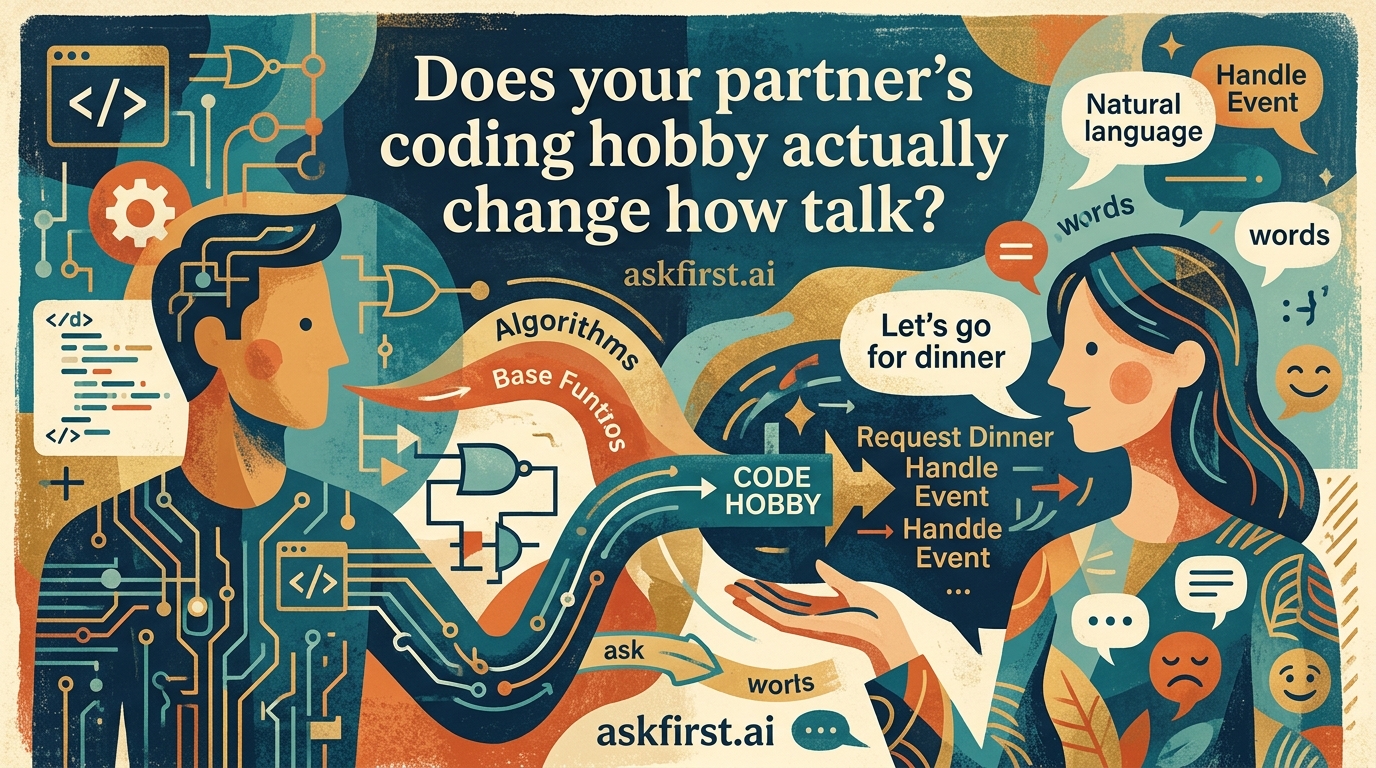
Coders are trained to prioritize precision. Ambiguity is the enemy of a functioning program, and this mental model often migrates into communication with a partner. You might notice a shift toward declarative, intent-focused communication. Rather than offering vague suggestions, the partner influenced by a coding mindset may structure requests like 'requirements specifications.' For instance, instead of asking, 'Should we eat dinner?' they might ask, 'What are the constraints for our meal tonight? Do we have a time dependency or specific ingredient dependencies?' This reduces friction by minimizing the need for recursive clarification.
Algorithmic Problem Solving in Conflict
When a couple faces a disagreement, a developer often views the conflict through the lens of a bug-fixing process. This involves several distinct phases that mirror the software development lifecycle (SDLC):
- Isolation of the Root Cause: The partner attempts to separate the symptom (the current argument) from the base code (the underlying emotional or logistics issue).
- Refactoring: Instead of engaging in circular blame, they might suggest 'refactoring' how the relationship handles household chores, proposing a new, more efficient protocol rather than addressing each instance of failure individually.
- Version Control: Partners may find themselves referring to past behaviors as previous iterations, asking to 'rollback' to a time before a specific incident occurred.
The Vocabulary of Logic
Certain boolean terms frequently bleed into natural language. Words like 'input,' 'output,' 'iterate,' 'deployment,' and 'scaling' lose their strictly technical meaning and become metaphors for emotional work. If your partner describes a shared chore as 'optimizing our weekend deployment,' they are fundamentally recontextualizing domestic life as a series of iterative tasks to be streamlined. This shift does not diminish intimacy; rather, it creates a unique, shared dialect that is exclusive to the couple.
The Curiosity Gap: Cognitive Empathy
While the adoption of technical language might seem alienating, research suggests it serves as a form of cognitive empathy. By translating their professional life into a shared household language, the developer is attempting to make their inner mental state transparent. The partner, in turn, often begins to absorb this terminology, even without technical knowledge. This leads to a mutual linguistic evolution, where both participants adopt a shared shorthand that allows them to communicate complex ideas in fewer words. This is the ultimate 'efficiency gain' in a long-term relationship.
Managing the Linguistic Shift
It is essential to recognize that this shift is not an intentional attempt to objectify relationships. It is a manifestation of the 'hammer and nail' effect: when your primary tool for navigating the world is algorithmic, everything starts looking like a logic problem. For the partner observing this shift, the goal should be to engage with the framework without feeling diminished by the lack of emotion typically associated with code. One can accept the 'logical structure' of the request while asserting the 'human context.'
Long-Term Impacts on Intimacy
Ultimately, the change in how a couple talks is a natural response to the hyper-rationalization of modern society. As more people spend their work hours in virtual, programmatic spaces, their romantic partners effectively become the ground-truth testing environment for these communication techniques. The result is a relationship that feels highly structured, predictable, and perhaps more resilient to chaotic external factors.
By embracing this new 'coding vernacular,' couples do not necessarily become less romantic. Instead, they create a specialized, high-bandwidth communication system that is uniquely their own. Whether it is identifying 'bottlenecks' in their daily schedules or 'patching' a misunderstanding, this technical lexicon provides a robust, scalable framework for staying aligned. It is a testament to the adaptability of human language, proving that even the most abstract digital environments can foster tangible, real-world connection.