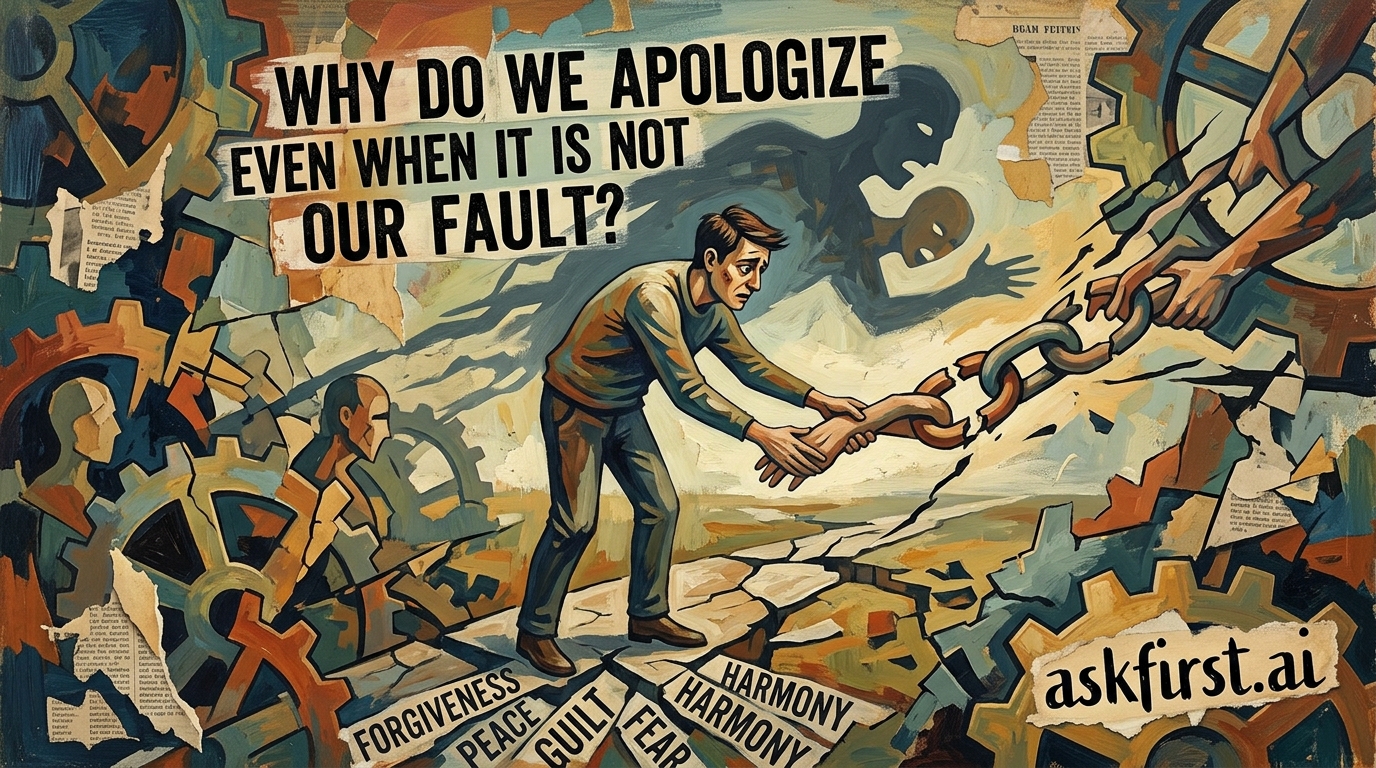
The Psychology of the Reflexive Apology
Human beings often find themselves uttering the words "I'm sorry" in situations where they bear absolutely no responsibility. This phenomenon, often termed the "over-apologizer," is deeply rooted in the complex architecture of human social behavior and evolutionary survival strategies. While it may appear to be a sign of weakness or a lack of self-esteem, the roots of this behavior are far more nuanced, often serving as a sophisticated social lubricant designed to maintain harmony and minimize perceived threats in a communal environment.
The Social Lubricant Theory
At its core, the tendency to apologize for things beyond one's control acts as a mechanism to signal agreeableness and reduce friction. From an evolutionary perspective, humans are obligate social animals. The survival of the species depended heavily on group cohesion. By offering a preemptive apology—even for minor inconveniences or external events—an individual signals that they are not a threat to the group’s stability. Research suggests that this behavior helps to de-escalate tension before it even manifests. When one apologizes for "taking up space" or for an event like a delayed train, they are implicitly stating, "I prioritize our collective comfort over my individual ego."
Psychological Underpinnings and Anxiety
There is a significant correlation between reflexive apologizing and social anxiety or high levels of conscientiousness. Individuals who are highly empathetic or hyper-aware of the emotions of those around them often use apologies to manage the distress of others. If a peer appears disappointed or frustrated, the reflexive apology serves as an attempt to soothe that discomfort, even if the source of the frustration is clearly unrelated to the speaker. This is often linked to 'emotional contagion,' where one individual mirrors the emotional state of their environment and attempts to neutralize any perceived negativity.
The Conflict Avoidance Strategy
Apologizing when not at fault is a potent, albeit sometimes subconscious, method of conflict avoidance. In many cultural frameworks, apologizing is perceived as a low-cost, high-reward strategy to ensure a smoother interpersonal interaction. By yielding the moral ground in a minor dispute, an individual effectively bypasses potential confrontation, allowing the interaction to proceed without the barrier of blame-attribution. Experts in conflict resolution note that in low-stakes situations, the act of apologizing is rarely about the truth; it is about prioritizing the maintenance of a functional, collaborative relationship.
Cultural Dimensions and Conditioning
Social conditioning plays a massive role in this habit. Different cultures prioritize either individual sovereignty or collective harmony. In collectivist societies, the focus on 'face'—a person’s social standing and the perceived honor of the group—makes the apology a standard tool for preventing 'loss of face' for all parties involved. Furthermore, gender roles have historically influenced this behavior. Sociological studies, such as those conducted by psychologists at the University of Waterloo, have indicated that individuals socialized to be more communal are more likely to interpret their own actions as potentially problematic, leading to a lower threshold for initiating an apology.
The 'Moral Buffer' Effect
Interestingly, the reflexive apology functions as a 'moral buffer.' By apologizing, an individual creates a protective layer of humility that makes them appear more approachable and less likely to be perceived as arrogant or demanding. This is a common tactic observed in leadership studies, where leaders who are willing to take the blame for minor systemic errors are often viewed as more 'human' and authentic by their subordinates. The act of apologizing, therefore, can be a form of social capital, signaling self-awareness and a willingness to facilitate the needs of others.
When the Habit Becomes Detrimental
While this behavior serves important social functions, experts suggest that excessive apologizing can have drawbacks. Over-apologizing can dilute the power of a sincere, meaningful apology. When one apologizes for everything, the weight of an apology for a genuine mistake is diminished. Furthermore, constant apologizing can signal a lack of confidence, which may lead others to undermine the individual's authority or voice. Achieving a balance involves recognizing the difference between 'cooperative empathy' (acknowledging another's pain) and 'submissive surrender' (accepting blame).
Strategies for Healthy Communication
- Pause and Assess: Before saying 'sorry,' ask, 'Is this my responsibility?' If not, replace the apology with an expression of empathy, such as, 'That sounds incredibly frustrating' or 'I understand why you feel that way.'
- Reframe the Narrative: Shift from an apologetic tone to an appreciative one. Instead of 'Sorry I am late,' try 'Thank you for your patience.'
- Build Self-Worth: Recognize that taking up space, speaking your truth, or experiencing bad luck are not moral failings that require an apology.
Ultimately, understanding why we apologize when we are not at fault helps us navigate our social world with greater intention, allowing us to maintain our dignity while still being the compassionate, cooperative humans we are wired to be.