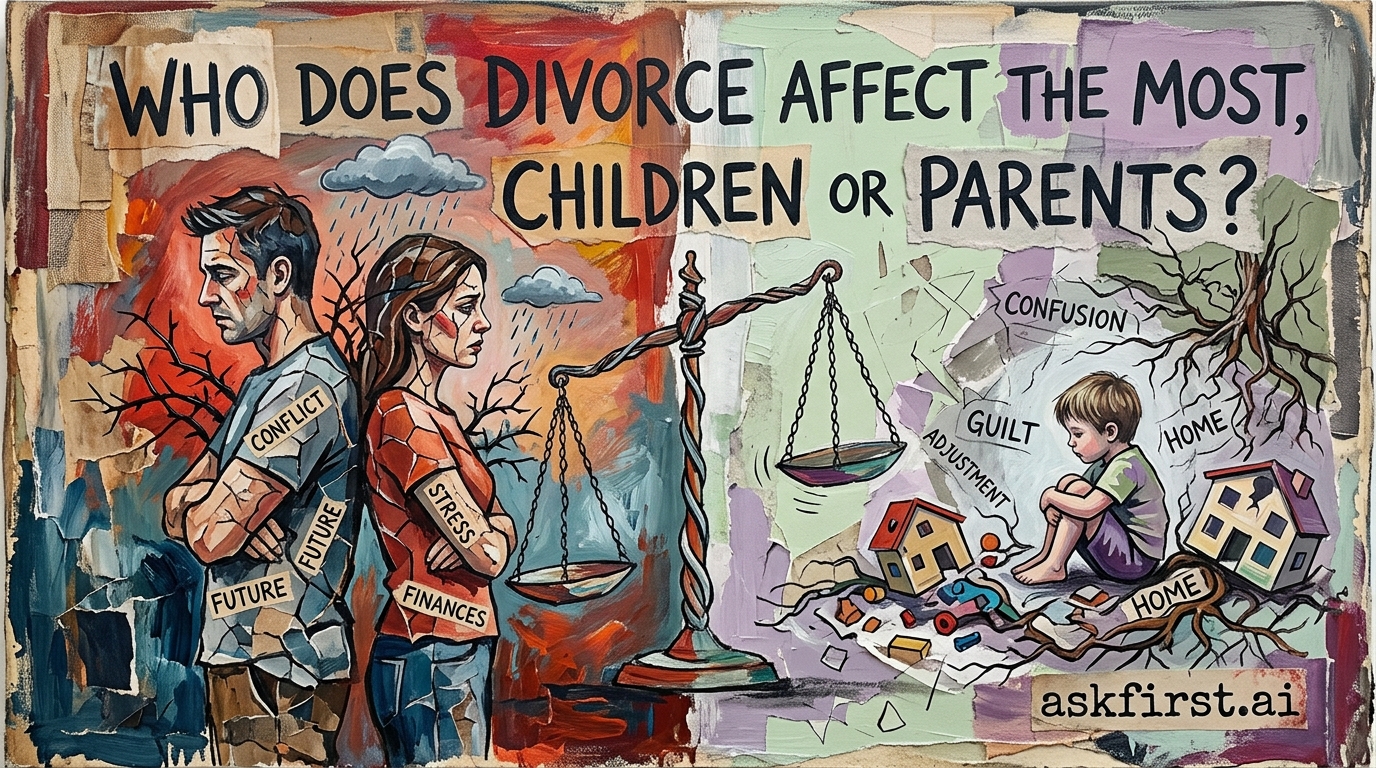
The question of whether divorce impacts children or parents more profoundly is one of the most debated subjects in developmental psychology and family sociology. While it is tempting to quantify emotional trauma or life upheaval, the reality is that divorce acts as a seismic shift for all parties involved, albeit in fundamentally different ways. To understand the depth of this impact, one must examine the longitudinal psychological data, the developmental stages of those involved, and the long-term societal consequences.
The Psychological Landscape of the Child
For children, divorce is rarely an isolated event; it is the dissolution of their primary reality. According to Judith Wallerstein, a pioneer in the study of divorce’s long-term effects and author of The Unexpected Legacy of Divorce, children do not simply "get over" a divorce once the initial conflict subsides. Wallerstein’s landmark 25-year study revealed that the effects of divorce often manifest in adulthood, particularly regarding intimacy and fear of abandonment.
Children lack the cognitive maturity to fully grasp the complexities of adult incompatibility. Consequently, they often internalize the blame. A child’s world is structured around the stability of their home; when that foundation cracks, their internal sense of security is compromised. This can lead to:
- Attachment Issues: A deep-seated anxiety regarding the reliability of close relationships.
- Academic and Behavioral Shifts: Younger children may exhibit regression or acting-out behaviors, while adolescents often experience academic decline or withdrawal.
- The "Sleeper Effect": As documented by Wallerstein, many individuals who seemed resilient as children reported intense emotional distress, particularly regarding their own romantic relationships, during their twenties and thirties.
The child’s experience is essentially one of powerlessness. They are the recipients of a decision they did not make, forced to adapt to fragmented living arrangements and the loss of the "family unit" as they knew it.
The Parental Burden: Identity and Loss
Conversely, parents experience divorce as a profound loss of identity, financial stability, and personal failure. Unlike children, parents are the architects of the transition, which brings its own unique set of burdens.
The stress experienced by parents is often categorized as "cumulative trauma." In The Case for Marriage by Linda Waite and Maggie Gallagher, the authors discuss the economic and psychological toll that divorce takes on adults. For many, divorce signifies the death of a life plan. It is a period of intense grief, often exacerbated by:
- Financial Instability: The transition from a dual-income household to a single-income household frequently results in a drastic reduction in the standard of living, particularly for custodial mothers.
- Social Isolation: Many adults find that their social circles, which were built around "couplehood," dissipate, leading to profound loneliness.
- The Guilt Factor: Parents, particularly those who initiate the divorce, often struggle with the "guilt of impact." Watching one’s child suffer as a result of one's own choices creates a psychological loop of regret that can hinder the parent's own emotional recovery.
Comparative Dynamics: Who Suffers "More"?
If we attempt to weigh these experiences, we find that the "impact" is qualitative rather than quantitative.
Children suffer from a lack of agency. They are forced into a new reality that they cannot control, and their development is inextricably linked to the quality of the post-divorce co-parenting relationship. If parents continue to fight, the child’s trauma is compounded. If parents manage to create a "binuclear family" (a term coined by Constance Ahrons in The Good Divorce), the child’s chances of healthy development increase significantly.
Parents suffer from the weight of responsibility. They must manage their own intense emotional distress while simultaneously acting as the emotional anchor for their children. The "parentification" of children—where children are forced to provide emotional support to their distraught parents—is a common consequence of parental failure to manage their own grief.
The Role of Conflict and Resolution
The most significant variable in determining the severity of impact is not the divorce itself, but the level of conflict surrounding it. Research by E. Mavis Hetherington, detailed in her book For Better or Worse: Divorce Reconsidered, suggests that children in high-conflict, intact marriages often fare worse than children in low-conflict, divorced households. This implies that the "damage" is not necessarily the divorce, but the toxicity of the environment.
When parents prioritize the child’s needs over their own desire for "winning" the divorce, the negative impact can be mitigated. However, when parents use children as pawns in legal battles, the long-term psychological scarring on the child is arguably more severe than the adult’s experience, as it disrupts the child's foundational development during their most formative years.
Conclusion
In the final analysis, determining who is affected "more" is a matter of perspective. Parents experience a complete restructuring of their adult identity and social standing, carrying the heavy burden of consequence. However, children are the ones whose developmental trajectory is altered by the loss of a cohesive family structure. While parents possess the tools and life experience to eventually reconstruct their lives, children are often forced to navigate the world with a modified sense of trust and security. Therefore, while parents bear the weight of the process, children bear the weight of the legacy. The most successful outcomes arise when parents recognize their shared, permanent responsibility to their children, effectively transforming the dissolution of a marriage into a functional, if different, parenting partnership.