The Interplay Between Care and Love: A Philosophical and Psychological Analysis
In the tapestry of human relationships, the concepts of "caring" and "loving" are frequently woven together, often treated as synonymous in casual conversation. However, a rigorous examination of psychology, philosophy, and behavioral science reveals that while they are deeply interconnected, they are distinct dimensions of human emotion and action. To understand whether caring is the same as loving, one must dissect the mechanisms of attachment, the ethics of responsibility, and the cognitive structures that define these two states.
The Definition of Caring: An Ethics of Responsibility
Caring is fundamentally an act of investment. Derived from the Old English cearu, meaning "sorrow" or "anxiety," the modern understanding of caring has evolved into a functional state of concern for the well-being of another. In her seminal work, Caring: A Feminine Approach to Ethics and Moral Education (1984), philosopher Nel Noddings argues that caring is a relational activity. She posits that to care is to be "engrossed" in the other—to attend to their needs with a sense of receptivity.
Caring is often objective and task-oriented. A nurse cares for a patient, a parent cares for a child’s nutritional needs, and a volunteer cares for a community garden. In these instances, the primary driver is the preservation, growth, or maintenance of the subject. Caring does not necessarily require a deep, romantic, or even personal emotional bond; it requires an acknowledgment of the other’s vulnerability and a commitment to address it. Therefore, caring can exist in the absence of love—such as in professional settings or acts of civic duty—where the "motive" is moral obligation rather than affection.
The Complexity of Love: Beyond Mere Maintenance
If caring is the maintenance of well-being, love is the integration of the "other" into the "self." In his classic text The Art of Loving (1956), psychoanalyst Erich Fromm distinguishes love as an active power, a force that breaks through the walls that separate man from his fellow man. Fromm argues that love is not a passive affect or a fleeting emotion, but an art that requires discipline, concentration, and patience.
Love incorporates caring, but it transcends it by adding layers of intimacy, vulnerability, and desire for union. While you can care for someone without wanting to be near them, love is defined by a pull toward the object of affection. Psychologists often refer to Sternberg’s Triangular Theory of Love, introduced by Robert Sternberg in his book The Psychology of Love (1988). Sternberg identifies three components: intimacy (the emotional bond), passion (the physical drive), and commitment (the decision to stay). Caring is a subset of the commitment and intimacy pillars, but it does not account for the totality of the experience.
The Intersection: Where Care Becomes the Language of Love
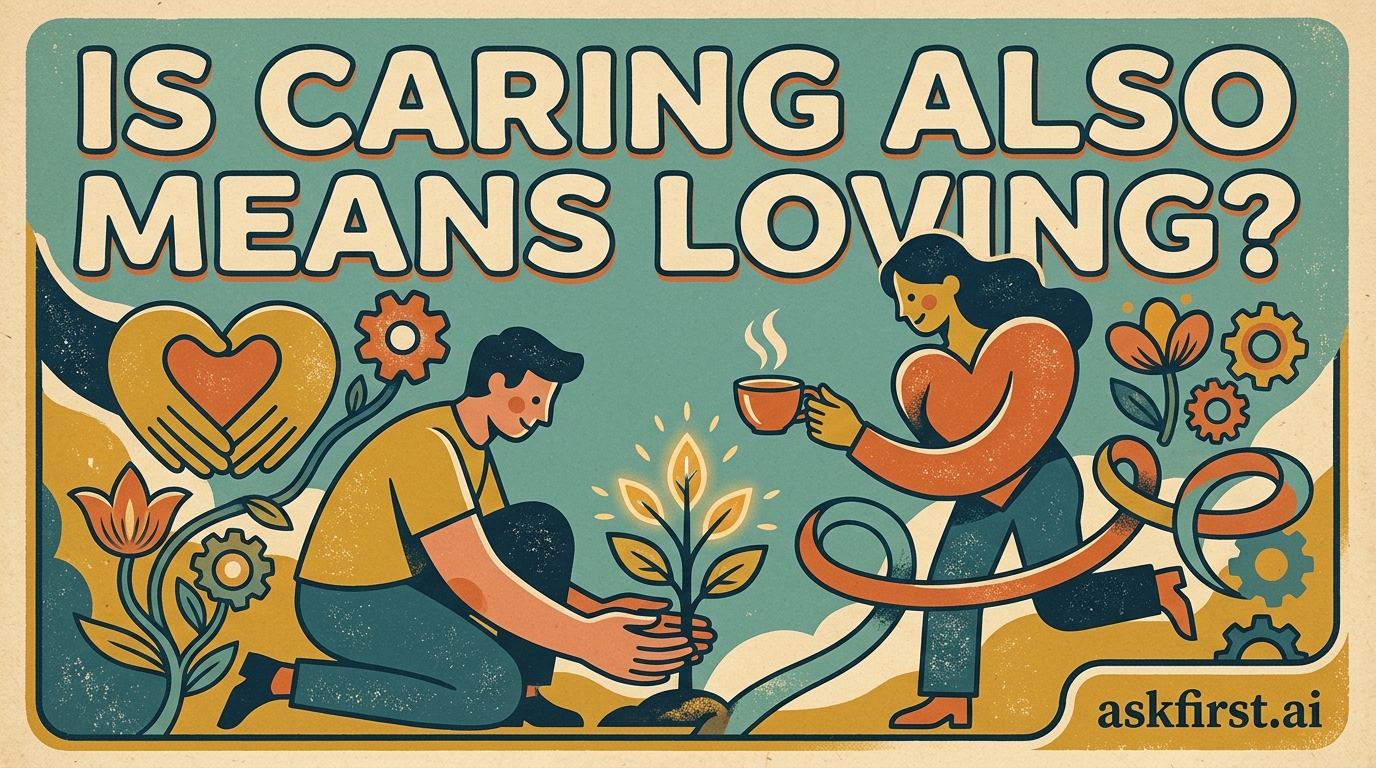
When caring and loving intersect, caring becomes the "language" through which love is expressed. In a long-term partnership, for instance, love might be the internal state of affection, but the daily acts of caring—making coffee, listening to a partner’s work frustrations, or providing support during an illness—are the concrete manifestations of that love.
Consider the distinction in behavioral terms:
- Caring without Love: An act of charity. You provide resources to a stranger because you recognize their humanity, but you do not experience a personal, transformative bond with them.
- Love without Caring: A theoretical impossibility. If one claims to love another but ignores their well-being, refuses to assist them in times of need, or remains indifferent to their suffering, that love is likely mere infatuation or a narcissistic projection. As Noddings notes, "caring" is the practical manifestation that validates the existence of "love."
Concrete Examples of the Distinction
To better visualize this, consider the relationship between a mentor and a student. A mentor cares deeply about the student's academic progress and career trajectory. They invest time, provide resources, and offer guidance. However, this is not "love" in the romantic or familial sense; it is a professionalized form of care aimed at the student's self-actualization.
Conversely, think of a parent-child bond. The parent cares for the child's survival (feeding, clothing, housing). If that were all, the child would be physically healthy but emotionally starved. The "love" component is the warmth, the psychological attunement, and the unconditional acceptance that goes beyond the functional requirements of care.
Conclusion
Caring is the foundation upon which love is built, but it is not the totality of love. Caring is the behavioral expression of concern, while love is the emotional and existential commitment to another person’s existence. You can certainly care for someone you do not love, but it is impossible to truly love someone without also caring for them. Caring is the vessel, and love is the substance that fills it. To conflate the two is to overlook the profound depth of human connection, which requires both the discipline of action and the vulnerability of the heart.