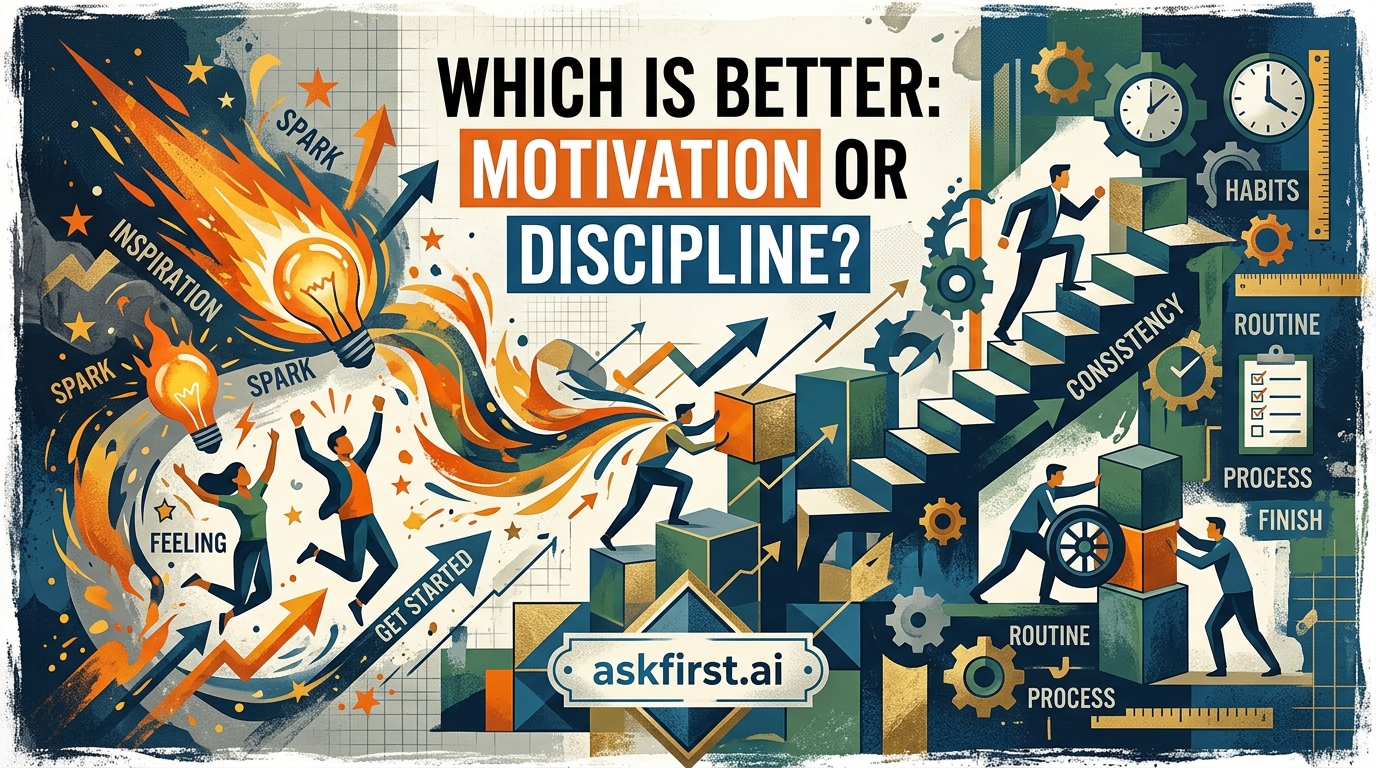
The Eternal Dichotomy: Motivation versus Discipline
In the pursuit of long-term goals, whether in business, athletics, or personal development, the debate between motivation and discipline is as old as the concepts themselves. Many individuals mistakenly believe that motivation is the fuel required to reach the pinnacle of success, while others argue that discipline is the only reliable engine. To understand which is "better," we must first deconstruct the psychological mechanics behind both and analyze why relying on one to the exclusion of the other is a recipe for stagnation.
The Fleeting Nature of Motivation
Motivation is an emotional state—a surge of enthusiasm, inspiration, or desire that compels an individual to act. It is often triggered by external stimuli, such as a motivational speaker, a compelling book, or a sudden realization of one’s potential. Psychologists like Edward Deci and Richard Ryan, in their seminal work on Self-Determination Theory, explain that motivation can be extrinsic (driven by rewards) or intrinsic (driven by the inherent satisfaction of the task).
The primary limitation of motivation is its volatility. It is biologically tied to dopamine release, which is inherently transient. You might feel "motivated" to start a fitness journey on January 1st because of the novelty of a new year, but when the physical discomfort of exercise sets in, that motivation evaporates. As James Clear notes in his best-selling book Atomic Habits, "Motivation is overrated. Environment often matters more." Relying on motivation is akin to waiting for the weather to be perfect before deciding to sail; it leaves your progress entirely at the mercy of your current mood or energy levels.
The Unyielding Reliability of Discipline
Discipline, by contrast, is not an emotion; it is a practice. It is the ability to execute a task regardless of how one feels in the moment. If motivation is the spark, discipline is the steady, controlled burning of the fuel. In his book The Road Less Traveled, psychiatrist M. Scott Peck defines discipline as "the basic set of tools we require to solve life's problems." He argues that without discipline, we cannot solve anything; with only total discipline, we can solve only some things.
Discipline operates on the principle of identity rather than impulse. When a professional pianist practices for four hours despite being exhausted, they are not doing so because they are "motivated" by the music in that specific moment. They are doing so because they have cultivated an identity as a disciplined musician. This aligns with the research of Angela Duckworth, a professor at the University of Pennsylvania and author of Grit: The Power of Passion and Perseverance. Duckworth’s research consistently demonstrates that "grit"—a combination of passion and long-term perseverance—is a far more accurate predictor of success than raw talent or intermittent bursts of motivation.
Why Discipline Outperforms Motivation
To understand why discipline holds the upper hand, consider the "Law of Diminishing Returns" applied to human willpower. Motivation requires a high cognitive load; you have to constantly "hype yourself up" to perform a task. Discipline, however, eventually crystallizes into habit. Once a behavior becomes automatic—a concept explored by Charles Duhigg in The Power of Habit—the mental energy required to initiate the task drops significantly.
Concrete Examples:
- The Athlete: An Olympic swimmer does not wake up at 4:00 AM because they are "motivated" to jump into freezing water. They do it because their training schedule is a non-negotiable part of their identity. Discipline acts as a safety net for the days when the motivation is absent.
- The Entrepreneur: A business owner who only works when they feel "inspired" will eventually fail during the inevitable periods of market downturn or personal burnout. The disciplined entrepreneur treats their business as a series of obligations, ensuring that even on "bad days," the core operations continue.
Integrating the Two: The Path to Mastery
While discipline is objectively more reliable, labeling it as "better" does not mean motivation is useless. Motivation is excellent for starting a new endeavor or pivoting toward a new goal. It provides the initial burst of energy needed to overcome inertia. However, the transition from "starting" to "sustaining" is where discipline must take over.
The most successful individuals utilize a framework of "Disciplined Motivation." They use discipline to build systems (habits, routines, environments) that make the desired behavior easier to perform, which in turn creates small wins. These small wins provide a feedback loop that generates new motivation. Thus, discipline creates the conditions under which motivation can thrive, rather than the other way around.
Conclusion
If one must choose, discipline is unequivocally superior to motivation. Motivation is a fickle guest; it arrives unannounced and leaves just as quickly. Discipline is a permanent resident. It is the architecture of success. While motivation can color our journey with excitement, discipline provides the foundation upon which that journey is built. By focusing on building habits, managing your environment, and adhering to a pre-defined schedule regardless of your emotional state, you move from being a slave to your feelings to being the architect of your own achievements. Mastery is not found in the fleeting high of inspiration, but in the quiet, consistent application of effort when no one is watching and when you least want to do the work.