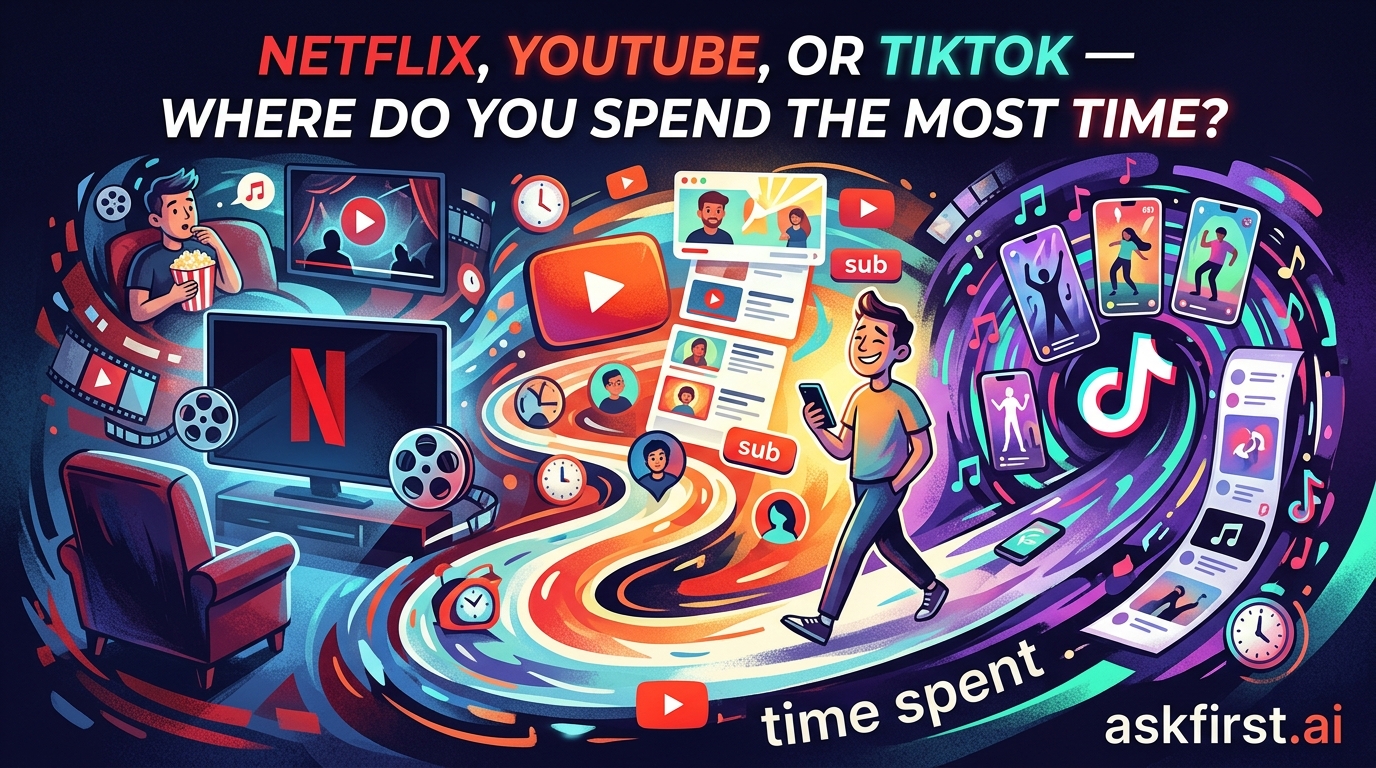
In the current digital landscape, the battle for human attention is the most lucrative and fiercely contested theater of the 21st century. While Netflix, YouTube, and TikTok all serve as primary conduits for media consumption, they occupy fundamentally different psychological and utility niches. To understand where one spends the most time is to understand how modern individuals balance the need for deep immersion, educational utility, and rapid-fire stimulation.
The Netflix Paradigm: The Architecture of Immersive Escapism
Netflix represents the "lean-back" experience. It is the successor to traditional broadcast television, optimized for long-form narrative consumption. When a user engages with Netflix, they are typically committing to a temporal investment ranging from thirty minutes to several hours. The platform utilizes algorithmic recommendations—often referred to as the "Netflix Prize" legacy—to keep users within its ecosystem through high-production-value content.
According to Reed Hastings and Erin Meyer in their seminal book No Rules Rules: Netflix and the Culture of Reinvention, the platform’s success is predicated on a radical corporate culture that prioritizes content density over volume. For the viewer, this manifests as a curated environment where the goal is "binge-watching," a phenomenon that essentially collapses the traditional episodic release schedule. Users spend significant time here when they seek high-quality storytelling or the "water cooler" cultural capital associated with trending shows like Stranger Things or The Crown. The time spent on Netflix is high-friction but high-reward, functioning as a primary tool for emotional regulation and evening decompression.
The YouTube Ecosystem: The Library of Alexandria Reimagined
YouTube occupies a unique space as both a search engine and a social network. Unlike Netflix, which is curated by executives, YouTube is a democratization of media. As documented by Kevin Roose in Futureproof: 9 Rules for Humans in the Age of Automation, YouTube has become the default university for the modern era. Whether one is learning how to repair a faucet, analyzing complex geopolitical tensions, or watching long-form video essays, the platform provides utility that is unmatched by its competitors.
The time spent on YouTube is often "intentional." Users migrate to YouTube when they have a specific query or a desire for deep-dive content that exceeds the scope of a standard social media post. Furthermore, the rise of the "Creator Economy"—a term popularized by venture capitalist Li Jin—has shifted the platform toward community-centric content. Users spend hours here because the feedback loop between the creator and the audience fosters a sense of intimacy and parasocial loyalty that Netflix, with its polished, impersonal veneer, simply cannot replicate.
The TikTok Phenomenon: The Neuroscience of Variable Rewards
TikTok represents the evolution of the "lean-forward" experience. It is perhaps the most efficient attention-capture machine ever designed. The platform’s "For You Page" (FYP) utilizes a sophisticated recommendation engine that relies on interest-based signals rather than social graphs. By serving content in 15-to-60-second increments, TikTok exploits the psychological principle of "variable ratio schedules," a concept famously explored by B.F. Skinner in his research on operant conditioning.
In The Age of Surveillance Capitalism, Shoshana Zuboff explains how platforms like TikTok harvest behavioral surplus to predict and modify user intent. Because the barrier to entry for content is so low, the variety of the feed is infinite. Users often find themselves in a "flow state" where time perception is distorted; this is known as the "infinite scroll" effect. TikTok captures the most "micro-time"—the five minutes spent in a grocery line, the transition between meetings, or the moments before sleep. While Netflix is for the evening, TikTok is for the interstices of the day.
Comparative Analysis: Where Does the Time Go?
When analyzing the distribution of time, a clear pattern emerges based on the user's psychological state:
- Intentionality: If the goal is education or skill acquisition, YouTube is the undisputed leader. Its search functionality and library depth allow for a level of mastery that is impossible on the other two platforms.
- Narrative Depth: If the goal is escapism and communal cultural experience, Netflix remains the gold standard. Its commitment to "prestige" content keeps users engaged for longer, uninterrupted sessions.
- Stimulation and Velocity: If the goal is immediate dopamine gratification or staying abreast of ephemeral trends, TikTok dominates. It is the high-frequency trader of the attention economy.
Conclusion
The question of where one spends the most time is ultimately a reflection of one's current priorities. A professional seeking to master a new software program will spend their hours on YouTube. A person experiencing high levels of stress may gravitate toward the predictable, high-budget comfort of Netflix. Meanwhile, the individual seeking social connection or rapid-fire entertainment will find themselves ensnared by the algorithmic precision of TikTok.
We are no longer passive consumers; we are active participants in an attention economy that maps our preferences with surgical accuracy. Whether one prefers the deep-dive library of YouTube, the narrative theater of Netflix, or the hyper-fast feedback loops of TikTok, it is clear that these platforms have become the fundamental infrastructure of our leisure and learning. The choice of platform is not merely a matter of preference—it is a reflection of how we choose to construct our reality in the digital age.