The Psychology of Wealth: Does "Dressing the Part" Actually Drive Financial Success?
For decades, the adage "dress for the job you want, not the job you have" has permeated corporate culture, suggesting that our outward appearance acts as a catalyst for internal and external shifts in status. In recent years, this concept has evolved into the "billionaire aesthetic"—a shift away from overt branding toward "stealth wealth," characterized by high-quality, understated garments. But does donning the uniform of the ultra-wealthy actually accelerate the accumulation of capital, or is it merely a costly performance of success?
The Signaling Theory and Socioeconomic Perception
At the heart of the debate is Signaling Theory, a concept deeply explored by economist Michael Spence in his seminal 1973 work, Job Market Signaling. Spence argued that individuals use signals—such as education, certifications, and appearance—to convey hidden information to others. In the context of wealth, dressing like a billionaire acts as a signal of high competence, stability, and belonging to an elite tier of society.
When you dress in a way that aligns with the visual codes of the ultra-wealthy, you trigger a psychological phenomenon known as the Halo Effect. First coined by psychologist Edward Thorndike in his 1920 paper, A Constant Error in Psychological Ratings, the Halo Effect suggests that our overall impression of a person influences how we feel and think about their character. If an individual is perceived as "wealthy" due to their attire, observers are more likely to subconsciously attribute qualities like intelligence, reliability, and leadership potential to them. In high-stakes business environments—such as venture capital pitches or luxury real estate negotiations—this initial perception can be the deciding factor in whether a contract is signed or a partnership is formed.
The "Enclothed Cognition" Phenomenon
Beyond how others perceive you, there is the matter of how you perceive yourself. Researchers Hajo Adam and Adam Galinsky introduced the term "Enclothed Cognition" in their 2012 study published in the Journal of Experimental Social Psychology. Their research demonstrated that the clothes we wear have a systematic influence on our psychological processes.
When a person wears high-quality, structured, or "professional" clothing, their cognitive focus tends to shift. They become more detail-oriented, exhibit higher levels of confidence, and are more likely to engage in "abstract thinking"—a trait essential for long-term strategic planning and wealth management. By dressing like a billionaire, you are effectively "priming" your brain to act with the discipline and gravity associated with the role of a high-net-worth individual. It is not that the fabric itself generates money, but rather that the garment serves as a tactile reminder of one's goals and expectations.
The Shift from "Logomania" to "Stealth Wealth"
It is crucial to distinguish between dressing like a "nouveau riche" individual and dressing like a "billionaire." Modern billionaires—as observed in the wardrobes of figures like Mark Zuckerberg, who famously wears plain grey Brunello Cucinelli t-shirts, or the late Steve Jobs with his iconic Issey Miyake turtlenecks—prioritize intentionality over exhibitionism.
This style, often termed "Quiet Luxury," is rooted in the philosophy of The Theory of the Leisure Class by sociologist Thorstein Veblen. Veblen distinguished between "conspicuous consumption" (buying items to show off) and the subtle, high-quality aesthetics that characterize the truly powerful. Dressing like a billionaire today means focusing on:
- Fit and Tailoring: A $500 suit that is custom-tailored to your exact measurements will always project more power than a $5,000 suit off the rack that fits poorly.
- Material Integrity: High-quality fabrics like cashmere, merino wool, and Egyptian cotton signal an appreciation for longevity and value—traits investors look for in business partners.
- Minimalism: By removing the "noise" of logos and patterns, you command attention through your presence rather than your attire, which is a hallmark of those who no longer feel the need to prove their status.
The Dangers of the "Fake It Till You Make It" Trap
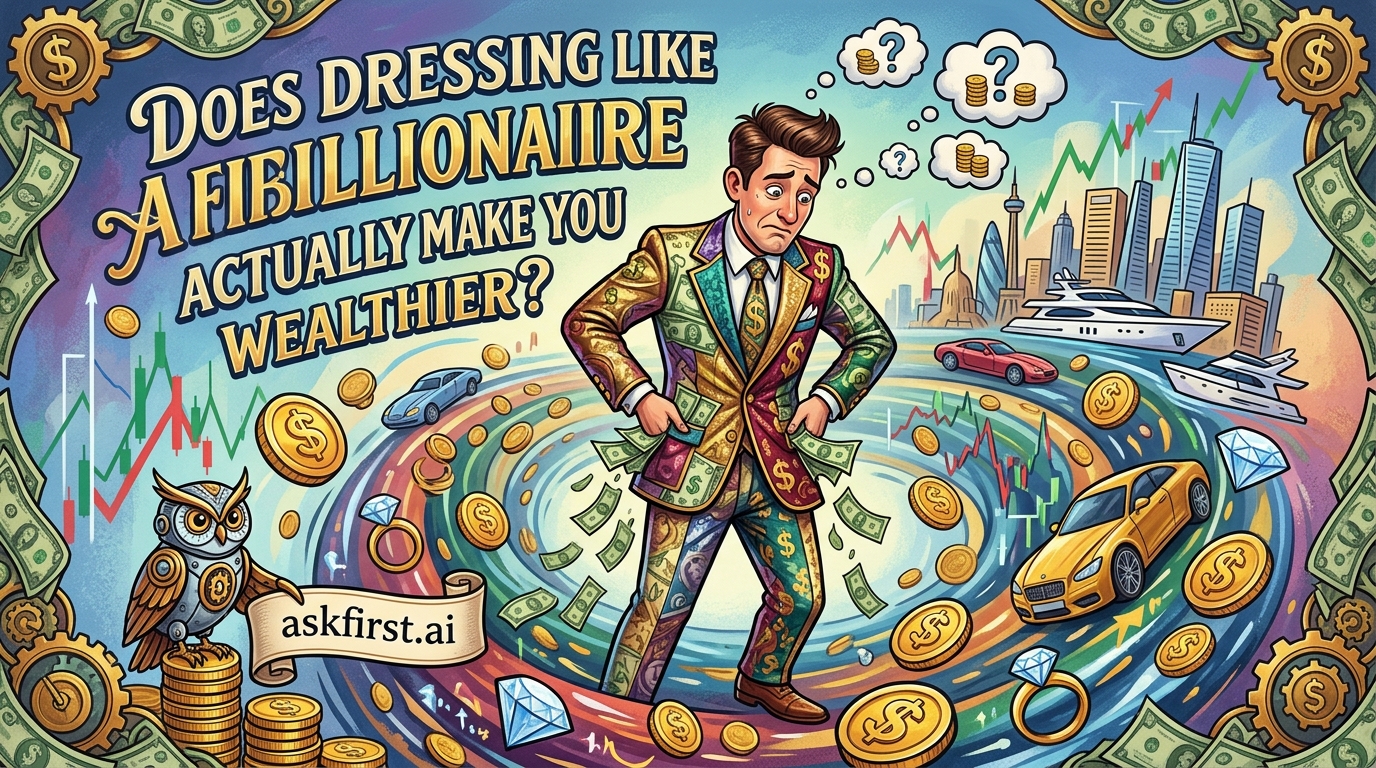
While there is undeniable utility in dressing the part, there is a significant financial risk in attempting to mirror the billionaire lifestyle before the wealth is actually there. This is the "Lifestyle Creep" trap. If your spending on clothing outpaces your income, you are actively eroding your capital, which is the antithesis of wealth building.
True wealth is defined by the gap between your income and your expenses. If you spend your seed capital on a luxury wardrobe, you are sacrificing the very liquidity that could be used for investments, scaling a business, or building a portfolio. As noted by Thomas J. Stanley in his classic study The Millionaire Next Door, the vast majority of self-made millionaires do not live in mansions or wear designer labels; they live well below their means.
Conclusion
Dressing like a billionaire does not generate wealth in a vacuum. It is not a magical talisman that attracts money. However, it acts as a strategic tool. When used correctly, it functions as a social lubricant that builds trust with peers and a psychological anchor that stabilizes your professional mindset. The key is to adopt the discipline of the billionaire—the focus on quality, the rejection of unnecessary clutter, and the commitment to excellence—rather than merely the cost of their clothes. If your attire serves to open doors and sharpen your focus, it is an investment. If it serves only to mask a lack of substance, it is a liability. Focus on the substance first, and let your appearance be the quiet, professional reflection of that reality.