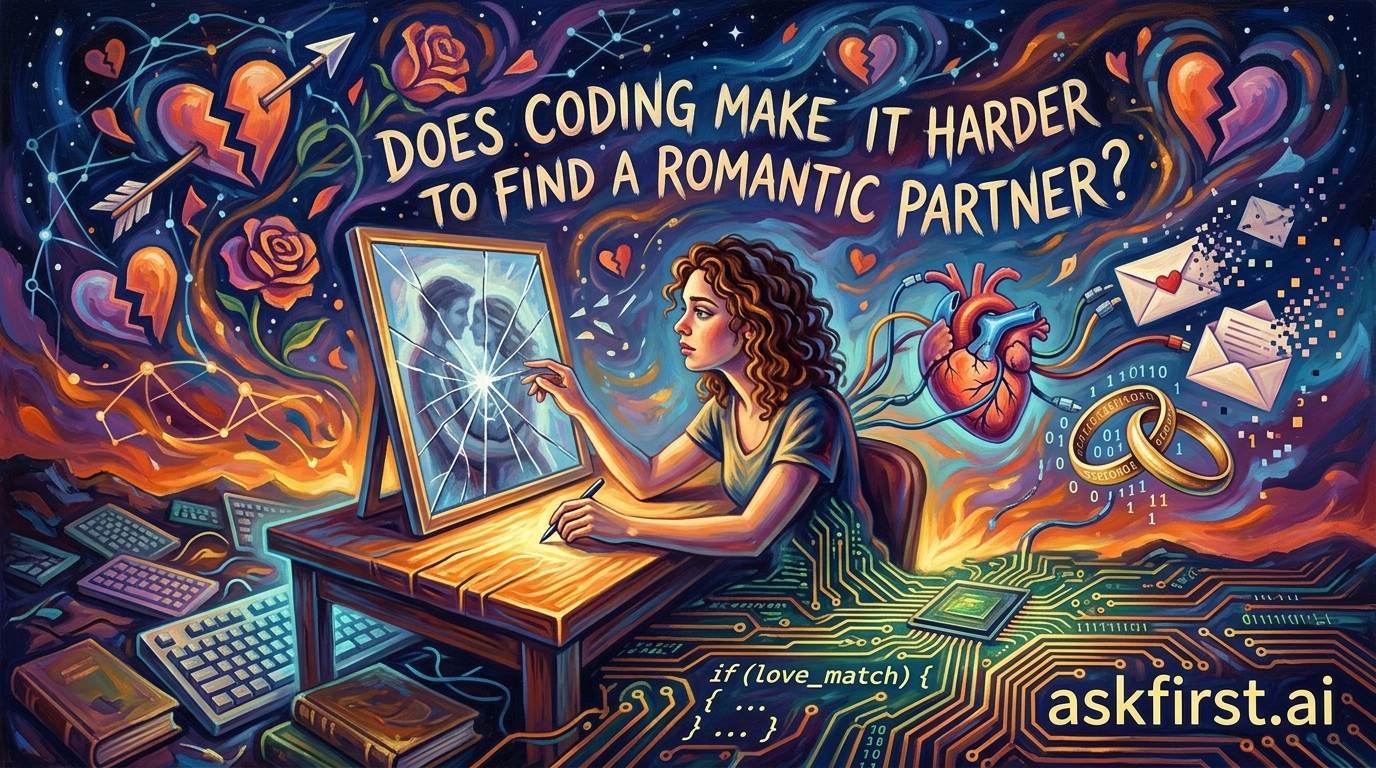
The question of whether coding—or, more broadly, a career in software engineering—acts as a barrier to romantic success is a topic that sits at the intersection of sociology, psychology, and modern workplace culture. While popular media often paints the "coder" as a socially isolated individual, the reality is far more nuanced. Data suggests that the impact of coding on romantic life is not inherent to the profession itself, but rather a byproduct of lifestyle choices, cognitive habits, and the specific demands of the tech industry.
The Myth of the Solitary Coder
For decades, cultural tropes in films like The Social Network or television series like Silicon Valley have perpetuated the archetype of the socially inept programmer. However, this is largely a stereotype. In his seminal work, The Cuckoo's Egg, astronomer and computer scientist Clifford Stoll documented the early days of networked computing, showing that while programmers were often deeply focused, they were frequently part of highly collaborative, tight-knit communities.
The misconception that coding makes finding a partner harder often stems from the "Flow State" phenomenon. According to psychologist Mihaly Csikszentmihalyi in his book Flow: The Psychology of Optimal Experience, deep engagement in a task—such as debugging complex code—can lead to a loss of self-consciousness and a distortion of time. When a developer spends twelve hours a day in a flow state, their social battery may be depleted by the evening. This isn't a lack of desire for romance; it is a physiological and psychological exhaustion that makes the high-effort process of dating feel like an additional, overwhelming task.
The Impact of Lifestyle and Cognitive Load
Coding is a high-cognitive-load profession. It requires intense logical processing, constant problem-solving, and often, an environment that prioritizes asynchronous communication (Slack, Jira, GitHub) over face-to-face interaction.
- The Sedentary Nature of the Work: Many developers spend the vast majority of their waking hours in front of a screen. This sedentary lifestyle can inadvertently lead to social withdrawal. If an individual spends eight to ten hours coding, then spends their leisure time gaming or building side projects, they are effectively shrinking their "social surface area"—the number of opportunities they have to meet potential partners.
- The "Optimization" Trap: Software engineers are trained to optimize systems. When this mindset is applied to dating, it can be detrimental. In the book Algorithms to Live By: The Computer Science of Human Decisions by Brian Christian and Tom Griffiths, the authors discuss the "Optimal Stopping Theory." They argue that treating dating like an optimization problem—constantly seeking the "perfect" match based on data points—can lead to the "Paradox of Choice," a concept popularized by Barry Schwartz. When you have too many options, you become less satisfied with any single choice, which can lead to serial dating without ever forming a deep, long-term connection.
The Advantages: Stability and Shared Interests
Conversely, a career in software development offers significant advantages that can actually improve one’s romantic prospects.
- Financial and Lifestyle Stability: Coding is one of the most lucrative and stable professions in the modern global economy. Financial stress is cited by the Gottman Institute—led by Drs. John and Julie Gottman—as one of the leading causes of relationship dissolution. The stability provided by a tech career can create a foundation where partners are less likely to experience the friction caused by economic anxiety.
- The Rise of Tech-Centric Social Circles: With the explosion of tech hubs in cities like San Francisco, Austin, and Berlin, the "tech bubble" provides a massive pool of potential partners who share similar values, intellectual interests, and lifestyle goals. Shared professional experiences can provide an instant bridge for communication, making the initial stages of dating significantly easier.
Navigating the Balance
To mitigate the potential negative effects of the profession, many successful software engineers adopt intentional habits. The key is to decouple one’s identity from the terminal.
- Diversifying Interests: Engage in hobbies that require physical presence and social interaction—such as team sports, hiking groups, or volunteer organizations. This forces the brain out of the "logical/binary" mode of coding and into the "emotional/spontaneous" mode required for dating.
- Setting Boundaries: As Cal Newport argues in his book Deep Work, the ability to focus is a superpower, but it must be balanced with "shallow work" and genuine rest. Setting a hard "stop time" for coding—where the laptop is closed and the work persona is put away—is essential for mental health and social availability.
Conclusion
Coding does not inherently make it harder to find a romantic partner; rather, it introduces specific challenges related to time management, social fatigue, and the temptation to apply algorithmic logic to human emotions. When a developer treats their social life with the same level of intentionality as they treat a codebase—prioritizing communication, setting healthy boundaries, and ensuring they exist in environments where they can meet new people—the profession can actually serve as a stable, rewarding backdrop for a healthy relationship. The limitations are not in the code, but in the lifestyle choices that often surround the craft. By balancing the logical demands of the screen with the messy, beautiful, and non-optimized nature of human connection, the "coder" is just as capable of finding a meaningful partner as anyone else.