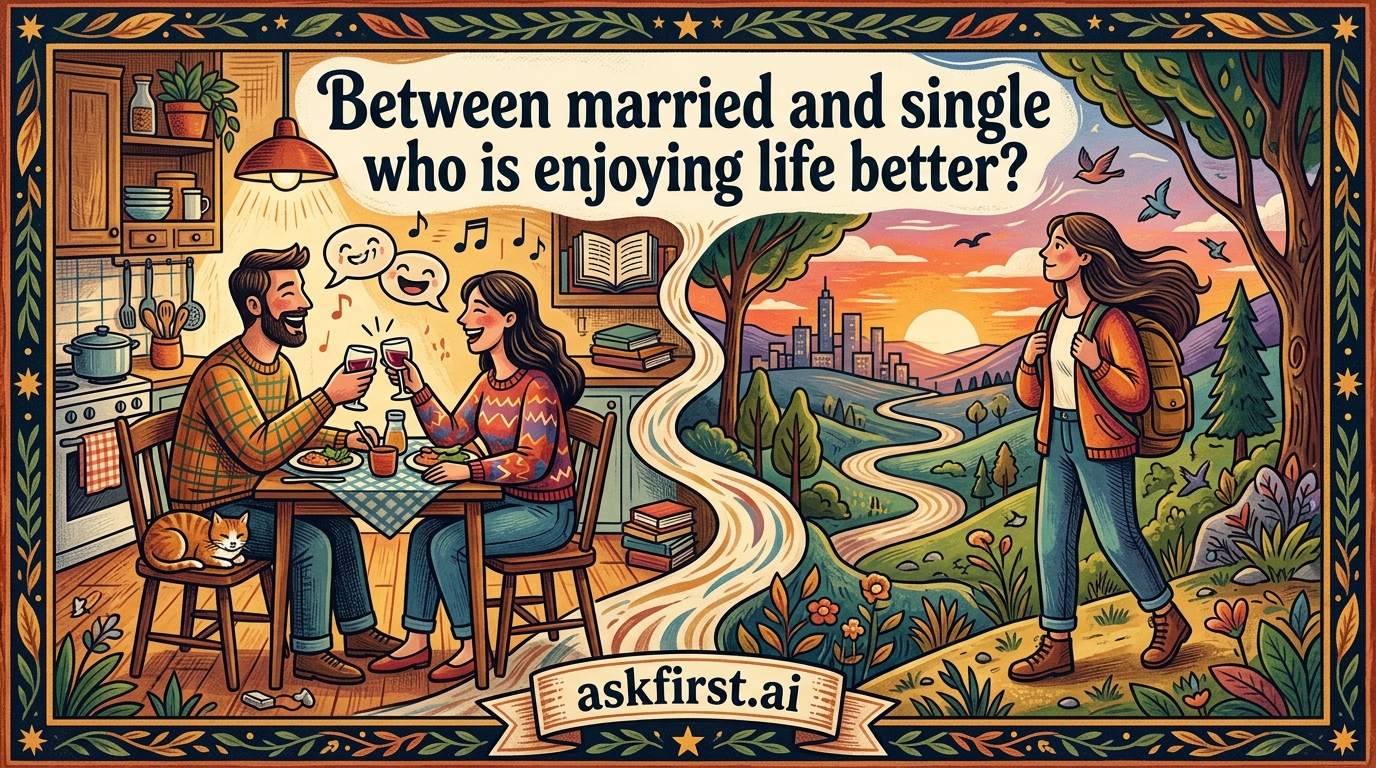
The debate regarding whether married individuals or their single counterparts experience higher levels of life satisfaction is a perennial subject in sociology, psychology, and economics. For decades, researchers have attempted to quantify "happiness" across different relationship statuses, leading to a complex landscape of data that suggests the answer is not a binary choice, but rather a reflection of individual priorities, social support systems, and cultural context.
The "Marriage Advantage": Stability and Resource Pooling
Historically, the dominant narrative in social science has been the "marriage advantage." Scholars such as Linda Waite and Maggie Gallagher, in their seminal work The Case for Marriage: Why Married People are Happier, Healthier, Better Off Financially, and Better Off Sexually, argue that the institution of marriage provides structural benefits that contribute to overall well-being.
The primary argument for the married cohort is the concept of resource pooling. Two individuals sharing a household benefit from economies of scale regarding housing, utilities, and grocery costs. This financial stability often reduces stress and allows for long-term investments in health and security. Furthermore, married individuals frequently report higher levels of "social capital"—a built-in support system that acts as a buffer during life’s crises. According to longitudinal studies conducted by the General Social Survey (GSS) in the United States, married people consistently report higher levels of happiness compared to those who are divorced, widowed, or never married, largely due to the presence of a primary confidant and emotional anchor.
The Rise of the "Solo Life": Autonomy and Self-Actualization
In contrast, the narrative surrounding singlehood has undergone a radical transformation. Sociologist Bella DePaulo, author of Singled Out: How Singles Are Stereotyped, Stigmatized, and Ignored, and Still Live Happily Ever After, challenges the traditional view that marriage is the only path to a fulfilled life. DePaulo’s research highlights that single people often possess higher levels of autonomy and self-determination.
For many, the "single life" is not a transition phase, but a deliberate lifestyle choice that prioritizes personal growth, career advancement, and the cultivation of deep, non-romantic friendships. Research published in the Journal of Social and Personal Relationships suggests that single people are often more likely to maintain wider social networks and engage more actively with their communities than their married counterparts, who may fall into the trap of "dyadic withdrawal"—the tendency for couples to isolate themselves from broader social circles. For the single individual, happiness is frequently derived from the freedom to pursue interests without the need for compromise, leading to a profound sense of self-actualization.
The Role of Subjective Well-Being and Life Stages
To understand who is "enjoying life better," one must look at the specific life stage of the individual. In early adulthood, the single life is often associated with high levels of exploration and social variety. Conversely, in middle and later life, the companionship provided by a healthy marriage can become a significant driver of life satisfaction.
However, it is critical to address the quality of the relationship. A volatile or unhappy marriage is consistently shown to have a more detrimental impact on health and mental well-being than being single. As noted by psychotherapist Esther Perel in her work The State of Affairs, the expectations we place on marriage today—demanding that a partner be our best friend, lover, confidant, and co-parent—are historically unprecedented and can lead to immense pressure. Therefore, a single person who cultivates a rich, independent life often reports higher life satisfaction than an individual trapped in a high-conflict or emotionally distant marriage.
Cultural and Economic Influences
The comparison is also deeply affected by the cultural environment. In collectivist societies, the social pressure to marry is intense, and the stigma against being single can negatively impact the reported happiness of those without a partner. In contrast, in more individualistic, post-industrial societies, the "singlehood" experience is increasingly normalized, allowing individuals to thrive without the societal mandate of a wedding ring.
Furthermore, economic factors play a vital role. In environments where the cost of living is prohibitively high, the single life can be a source of significant anxiety. Conversely, in regions with robust social safety nets and a culture of communal living, single individuals enjoy a level of freedom and quality of life that rivals any married household.
Conclusion
Ultimately, the question of who enjoys life better cannot be answered with a universal "married" or "single." The data suggests that happiness is less a function of status and more a function of connection and autonomy.
Married individuals who prioritize communication, shared goals, and mutual respect reap the benefits of stability and emotional intimacy. Single individuals who cultivate meaningful friendships, pursue personal passions, and embrace their independence enjoy the benefits of self-determination and social breadth. The most satisfied people, regardless of their marital status, are those who feel a sense of purpose, maintain strong social ties, and have the agency to design a life that aligns with their personal values. Whether one is married or single, the secret to enjoying life appears to lie in the quality of the bonds one forms and the intentionality with which one lives.