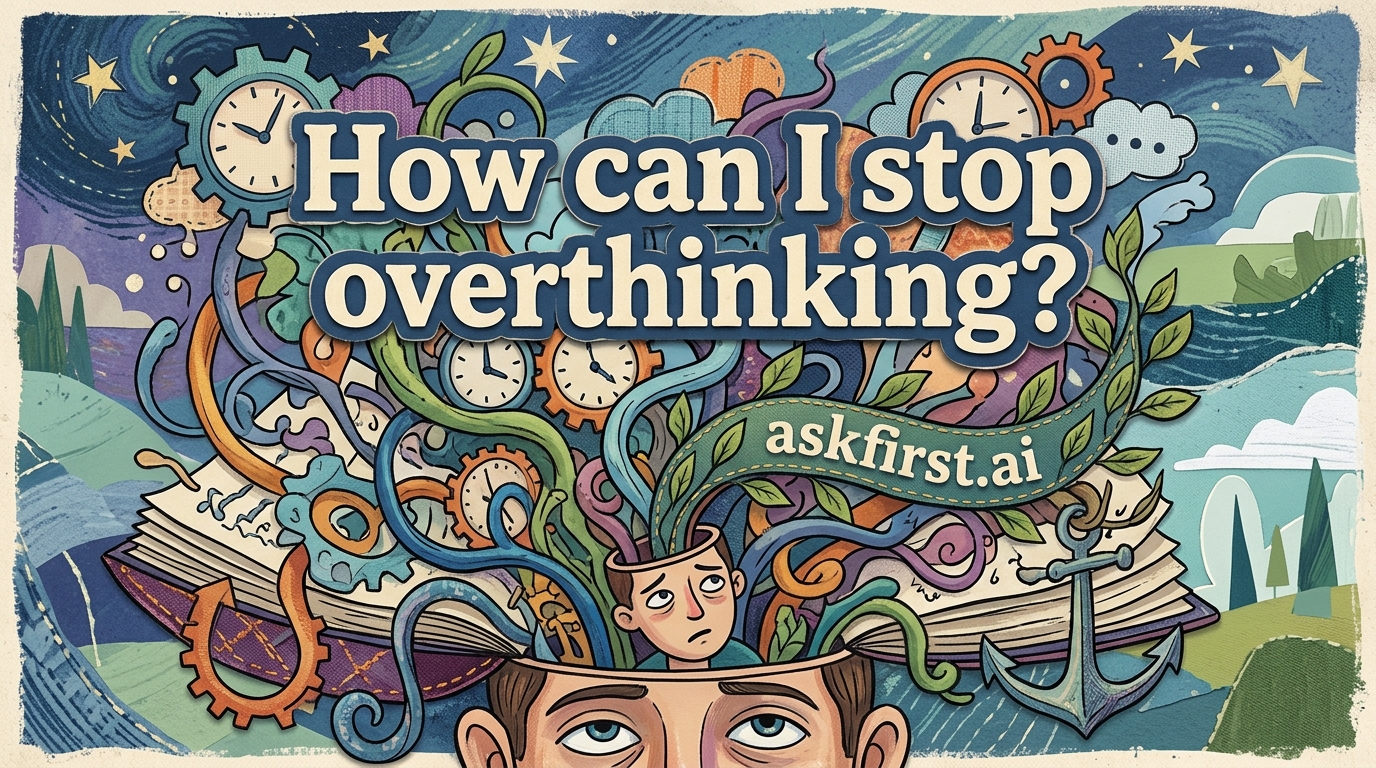
Overthinking, often clinically referred to as rumination, is a psychological pattern characterized by the repetitive dwelling on negative thoughts, past mistakes, or future anxieties. It is not merely "thinking too much"; it is an unproductive cycle that drains cognitive resources, increases cortisol levels, and hampers one’s ability to make decisive actions. To break free from this mental loop, one must adopt a multi-faceted approach involving cognitive restructuring, mindfulness, and behavioral intervention.
Understanding the Mechanism of Rumination
At its core, overthinking is a maladaptive coping mechanism. The brain attempts to solve an emotional problem by replaying scenarios, believing that if we think about it long enough, we will find a solution or prevent a future catastrophe. In her seminal work "Women Who Think Too Much," Dr. Susan Nolen-Hoeksema of Yale University explains that rumination is essentially a "thought trap." She notes that because the brain is wired to prioritize threats, it focuses intently on negative stimuli. When we ruminate, we are essentially training our neural pathways to favor anxiety over resolution.
The physiological impact is profound. Chronic overthinkers often experience "analysis paralysis," where the prefrontal cortex—the area responsible for decision-making—becomes overwhelmed by the noise of the amygdala, the brain's emotional alarm system. To stop this, you must treat your mind like an engine that needs to be shifted out of a stuck gear.
Implementing Cognitive Reframing
Cognitive Behavioral Therapy (CBT) provides the most robust framework for dismantling overthinking. The primary technique here is cognitive reframing. This involves identifying "cognitive distortions"—irrational thought patterns such as catastrophizing (assuming the worst outcome) or black-and-white thinking.
- Label the Thought: When you feel the spiral beginning, pause and name it. Say to yourself, "I am currently ruminating." This creates a meta-cognitive distance, separating your identity from the thought.
- Challenge the Evidence: Ask yourself, "What is the concrete evidence that this worst-case scenario will happen?" Often, you will find that your fears are based on feelings rather than empirical reality.
- The "So What?" Technique: Push your fear to its logical conclusion. If the worst happens, how would you handle it? By visualizing a plan for the outcome, you strip the fear of its power.
Dr. David Burns, in his classic book "Feeling Good: The New Mood Therapy," emphasizes that thoughts are not facts. By documenting your thoughts in a "Triple Column Technique" (Automatic Thought, Cognitive Distortion, Rational Response), you can systematically train your brain to prioritize logic over anxiety.
The Power of "Scheduled Worrying" and Mindfulness
One of the most effective behavioral interventions is the concept of "Scheduled Worrying." Instead of allowing anxiety to permeate your entire day, designate a specific 15-minute window—perhaps at 5:00 PM—to write down your worries. If a troubling thought arises at 10:00 AM, acknowledge it, record it for your later session, and return to your current task. This provides the brain with a sense of control and containment.
Mindfulness, contrary to popular belief, is not about "clearing your mind." It is about changing your relationship with your thoughts. In "The Mindfulness Workbook for OCD" by Jon Hershfield and Tom Corboy, the authors suggest that observing thoughts like "clouds passing in the sky" allows you to notice them without needing to engage with or "solve" them. By practicing Diaphragmatic Breathing or the 5-4-3-2-1 Grounding Technique (naming 5 things you see, 4 you can touch, 3 you hear, 2 you smell, and 1 you can taste), you pull your consciousness out of the abstract future and anchor it firmly in the physical present.
Moving from Thought to Action
Overthinking is often a defense mechanism against the discomfort of taking action. When you are stuck in a loop, you are essentially seeking a guarantee of success before you begin. However, as Dr. Jordan Peterson argues in "12 Rules for Life," the chaos of the world cannot be managed through contemplation alone. Action is the only antidote to anxiety.
- The Two-Minute Rule: If a task is causing you to overthink, ask if it can be done in two minutes. If so, do it immediately.
- Decisive Limits: Set a strict time limit for making decisions. If you are choosing a restaurant or a project direction, give yourself ten minutes. Once the timer dings, commit to a path. The cost of a "wrong" decision is almost always lower than the cost of prolonged indecision.
Conclusion
Stopping the cycle of overthinking is not a one-time event; it is a discipline. It requires the constant vigilance of a gardener weeding a plot. By utilizing the cognitive tools of reframing, the behavioral containment of scheduled worrying, and the grounding power of mindfulness, you can reclaim your mental bandwidth. You must accept that uncertainty is a permanent feature of existence and that the goal is not to eliminate all doubt, but to act effectively despite its presence. Start today by labeling your next intrusive thought, challenging its premise, and taking one small, tangible action toward your goal. Over time, these habits will rewire your brain, transforming you from a passive victim of your thoughts into an active architect of your reality.