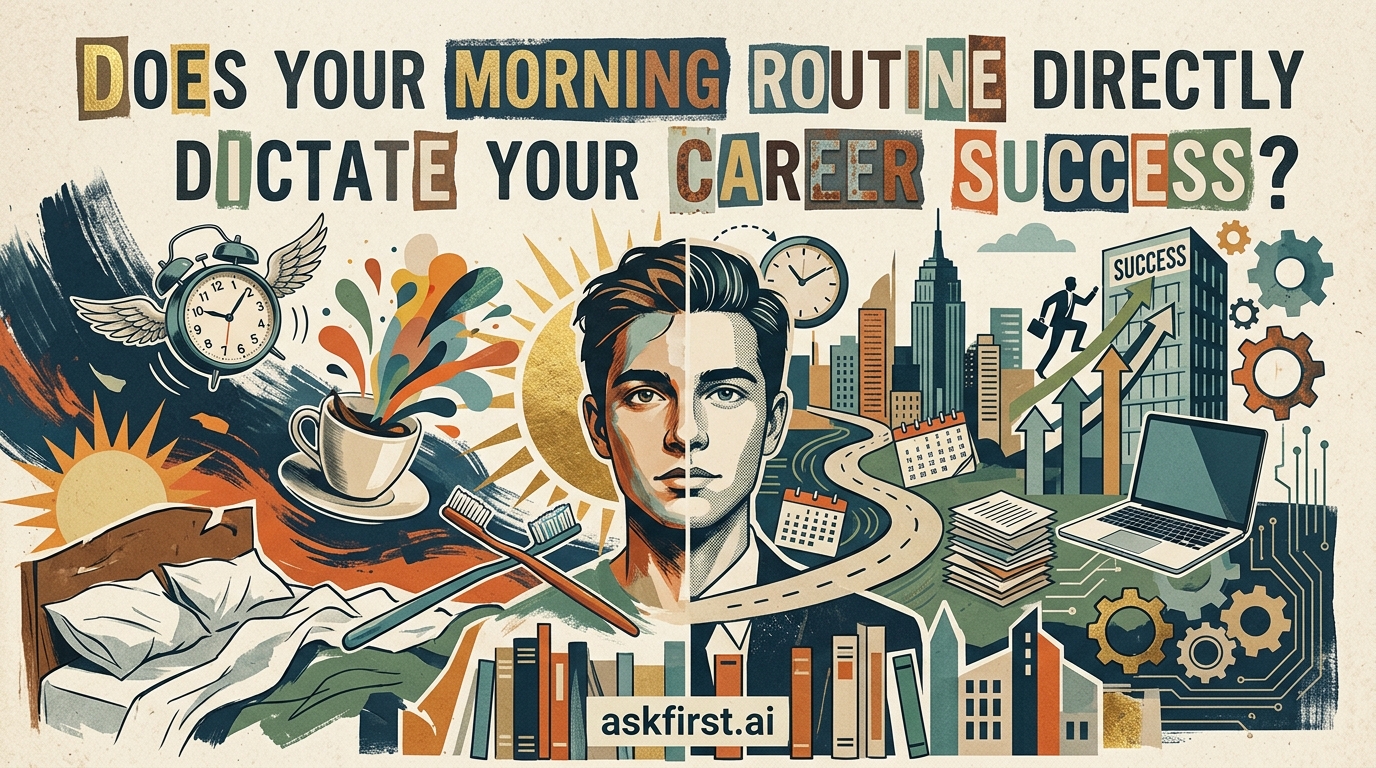
The Morning Routine Myth: Unpacking the Correlation Between AM Habits and Professional Performance
There is a prevailing narrative in modern productivity culture suggesting that the secret to becoming a CEO or a titan of industry lies exclusively within the first sixty minutes of the day. From 'The 5 AM Club' to the obsession with ice baths and journaling at sunrise, the belief that a rigid morning routine dictates career success has become a cornerstone of professional self-help literature. However, a deeper analysis reveals that while the structure of a morning can influence physiological readiness, it is rarely the singular, direct cause of career advancement.
The Psychological Foundation of Rituals
Psychologically, morning routines function as a tool for cognitive priming. By initiating a series of consistent, predictable behaviors, the brain creates a sense of agency and control. This reduction in 'decision fatigue' allows professionals to preserve their mental energy for high-stakes tasks rather than squandering it on mundane morning choices like clothing or breakfast. This is not necessarily about the activity itself—whether it is yoga or reading—but rather the predictability of the environment. According to researchers in occupational psychology, those who engage in pre-work rituals often report higher levels of self-efficacy. They feel more prepared to handle the stressors of the workplace because they have already completed a sequence of tasks successfully before reaching the office.
Separating Causation from Correlation
It is vital to distinguish between success and the appearance of discipline. Highly successful individuals often possess an internal drive and a capacity for long-term goal setting that permeates every facet of their lives, including their mornings. Critics of the 'morning miracle' movement argue that the routine is a lagging indicator of a high-achieving personality, not the catalyst for it. In other words, a driven individual would likely achieve success regardless of whether they wake up at 5:00 AM or 8:00 AM. The routine is a symptom of their dedication, not the primary mechanism of their promotion or revenue growth.
The Impact of Biological Individuality
One of the most persistent myths is the 'universal' morning routine. Science tells us that circadian rhythms—the internal body clocks that dictate sleep-wake cycles—are heavily influenced by genetics. Forcing a person with a 'night owl' chronotype into an extreme early-rising routine often leads to chronic sleep debt. When sleep is compromised, cognitive function, emotional regulation, and decision-making capabilities—all essential for career success—decline sharply. True peak performance is achieved when professional habits align with the individual's natural biological propensity rather than mimicking the schedules of famous executives.
Essential Components of Professional Efficacy
If the morning routine is not the direct key to success, what is? Evidence suggests that career growth is more directly influenced by:
- Deep Work Capacity: The ability to focus for long periods without distraction is the primary engine of value creation.
- Strategic Networking: Meaningful relationships and emotional intelligence remain the strongest predictors of long-term professional elevation.
- Continuous Learning: The rapid evolution of technology and industry demands a commitment to upskilling that transcends a morning reading list.
- Goal Alignment: Understanding the business objectives and identifying how individual contributions influence the bottom line.
Beyond the Morning Window
When evaluating what truly drives a career, one must look at the 'macro' rather than the 'micro.' Success is an aggregation of choices made over years, not minutes. While starting the day with intention can provide a competitive edge in emotional stability, it cannot compensate for a lack of industry expertise, poor social skills, or an inability to execute strategy. The obsession with a 'perfect morning' can occasionally become a form of productive procrastination, where individuals spend so much energy optimizing their morning rituals that they lose sight of the actual outputs required to drive their careers forward.
Final Verdict: Intentionality Over Dogma
Ultimately, the value of a morning routine lies in its ability to serve the individual, not the other way around. A successful career is built upon a foundation of sustained output, ethical decision-making, and perpetual adaptation. If a routine helps a person arrive at work feeling composed, focused, and ready to contribute at the highest level, it is a valuable asset. If it becomes a rigid, anxiety-inducing set of tasks that leaves the individual feeling 'behind' before the day has truly begun, it becomes a hindrance. Professionals are encouraged to view their routines as an experiment in self-management rather than a mandatory ladder to the top. By focusing on alignment with personal chronobiology and prioritizing high-leverage activities throughout the entire day, individuals can achieve sustainable success that far outlasts any temporary trend.