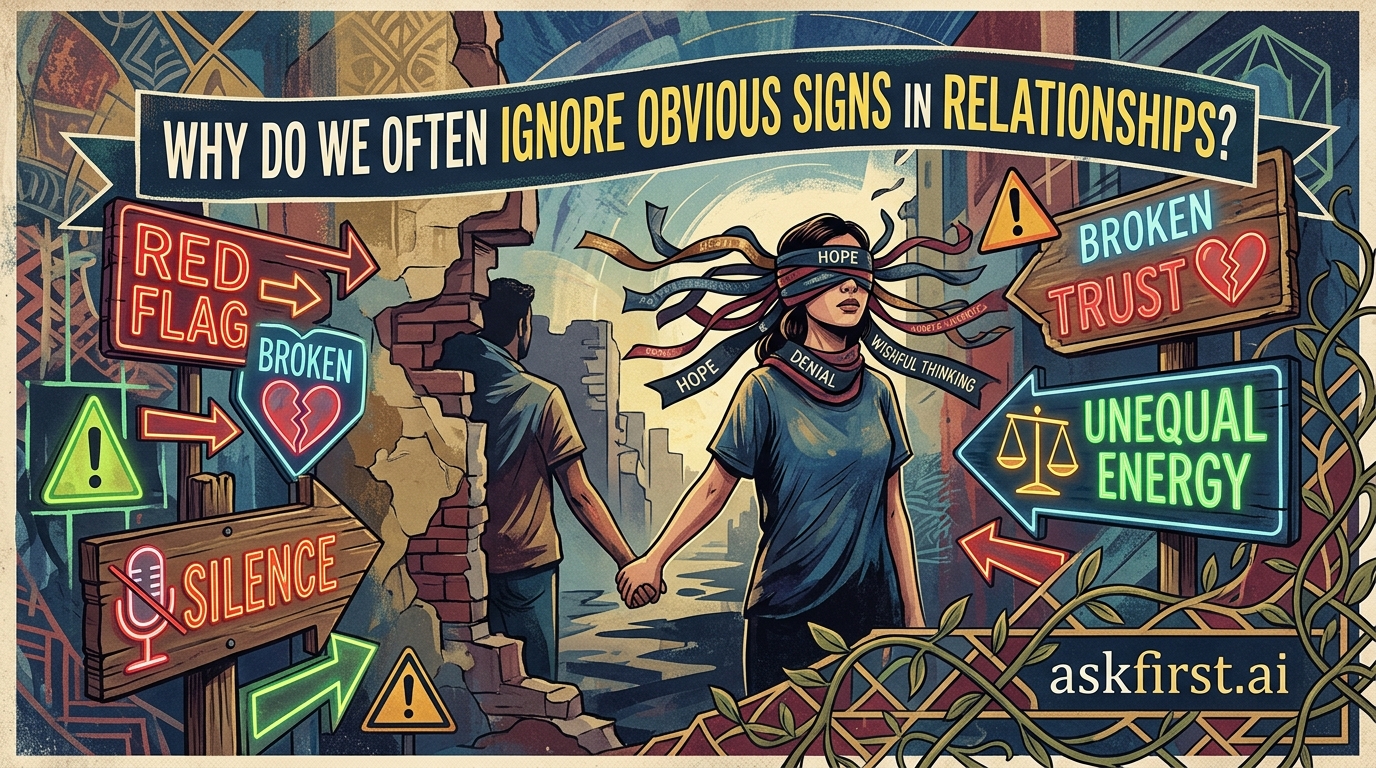
The Psychology of Selective Perception
Human behavior is governed by a fascinating interplay between logical reasoning and emotional defense mechanisms. When individuals enter intimate partnerships, the brain undergoes neurochemical changes—specifically the release of dopamine and oxytocin—which create a biological bias toward attachment. This 'honeymoon phase' creates a protective bubble that often masks reality, a phenomenon psychologists refer to as motivated reasoning. In essence, the human mind prioritizes the desire to sustain a bond over the objective analysis of contradictory evidence.
Cognitive Dissonance and the Comfort Trap
One primary driver for ignoring red flags is cognitive dissonance. When a person realizes that their partner is displaying behavior inconsistent with their ideal vision of a healthy relationship, the mind experiences psychological discomfort. To alleviate this, the brain engages in rationalization. By downplaying obvious warning signs, the individual protects their self-image and their investment in the relationship. This process is not a conscious choice but a subconscious defense mechanism designed to prevent the pain of rejection or the upheaval of breaking an established attachment pattern.
Attachment Theory: The Role of Past Blueprints
Attachment theory, pioneered by John Bowlby and Mary Ainsworth, explains why some individuals remain blind to negative traits. Those with anxious attachment styles often perceive a partner's distancing or erratic behavior not as a red flag, but as a challenge to be 'fixed' or an invitation to pursue harder. Because the brain is wired to repeat familiar emotional landscapes from childhood, individuals may mistake chaos for passion or neglect for independence. The brain struggles to identify a threat when that threat feels emotionally familiar.
The Sunk Cost Fallacy in Romantic Dynamics
The sunk cost fallacy plays a significant role in relationship blindness. This economic principle suggests that people continue to invest in a endeavor simply because they have already invested time, emotional energy, and resources into it. The longer a relationship lasts, the harder it becomes to acknowledge that the signs were there from the beginning. Admitting the truth would mean acknowledging that previous years were potentially wasted, which creates an enormous barrier to clarity. Instead, individuals commit to the 'hope' of improvement, essentially doubling down on an investment that has already lost its value.
The Role of Intermittent Reinforcement
Intermittent reinforcement is one of the most powerful psychological tools for trapping the human attention span. If a partner provides affection inconsistently, the brain becomes hyper-focused on securing the next 'hit' of validation. This mechanism mimics the structure of addiction. In this state of neural conditioning, obvious negative signs become background noise. The priority shifts from evaluating the partner’s character to navigating the unpredictable reward cycle. By the time a warning sign is identified, the individual is already biologically conditioned to minimize it to protect the possibility of a reward.
Strategies for Cultivating Radical Clarity
To overcome the tendency to ignore signs, one must cultivate a practice of emotional objectivity. This involves three key pillars:
- The Perspective Shift: Imagine a trusted friend comes to you with the exact scenario you are currently living. What advice would you offer them? This cognitive distance removes the emotional investment that clouds judgment.
- Data Over Narrative: Do not trust the story you tell yourself about why someone is acting a certain way. Trust the frequency and impact of the behavior itself. If a behavior repeats, it is a pattern, not an accident.
- Setting Non-Negotiables: Before emotional attachment runs deep, establish clear, written values for what is acceptable in a partner. Having a physical list provides a baseline to return to when emotions become overwhelming.
The Final Analysis
Ultimately, ignoring obvious signs is a strategy of emotional self-preservation that has backfired. It is a biological survival tactic adapted for modern social structures where emotional security is more vital than ever. By understanding the chemical, cognitive, and evolutionary reasons for this blindness, individuals can transition from a state of passive reaction to one of conscious observation. True partnership requires the courage to face reality, even when that reality requires a difficult change. Awareness is the first step toward reclaiming agency in one’s personal life.