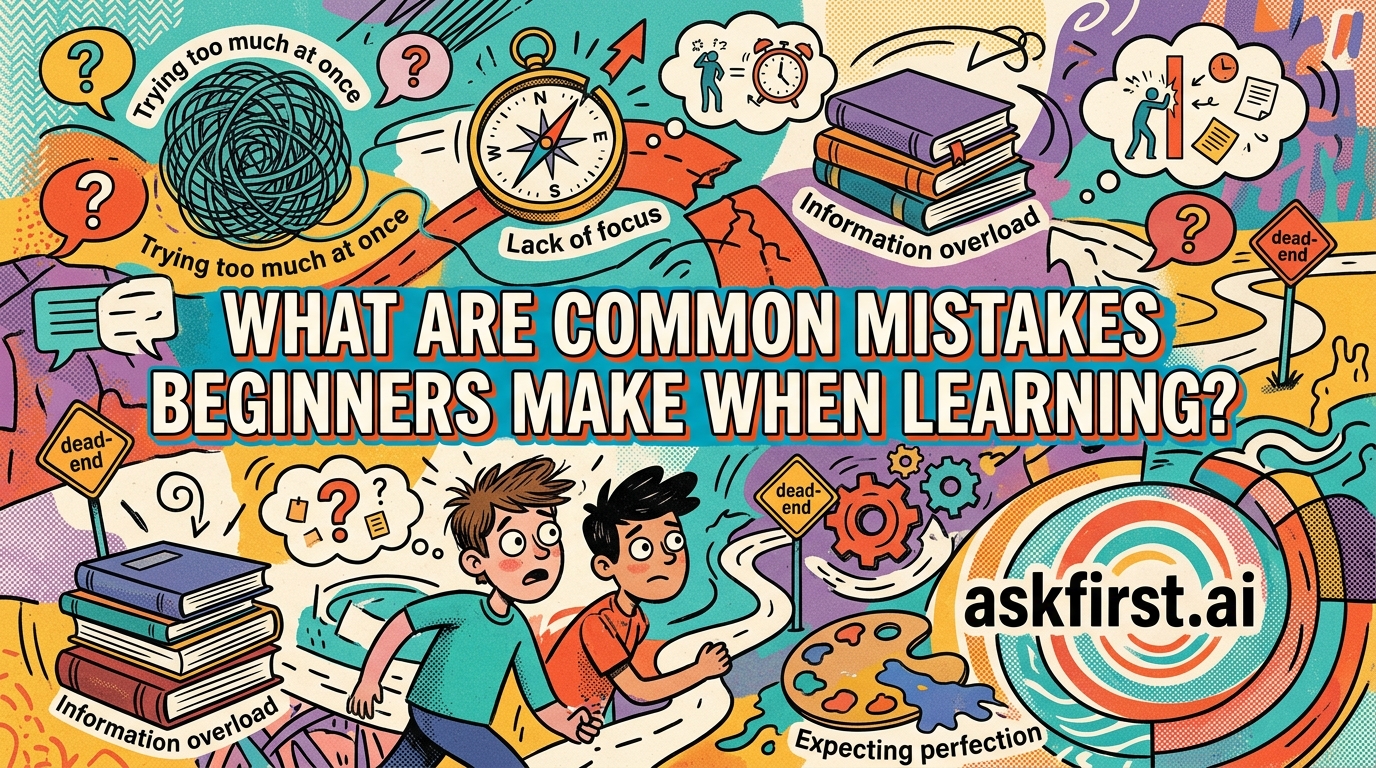
The Architecture of Mastery: Avoiding Pitfalls in the Learning Process
Learning is not merely the accumulation of data; it is the deliberate restructuring of the brain’s neural pathways to accommodate new information and skills. However, most beginners approach the acquisition of knowledge with intuitive methods that are often counterproductive. By understanding the psychological and cognitive barriers to effective learning, one can transition from a frustrated novice to a proficient practitioner. This analysis explores the common traps that stall progress and provides evidence-based strategies to overcome them.
1. The Trap of Passive Consumption
The most pervasive mistake beginners make is confusing "exposure" with "learning." Many students spend hours reading textbooks, highlighting key passages, or re-watching lecture videos, believing that because the material feels familiar, they have mastered it. This is known as the Illusion of Competence.
Cognitive scientists like Dr. Barbara Oakley, author of A Mind for Numbers, emphasize that passive reading is one of the least effective ways to encode information into long-term memory. When you read, the information is right in front of you, creating a false sense of security. True learning requires Active Recall. Instead of re-reading a chapter, a learner should close the book and attempt to summarize the core concepts from memory. If you cannot explain a concept in simple terms without looking at your notes, you do not yet understand it. This principle is famously known as the Feynman Technique, named after the Nobel Prize-winning physicist Richard Feynman, who argued that if you cannot explain a concept to a child, you do not understand it well enough.
2. Neglecting the Power of Spaced Repetition
Another critical error is "cramming." Many beginners attempt to master a subject in a single, marathon session. While this may lead to short-term retention for an exam, it results in rapid forgetting—a phenomenon described by the Forgetting Curve, first identified by the psychologist Hermann Ebbinghaus in the late 19th century.
Ebbinghaus demonstrated that memory decays exponentially over time unless it is reinforced. To combat this, learners must employ Spaced Repetition. This involves reviewing material at increasing intervals—first after a few hours, then a day, then a week, and finally a month. By forcing the brain to retrieve information just as it is about to fade, you strengthen the neural connections, effectively "locking" the knowledge into long-term storage. Tools like Anki or simple physical flashcard systems are essential for managing these intervals effectively.
3. The Lack of Deliberate Practice
Beginners often engage in "mindless repetition" rather than Deliberate Practice. In his seminal book Peak: Secrets from the New Science of Expertise, Dr. K. Anders Ericsson explains that simply doing a task repeatedly—like playing a musical scale or solving basic math problems—does not lead to expertise.
Deliberate practice requires:
- Specific Goal Setting: Breaking a complex skill down into small, manageable components.
- Immediate Feedback: Identifying where you are making mistakes in real-time.
- High Focus: Working at the edge of your current ability, where the task is difficult but achievable.
For example, a beginner learning a new language shouldn't just listen to podcasts all day; they should actively try to construct sentences and have them corrected by a native speaker or a tutor. If you aren't struggling, you aren't learning.
4. Overlooking the Importance of Metacognition
Metacognition is "thinking about thinking." Beginners often lack the awareness to monitor their own learning progress. They might continue to study a topic they are already comfortable with because it feels good, while avoiding the topics that make them feel confused or incompetent. This is a form of cognitive bias.
To improve, you must develop a diagnostic mindset. Before starting a study session, ask yourself: "What exactly do I not understand?" and "How will I know if I have mastered this?" By constantly auditing your own understanding, you can adjust your study habits to focus on your "weak spots." As Peter Brown notes in his book Make It Stick: The Science of Successful Learning, the effortful process of retrieving information—even when it feels difficult—is exactly what builds durable memory.
5. Ignoring Physical Foundations
Finally, many beginners treat their brains as independent of their bodies. Learning is a metabolic process. Dr. Matthew Walker, in his book Why We Sleep, provides extensive evidence that sleep is not a luxury but a biological necessity for memory consolidation. During sleep, the brain processes information gathered during the day, moving it from the hippocampus to the neocortex for long-term storage. A beginner who sacrifices sleep to study is effectively deleting the progress they made during the day. Similarly, consistent physical exercise has been shown to increase the production of Brain-Derived Neurotrophic Factor (BDNF), a protein that supports the survival of existing neurons and encourages the growth of new synapses.
Conclusion
The journey to mastery is rarely a straight line. By shifting away from passive consumption toward active recall, implementing spaced repetition, engaging in deliberate practice, practicing metacognition, and honoring the biological requirements of the brain, a beginner can bypass the common pitfalls that cause most people to quit. Learning is a skill in itself; once you understand the mechanics of how your brain acquires and retains information, you gain a significant advantage in any discipline you choose to pursue.