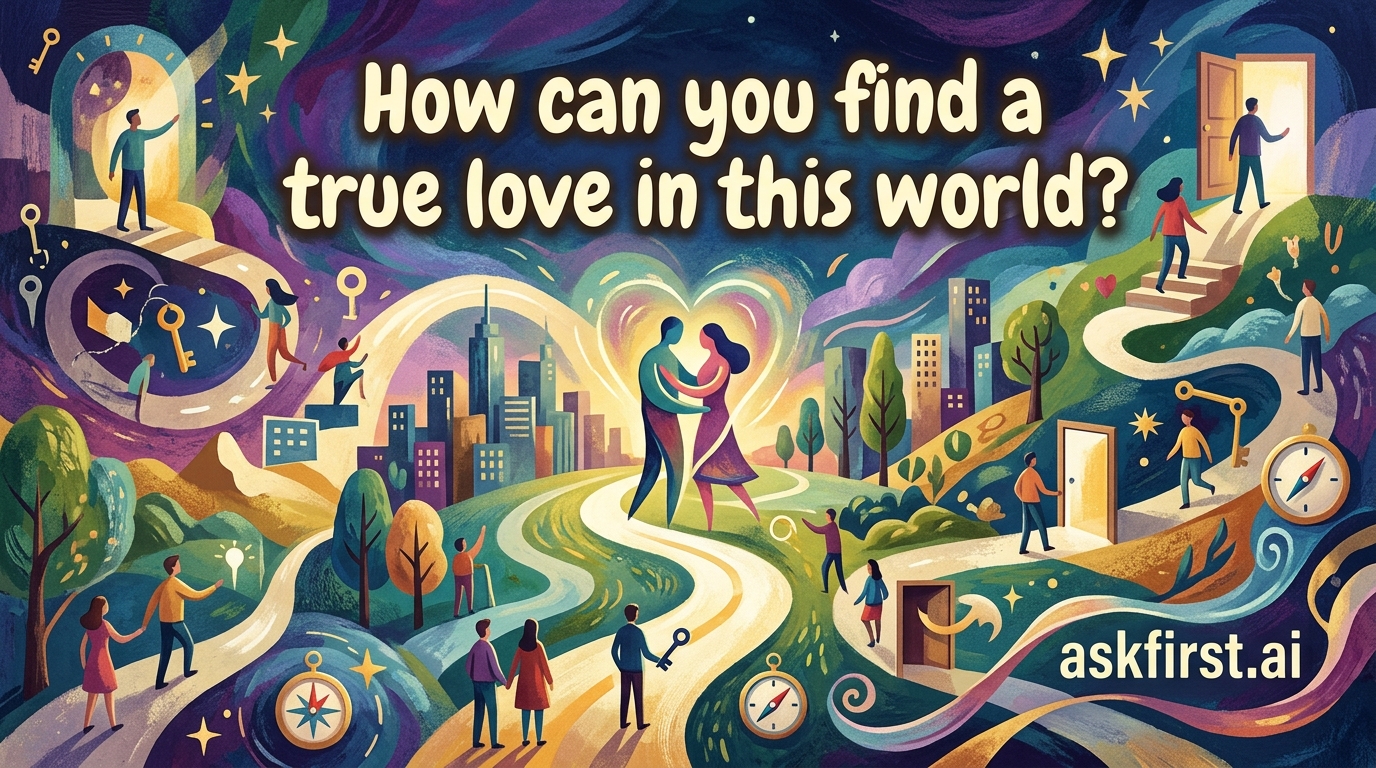
Finding "true love" is perhaps the most enduring pursuit of the human experience. While poets and songwriters often frame it as a stroke of cosmic luck or a lightning strike of fate, the reality is far more grounded in psychology, behavioral science, and intentionality. To find a lasting, profound connection, one must move beyond the superficial allure of "the spark" and toward the cultivation of shared values, emotional intelligence, and mutual growth.
The Foundation: Knowing Thyself
Before one can identify a compatible partner, one must possess a granular understanding of the self. As the renowned psychologist Carl Jung articulated in his seminal work, The Archetypes and the Collective Unconscious, the projection of our own unintegrated traits onto others is often what we mistake for "love at first sight." If you do not know your own boundaries, attachment style, and core values, you will inevitably seek partners who mirror your internal chaos rather than your potential for growth.
To find true love, start by auditing your life. What are your non-negotiables? If you value intellectual curiosity but date someone who disdains reading, conflict is inevitable. If you prioritize financial security but partner with someone who views money as a means to immediate gratification, the foundation will crumble. Use the framework provided by Dr. Helen Fisher in Why We Love, which categorizes human temperament into four biological types (Explorer, Builder, Director, Negotiator). Understanding your own "brain chemistry" helps you identify which personality types offer the highest probability of long-term compatibility.
Shifting from "Chemistry" to "Compatibility"
In modern dating, we are often seduced by dopamine-driven chemistry—that dizzying, anxious feeling of early infatuation. However, as Dr. John Gottman, co-founder of The Gottman Institute, proves in his decades of research (detailed in The Seven Principles for Making Marriage Work), lasting love is not built on intensity, but on friendship and the management of conflict.
True love is found by looking for the "boring" traits:
- Reliability: Does this person follow through on small promises?
- Conflict Resolution: When you disagree, do they attack your character, or do they seek a solution to the problem?
- Shared Vision: Do you both want the same things out of life in five, ten, or twenty years?
Stop looking for a "soulmate" who completes you. Instead, look for a "life partner" with whom you can build. As M. Scott Peck wrote in The Road Less Traveled, love is "the will to extend one's self for the purpose of nurturing one's own or another's spiritual growth." This definition shifts the focus from what you get to what you contribute.
The Strategy of Intentional Exposure
You cannot find a partner by staying within the same narrow patterns of your daily life. If you want to meet someone who shares your values, you must inhabit the spaces where those values are practiced.
If you value community service, volunteer at local shelters. If you value physical health and discipline, join clubs that require consistent participation, such as running groups or mountain climbing collectives. Dr. Robert Putnam discusses the importance of "social capital" in his book Bowling Alone, noting that deep bonds are forged through repeated, low-stakes interactions in shared social environments.
Do not rely on dating apps as your sole source of connection. While they provide volume, they often strip away the context of character. True love is more easily detected in person, where you can observe how a person treats service staff, how they handle stress in public, and how they interact with their own circle of friends.
Cultivating Vulnerability and Resilience
Once you find someone who possesses the requisite compatibility, the "search" ends, but the "creation" of true love begins. This requires radical vulnerability. As Brené Brown explains in Daring Greatly, vulnerability is the birthplace of connection. Many people sabotage potential true love because they are terrified of being seen in their entirety—flaws, insecurities, and all.
To foster this, practice "active listening." When your partner speaks, do not formulate your rebuttal; listen to understand their internal world. This builds the "emotional bank account" that Gottman describes as the primary predictor of relationship longevity. When you have a high balance of positive interactions, you become resilient enough to weather the inevitable storms of life.
Conclusion: Love as a Practice
Finding true love is not about discovering a hidden treasure; it is about the patient, deliberate cultivation of a garden. It requires the courage to be honest about who you are, the wisdom to choose a partner whose character aligns with your own, and the discipline to continue choosing that person every day, even when the initial excitement fades.
By grounding your search in self-awareness, prioritizing compatibility over fleeting chemistry, and committing to the hard work of vulnerability, you transform "true love" from a romantic myth into a tangible, lived reality. It is not something you find; it is something you build with another person through years of shared experience and mutual respect.