Navigating the Stasis: A Theoretical Framework for Surviving a Frozen Temporal Plane
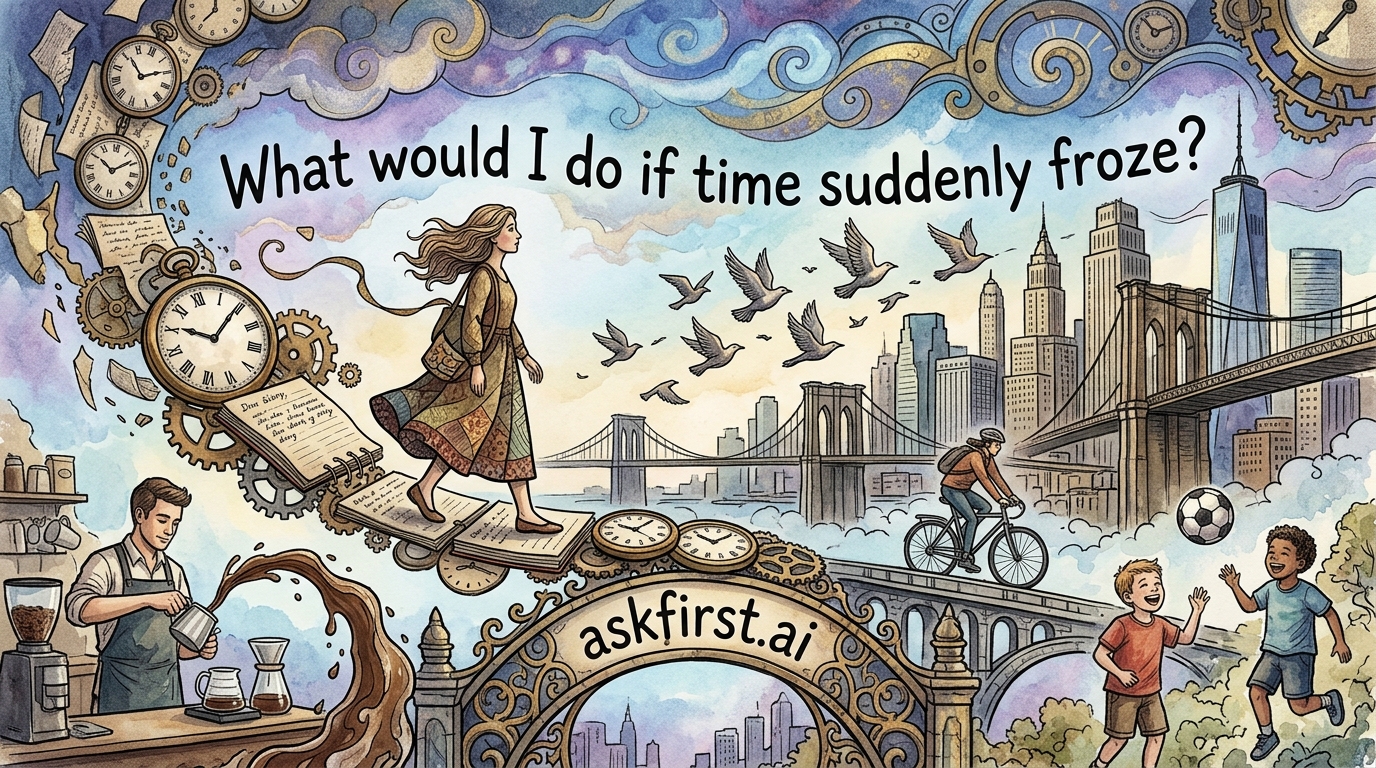
The concept of a "frozen" time state—a condition where the progression of entropy ceases and the kinetic energy of the universe drops to absolute zero—has long been a staple of theoretical physics and speculative fiction. If time were to suddenly stop, you would face a reality that defies every biological and physical law governing our existence. In this scenario, we must distinguish between the subjective experience of the observer and the objective state of the universe. Here is a comprehensive analysis of the physical, biological, and existential implications of such an event, and how one might theoretically navigate this impossible landscape.
The Physics of Absolute Stasis
If time were to "freeze," the most immediate consequence would be the cessation of all atomic motion. According to the Laws of Thermodynamics, specifically the Third Law, as temperature approaches absolute zero, the entropy of a system approaches a constant minimum. If the flow of time ceases, particles cease their vibration. Consequently, the universe would become a rigid, immutable block.
In his seminal work The Fabric of the Cosmos, physicist Brian Greene explores the "block universe" theory, suggesting that past, present, and future exist simultaneously as a four-dimensional structure. If you were somehow exempt from this freeze, you would find yourself moving through a universe where light itself is stationary. Because light is composed of photons—which must move at c to exist—a true temporal freeze would imply that light has ceased to propagate. You would be effectively blind, as photons would no longer strike your retinas. To survive, you would need a mechanism to re-introduce kinetic energy into your immediate surroundings, essentially "re-starting" the flow of causality in your local bubble.
Biological and Physiological Constraints
Your primary challenge in a frozen world is not the environment, but your own biology. Human life is a chemical process. The firing of neurons, the pumping of blood, and the synthesis of ATP (adenosine triphosphate) rely on the movement of ions and molecules across membranes. If time is frozen, these electrochemical signals cannot propagate.
To survive, you would require a localized temporal field—a "bubble" of causality. Without it, your own internal clock would stop the moment the universe did. If you were to retain consciousness while the rest of the world remained static, you would be forced to contend with the Heisenberg Uncertainty Principle. If you try to measure the position of a particle in a frozen state, you must impart energy to it. In a universe where entropy is zero, adding energy to your environment could result in catastrophic localized explosions. You would have to move with extreme deliberation, essentially "breaking" the stasis of every object you touch, one molecule at a time.
Navigating the Static Landscape
If you were granted the ability to move while the world was paused, your navigation would become a matter of mechanical engineering rather than walking. Since the atmosphere would be frozen solid, the air molecules would not move out of your way. You would be walking into a wall of nitrogen and oxygen atoms that are effectively as dense as steel.
- Kinetic Displacement: You would need to push air molecules aside with significant force. This would likely create a vacuum in your wake, followed by a violent rush of air once you moved past, as the atmosphere attempted to fill the void.
- Thermal Regulation: Because you are moving through a non-conductive, frozen medium, you would generate immense friction. You would need a suit capable of dissipating heat that cannot be transferred to the frozen air around you.
- Communication: Light would not travel. You could not see the sun, the stars, or even your own hands unless you carried a light source that generated its own temporal field, allowing photons to travel from the source to your eyes.
Existential and Psychological Implications
The isolation of a frozen world is difficult to overstate. In The End of Eternity by Isaac Asimov, the author explores the psychological toll of moving outside the standard flow of time. The lack of feedback from the environment—no shifting shadows, no rustling leaves, no heartbeat of other living beings—leads to rapid sensory deprivation.
If you found yourself in this state, your primary objective should be the restoration of the temporal flow. You would need to locate a "source" of entropy. If the freeze is a local event, you might find that moving toward a region of higher gravity or intense energy—such as a power plant or a celestial body—could act as an anchor to pull you back into the stream of time.
Conclusion
A world without time is a world without event, cause, or effect. It is a universe rendered into a singular, crystalline photograph. If you were to find yourself in such a predicament, the laws of physics as we know them would dictate that you could not exist within it; you would be a frozen statue among billions of others. However, if we assume a theoretical exemption, your existence would be defined by a constant battle against the lack of entropy. You would be a lone traveler in a gallery of statues, requiring immense energy to move, see, and think. Ultimately, the most logical course of action would be to seek the "anchor" of the freeze—the point of origin—and attempt to reverse the mechanism that stopped the clock, returning the universe to the chaotic, beautiful, and fleeting progression of time that defines our existence.