The Psychology of Employment: Why Stability Often Trumps Independence
In a world that frequently romanticizes the figure of the entrepreneur, the reality remains that the vast majority of the global workforce functions within an employer-employee framework. This phenomenon is not merely a byproduct of economic necessity but is rooted in complex psychological, evolutionary, and sociological foundations. Understanding why individuals gravitate toward organizational structures rather than solitary ventures requires a deep dive into the human aversion to ambiguity and the need for structural support.
The Comfort of Predictability: Eliminating the Burden of Choice
One of the primary drivers behind preferring to work for others is the concept of cognitive load management. Being an entrepreneur or a solopreneur entails a constant barrage of decision-making. From high-stakes strategic planning to mundane operational details, the self-employed must bear the psychological weight of every failure. Conversely, working for an organization provides a clearly defined 'scope of work.' According to Schwartz's Paradox of Choice, the abundance of options can lead to anxiety and paralysis. By working for others, individuals delegate the responsibility of vision, strategy, and risk management to leadership, allowing them to focus their energy on executing specific tasks, which often fosters a sense of competence and mastery.
Evolutionary Biology and the Need for Belonging
From an evolutionary perspective, human beings are social animals programmed for group cohesion. For millennia, survival depended on being part of a tribe. A workplace functions as a modern-day 'tribe,' offering a sense of belonging, shared mission, and collective identity. The isolation inherent in working for oneself can be psychologically taxing. Large organizations create communal environments where social bonds are forged, mentorship occurs, and personal growth is validated by peers and supervisors. This structured social environment mitigates the feelings of alienation that often accompany the path of individual enterprise.
The Safety Net: Risk Aversion and Financial Stability
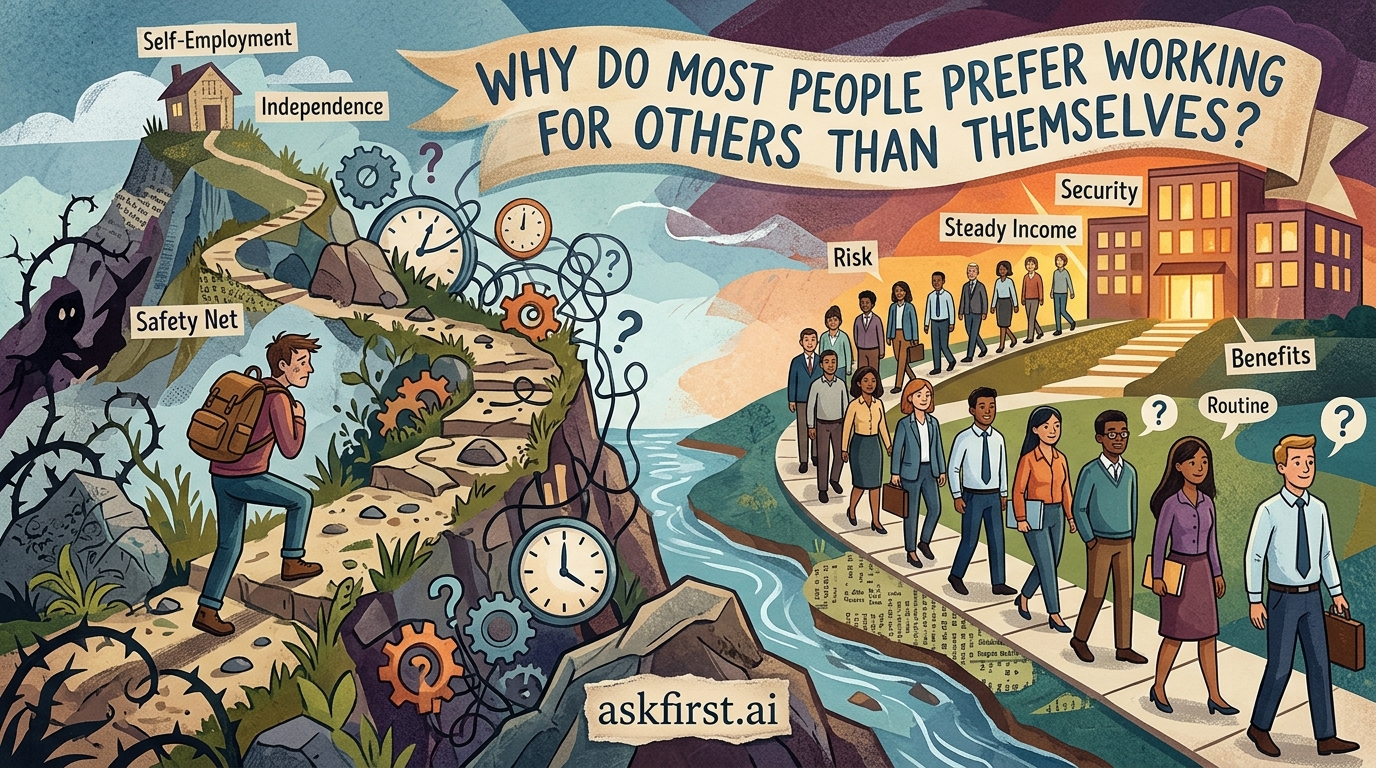
Financial psychology highlights the human tendency toward Loss Aversion, a cognitive bias identified by Nobel laureate Daniel Kahneman. Most individuals perceive the pain of losing a consistent salary to be significantly greater than the potential joy of gaining higher entrepreneurial profits. Regular paychecks, insurance benefits, and retirement contributions act as a 'psychological safety blanket.'
- Risk Mitigation: Employees trade a portion of their potential earnings in exchange for the employer absorbing the primary risks of the market.
- Resource Access: Large organizations provide tools, infrastructure, software, and capital that an individual would find prohibitively expensive to secure on their own.
Skill Specialization and Division of Labor
Since the Industrial Revolution, human productivity has skyrocketed due to the division of labor. By working for others, an individual can become a specialist in their chosen field without needing to be an accountant, a marketer, a legal expert, and a salesperson simultaneously. This allows the employee to reach higher levels of excellence in their niche. Adam Smith’s classic economic observation remains true today: productivity and satisfaction often increase when individuals can focus on their specific craft while relying on others to handle the adjacent complexities of a business model.
The Myth of Autonomy
There is a common misconception that working for oneself equates to complete freedom. In reality, entrepreneurs are often 'slaves' to their clients, stakeholders, and the unforgiving whims of market forces. Paradoxically, an employee may experience higher levels of actual 'time freedom' or 'mental detachment' once they clock out. The ability to compartmentalize work and life is much easier when one does not have to worry about the survival of an entire enterprise during personal time. Thus, the preference for employment is often a rational calculation to maximize mental well-being and protect personal boundaries.
Conclusion: A Matter of Temperament
Ultimately, the choice between employment and self-employment is rarely about who is 'smarter' or 'harder working'; it is about temperament and personal value structures. For many, the organizational environment provides the exact scaffolding required to perform at their best. By offloading the volatility of business ownership, employees gain the space to innovate, collaborate, and thrive within a structured reality. Recognizing this is crucial for personal development—understanding whether one thrives in a collaborative ecosystem or requires the solitude of independence is the first step toward a fulfilling career path. The stability, social connection, and specialized focus provided by modern employment continue to make it the preferred vehicle for human professional endeavor.