The Architecture of Scarcity: Does Poverty Permanently Reshape the Mind?
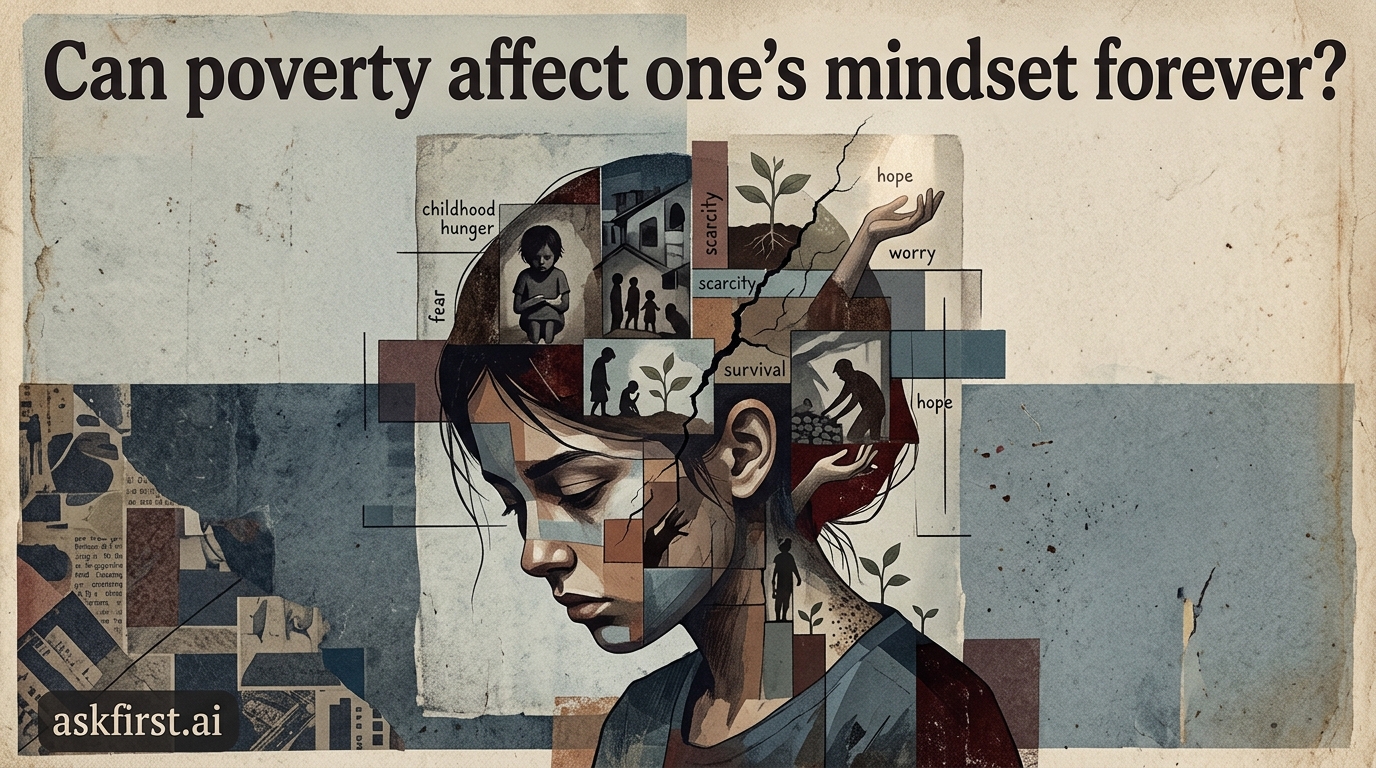
The question of whether poverty leaves an indelible mark on the human psyche is one of the most profound inquiries in behavioral economics, psychology, and neuroscience. For decades, the prevailing narrative suggested that poverty was merely a temporary condition—a lack of financial resources that would vanish once income increased. However, modern research into the "scarcity mindset" suggests that poverty is not just a circumstance; it is a cognitive environment that reshapes how we process information, perceive risk, and make long-term decisions.
The Cognitive Load of Scarcity
The most compelling evidence regarding the impact of poverty on the mind comes from the work of Sendhil Mullainathan (Harvard University) and Eldar Shafir (Princeton University). In their seminal book, Scarcity: Why Having Too Little Means So Much (2013), they posit that poverty imposes a significant "bandwidth tax" on the brain.
When an individual lives in a state of chronic scarcity, their cognitive resources are perpetually consumed by the "urgent" problems of survival—how to pay the rent, how to afford food, or how to manage debt. This creates a tunnel vision effect. Just as a driver focused on a narrow path might miss a pedestrian on the side of the road, a person living in poverty becomes hyper-focused on immediate stressors, often at the expense of long-term planning or cognitive flexibility. This is not a failure of character; it is a physiological response to an environment that demands constant, high-stakes decision-making. Over time, this state of constant vigilance can alter the brain's executive functions, making it harder to transition back to "big picture" thinking even when financial stability is eventually achieved.
Neuroplasticity and the Childhood Environment
The impact of poverty is particularly profound when experienced during childhood, a period of heightened neuroplasticity. Research led by neuroscientist Kimberly Noble at Teachers College, Columbia University, has demonstrated that children raised in lower-socioeconomic environments often show differences in the structural development of the brain, particularly in the hippocampus (associated with learning and memory) and the prefrontal cortex (associated with executive function).
These findings, published in journals such as Nature Neuroscience, suggest that the chronic stress—often referred to as "toxic stress"—associated with poverty can lead to an overactive amygdala. The amygdala is the brain’s alarm system. When it is constantly primed for threat, it suppresses the development of the prefrontal cortex, which is responsible for reasoning and impulse control. While the brain is remarkably resilient, these early developmental patterns can establish a default "threat-response" mode that persists into adulthood, manifesting as heightened anxiety or an inability to trust in the stability of future resources.
The "Scarcity Trap" and Behavioral Patterns
The long-term psychological imprint of poverty often manifests as the "scarcity trap." This is a behavioral phenomenon where individuals who have escaped poverty continue to engage in "poverty-like" decision-making. For example, a person who grew up in extreme deprivation might feel an overwhelming, irrational compulsion to hoard food or money, or they might engage in "present bias"—the tendency to value immediate rewards over much larger future gains.
In his book The Soul of a Nation, historian and social commentator Robert D. Putnam explores how social capital and environment dictate long-term life outcomes. He illustrates that the "mindset" is not just internal; it is reinforced by the social networks and institutions one interacts with. If one grows up in an environment where the system is perceived as rigged or unreliable, the belief that "hard work equals success" is often replaced by a belief in "luck or manipulation." This core belief system, forged in the fires of early poverty, can be incredibly difficult to unlearn, as it serves as a protective mechanism against the pain of future disappointment.
Can the Mindset Be Rewired?
While the evidence suggests that poverty leaves a lasting footprint, it is vital to avoid a deterministic view. The human brain is characterized by neuroplasticity throughout the lifespan. Just as the brain adapts to scarcity, it can adapt to security.
Interventions that focus on "cognitive reframing" and the reduction of environmental stressors have shown success. For instance, programs that provide a "guaranteed floor"—such as basic income pilots—have demonstrated that when the constant, gnawing anxiety of survival is removed, the "bandwidth" of participants expands, allowing them to engage in the very planning and long-term goal setting that was previously suppressed.
Conclusion
Poverty does affect one’s mindset, often leaving behind a legacy of hyper-vigilance, present-bias, and a deep-seated skepticism regarding the future. It is not merely a matter of lacking money; it is an experience that wires the brain to prioritize survival above all else. However, this is not a permanent sentence. Understanding that these cognitive patterns are biological and psychological adaptations—rather than inherent personality flaws—is the first step toward mitigation. By creating environments that offer genuine stability and security, society can help rewire the cognitive architecture that poverty has so relentlessly shaped, allowing individuals to transcend the limitations of their past.