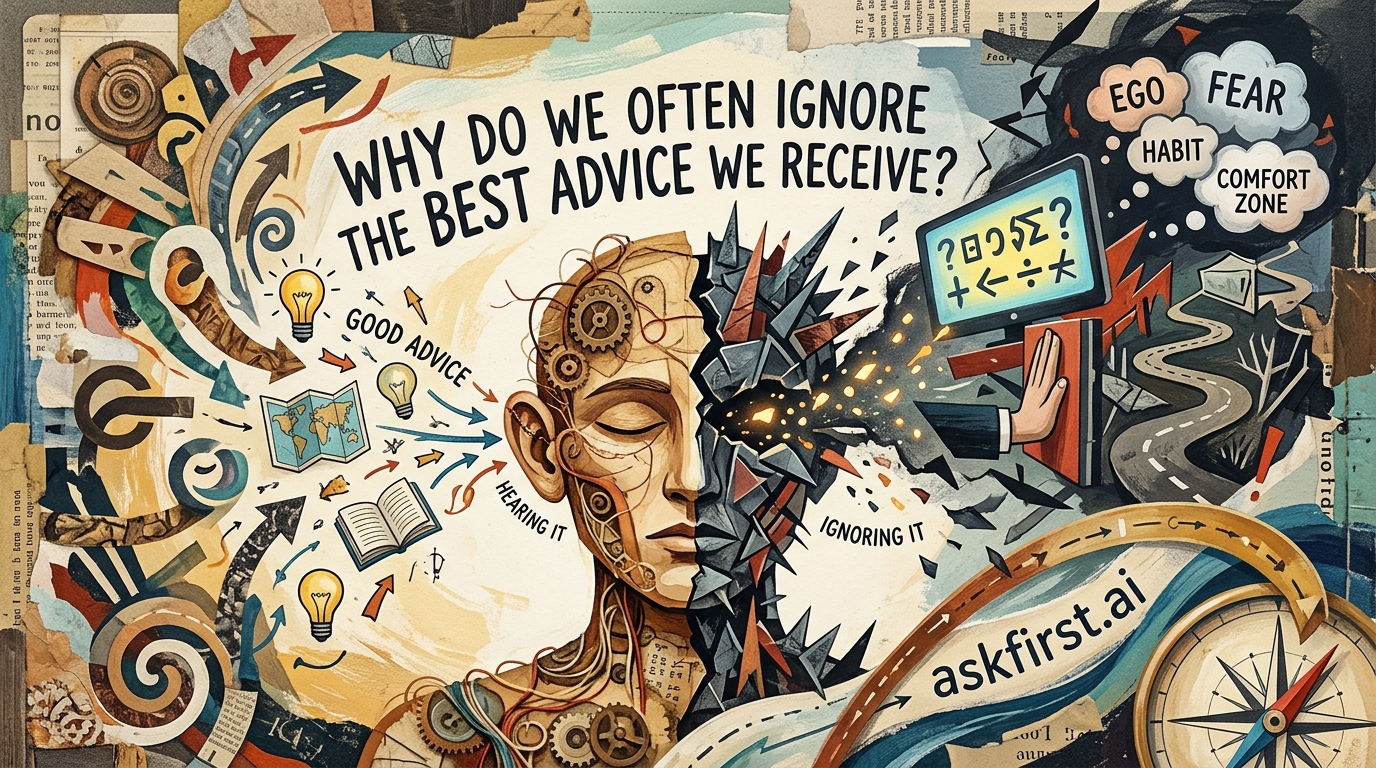
The Paradox of Resistance: Why Advice Often Falls on Deaf Ears
Human behavior is frequently defined by a strange contradiction: the pursuit of wisdom paired with a stubborn refusal to implement it. While individuals actively seek guidance to overcome obstacles, a psychological phenomenon often triggers an immediate internal rejection once that advice is received. Understanding this resistance requires a deep dive into cognitive biases, the mechanics of identity, and the evolutionary need for autonomy.
1. The Psychological Cost of Autonomy
One primary reason advice is ignored lies in the psychological concept of Reactance. When a person receives direct advice, they may perceive it as a threat to their freedom of choice. According to the Theory of Psychological Reactance, when individuals feel that their behavioral freedom is being restricted by external influence, they experience an unpleasant motivational state that pushes them to regain control. By ignoring or rejecting the advice, the individual asserts their independence, effectively signaling to themselves that they are the primary architects of their own decisions.
2. The Influence of Confirmation Bias
Confirmation bias is perhaps the most pervasive barrier to accepting high-quality advice. Human brains are hard-wired to prioritize information that aligns with existing beliefs while discarding information that contradicts them. If advice challenges a deeply held personal narrative or a long-standing method of operation, the brain treats it as a 'data error.' Instead of objectively evaluating the merit of the advice, the mind immediately constructs counter-arguments to protect the stability of its worldview. This ensures that the status quo remains unchallenged, even when the status quo is ineffective.
3. The 'Not Invented Here' Bias
Commonly seen in organizational psychology, the 'Not Invented Here' (NIH) syndrome manifests in individuals as a devaluation of ideas generated outside of their immediate awareness. When advice comes from another person, it lacks the 'ownership' factor. Because the individual did not arrive at the conclusion themselves, they fail to feel the necessary emotional investment required to act upon it. Wisdom, to be effective, often needs to be 're-discovered' by the person through their own trial and error, a process that, while inefficient, creates the internal conviction required for sustained behavior change.
4. Ego Defense and the Illusion of Competence
Accepting advice is an implicit admission that one lacks the answer to a problem. For many, this admission is painful. It triggers a defensive reaction known as ego protection. If someone believes they should possess all the answers, taking advice feels like a demotion in status. This phenomenon is closely tied to the Dunning-Kruger effect, where individuals with limited competence in a specific domain overestimate their own abilities. Consequently, they reject expert advice because they literally do not realize how much they do not know.
5. The Temporal Discounting Trap
Humans are biologically wired for immediate gratification, a concept known as Hyperbolic Discounting. The best advice often involves long-term strategies—saving money, improving health, or developing complex skills—that yield results in the distant future. Conversely, the temptation to stick to current habits offers immediate comfort or convenience. When advice demands long-term sacrifice in exchange for delayed rewards, the brain's emotional center prioritizes the immediate comfort of the familiar over the distant success promised by the wise council.
Strategies for Overcoming Resistance
To bridge the gap between receiving wisdom and taking action, several mental shifts are required:
- Adopt a Growth Mindset: Cultivate the belief that intelligence and ability can be developed. This shifts the focus from 'protecting the ego' to 'expanding the repertoire.'
- Seek Insight over Instructions: Instead of asking for 'what to do,' ask for 'how to think about this problem.' Framing the conversation as a collaborative inquiry rather than a prescriptive command reduces the sense of reactance.
- The 24-Hour Rule: When receiving advice that induces immediate frustration or rejection, force a 24-hour waiting period before deciding to discard it. This cools the emotional centers of the brain and allows the logical, prefrontal cortex to analyze the advice objectively.
- Practice Intellectual Humility: Regularly acknowledge that the current strategy is not yielding the desired results. Admitting that current methods are insufficient is the first step toward becoming open to superior guidance.
Conclusion
Ignoring the best advice is rarely a result of stupidity; it is a complex reaction of the human psyche designed to maintain autonomy, protect the ego, and preserve mental energy. Recognizing these hidden mechanisms is the key to bypassing them. By understanding that the resistance to advice is an internal process rather than an external truth about the advice itself, individuals can learn to override their cognitive defenses, ultimately unlocking their true potential through the application of the wisdom they have spent their lives seeking.