The Psychology of Aspirational Consumption and Wealth Signaling
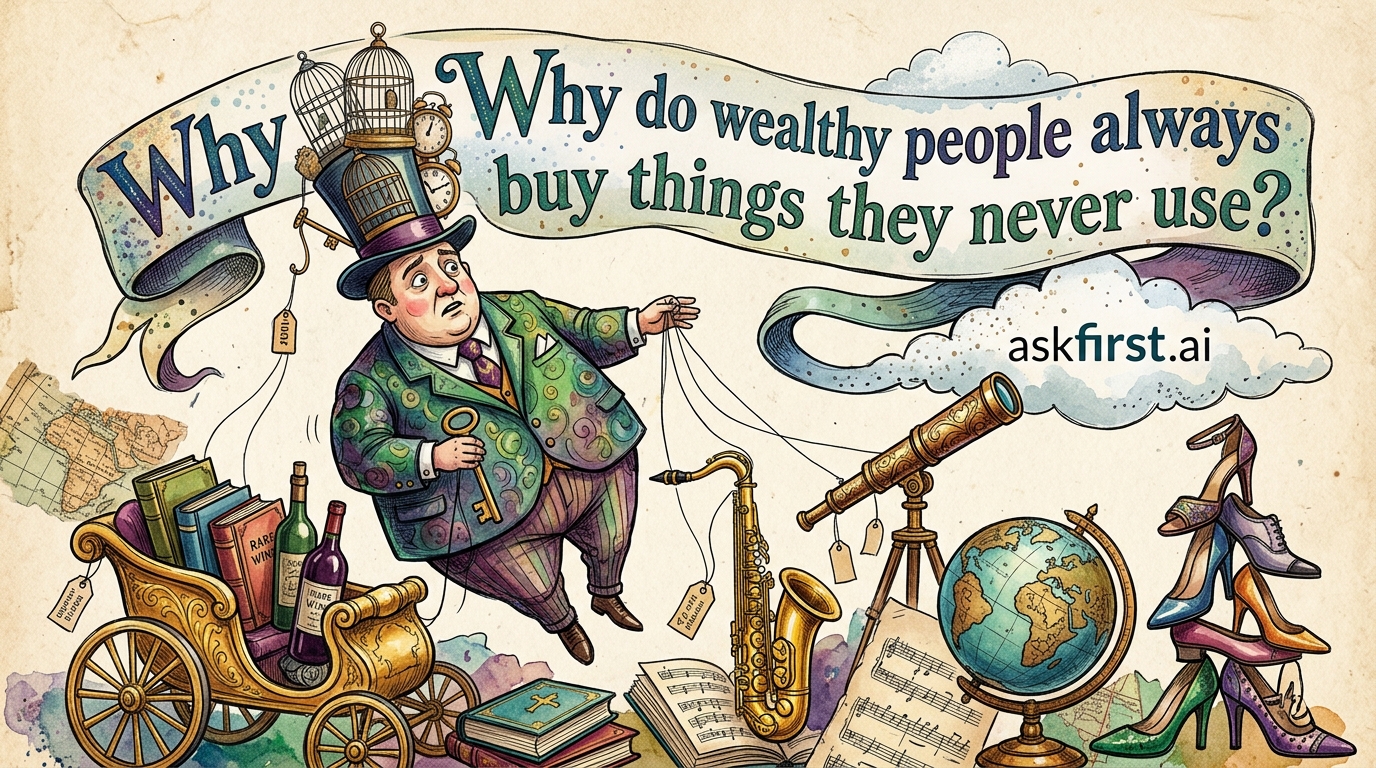
Wealthy individuals often accumulate vast inventories of items—luxury watches, high-end kitchen appliances, multiple vehicles, or rare collectables—that remain untouched for years, if not decades. This phenomenon is not merely an exercise in wastefulness; it is a complex intersection of social signaling, psychological satisfaction, and investment behavior. To understand why this happens, one must move beyond the surface-level assumption that consumption is strictly about utility.
The Signaling Function of Goods
In sociological terms, many luxury items serve as conspicuous consumption, a concept popularized by economist Thorstein Veblen. Wealthy individuals purchase goods that are inherently expensive and often difficult to acquire to communicate their social status to peers and the public. In this context, the utility of the object is entirely irrelevant. The actual 'function' of a high-end, unused espresso machine or a classic sports car parked in a climate-controlled garage is to act as a signal of disposable income, taste, and social stratification. Once the signal is sent—or the item is acquired—the object has fulfilled its purpose. The act of owning it is a status indicator, not an act of practical usage.
The Pursuit of Optionality and Future-Self Projection
Wealthy consumers often engage in 'lifestyle expansion,' where they purchase items for hypothetical scenarios. This behavior is rooted in future-self projection. A billionaire might buy professional-grade mountain climbing gear or complex painting supplies because, in their mind, they desire to be the type of person who engages in those hobbies. Purchasing the equipment is the first step in creating that identity. When time constraints or professional obligations intervene, the items remain unused. These objects are 'identity anchors,' representing a version of the owner that is aspirational rather than actualized.
Investing in Asset Appreciation
Many luxury items are acquired as alternative assets. In an economic climate characterized by inflation and market volatility, luxury goods—such as fine art, vintage wines, rare handbags, and horological masterpieces—often function as stores of value. Collectors understand that using or wearing these items can decrease their resale value significantly. Therefore, the item is kept in 'new, old stock' condition to maximize its future appraisal. For the wealthy, 'use' is secondary to the preservation of capital. Buying something that one does not use is often a deliberate strategy to ensure the asset maintains its mint condition for a lucrative future sale.
The Endowment Effect and Hoarding Tendencies
Psychologically, the endowment effect suggests that people value objects more simply because they own them. For the wealthy, the cost of acquisition is often negligible compared to their net worth. As a result, the motivation to offload items that are not being used is extremely low. There is minimal 'opportunity cost' in keeping an unused item, whereas the mental effort required to sell or manage the disposal of the item outweighs the benefit of clearing space. Consequently, unused inventory accumulates as a byproduct of high-velocity consumption.
Hedonic Adaptation and the Search for Novelty
Human happiness is subject to hedonic adaptation—the tendency to quickly return to a baseline level of satisfaction despite positive or negative events. Wealthy individuals are often bombarded with constant novelty. They might purchase an item with genuine excitement, only for the psychological 'novelty high' to wear off within days. Once the dopamine hit associated with the purchase cycle concludes, the object loses its allure. It becomes part of the background, a silent testament to a brief moment of interest that has since shifted elsewhere.
Strategic Storage of Potential Utility
Finally, there is the principle of preparedness and redundancy. Wealthy households often operate on a scale that prioritizes accessibility and immediate availability over resource management. It is more convenient to own three different versions of a tool 'just in case' than it is to worry about sourcing the right one when the rare need arises. This creates a surplus of goods that are intended for contingencies that may never materialize. In this light, the item is not 'unused'—it is serving its purpose as a piece of available inventory, waiting for a hypothetical, specific requirement.
Summary: The acquisition of unused items by the wealthy is rarely a result of irrationality. It is a strategic blend of status signaling, asset protection, identity projection, and the luxury of maintaining a lifestyle where time and space are not considered finite constraints.