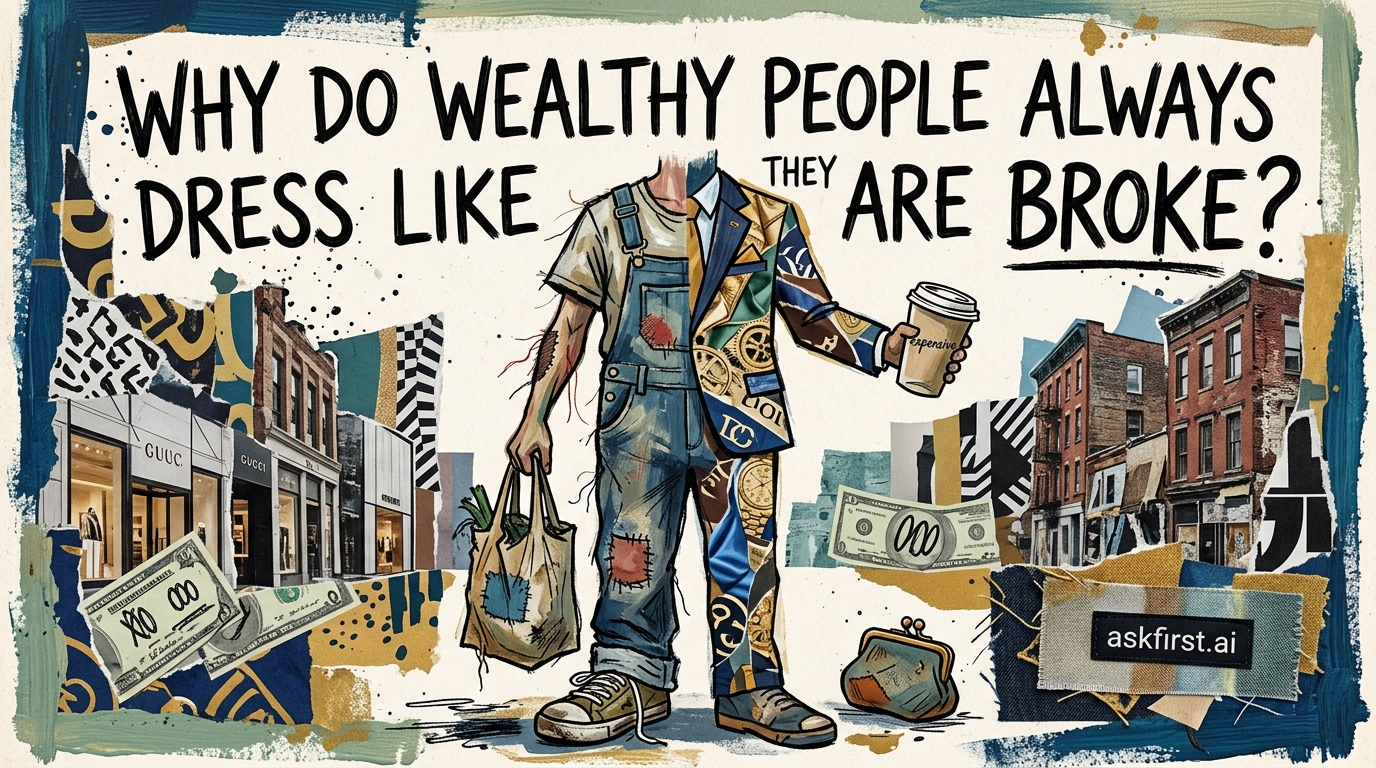
The Psychology of Stealth Wealth
In the realms of sociology and behavioral economics, the phenomenon of high-net-worth individuals eschewing ostentatious displays of luxury in favor of nondescript, minimalist, or even threadbare clothing is often referred to as 'Stealth Wealth' or 'Quiet Luxury.' Contrary to the assumption that this choice reflects a lack of resources, it is a deliberate signaling mechanism used by those who have already achieved financial security to differentiate themselves from the 'nouveau riche.'
The Signaling Theory: Codes of Recognition
Sociologist Thorstein Veblen famously introduced the concept of 'conspicuous consumption' in the 19th century, suggesting that the wealthy display their status through lavish spending. However, the modern wealthy elite often perform the inverse: 'conspicuous under-consumption.' This serves as a specialized code. Among the ultra-wealthy, recognizing that an unbranded cashmere sweater costs more than a car requires a specific level of cultural capital. By dressing in a way that appears plain to the uninitiated, the elite engage in an in-group signaling process. They communicate status to those who share their pedigree, while remaining invisible to the general public.
Psychological Motives and Social Security
Beyond status signaling, there are several psychological drivers for this aesthetic choice:
- Reduction of Cognitive Load: Much like the decision-making fatigue addressed by tech moguls wearing identical uniforms daily, high-achievers often simplify their wardrobe to focus mental energy on high-stakes business or creative pursuits rather than fashion trends.
- Social Fluidity and Relatability: By avoiding flashy designer logos, wealthy individuals can move through various social environments without triggering resentment or target-seeking behaviors. It lowers the barrier to interaction, allowing for more authentic human connection.
- Focus on Utility and Longevity: The investment mentality is deeply ingrained in those who sustain long-term wealth. Instead of spending on fleeting fast-fashion trends, they invest in high-quality materials that last for decades. This shift in mindset transforms 'broke-looking' clothing into a long-term asset.
The Antithesis of Nouveau Riche
Historians and sociologists frequently observe that the desire to prominently display wealth is most prevalent among those who have recently acquired it. The 'nouveau riche' often use brand logos and high-contrast designs to prove their success to themselves and their peers. In contrast, 'old money' families—those who have held wealth for generations—are often socialized to prioritize discretion. In this context, dressing 'like one is broke' is an assertion of security; the person knows they do not need to prove their value to anyone through the medium of apparel.
Market Dynamics and 'Quiet Luxury'
What the observer perceives as 'broke' is often the most expensive market segment. The 'Quiet Luxury' movement emphasizes craftsmanship over branding. This market segment includes:
- Bespoke Tailoring: Items made-to-measure that lack visible branding but cost significantly more than mass-produced luxury items.
- Ethically Sourced Materials: Ultra-rare fabrics like vicuña or sustainable artisanal textiles that look unassuming but offer unparalleled comfort and durability.
- Historical Continuity: Items that do not follow seasonal trends remain fashionable for decades, providing a form of 'anti-fashion' that is inherently exclusive.
Is It Actually 'Broke' or Just Unfiltered Reality?
It is important to acknowledge that the perception of 'looking broke' is inherently subjective. A hoodie or a plain cotton t-shirt is a culturally ubiquitous garment. When worn by a billionaire, the public labels it 'minimalist;' when worn by a low-income individual, the same garment is viewed through the lens of economic necessity. This cognitive bias—where we attribute intent based on the assumed identity of the wearer—is the ultimate psychological trick of modern fashion. The wealthiest individuals are effectively utilizing the 'common' aesthetic as a protective camouflage, allowing them to traverse the world unburdened by the social expectations of their tax bracket.
In conclusion, the decision to dress in an understated, simple, or worn-out manner is rarely a sign of financial distress. Instead, it is a masterclass in social navigation, cultural signaling, and personal efficiency. By opting out of the performative arms race of fashion, the wealthy ensure their identity is defined by their actions and networks rather than the logos on their chests. This practice proves that the most powerful form of luxury is the luxury of not needing to be noticed at all.