The Cognitive Symmetry of Coders and Puzzle Solvers
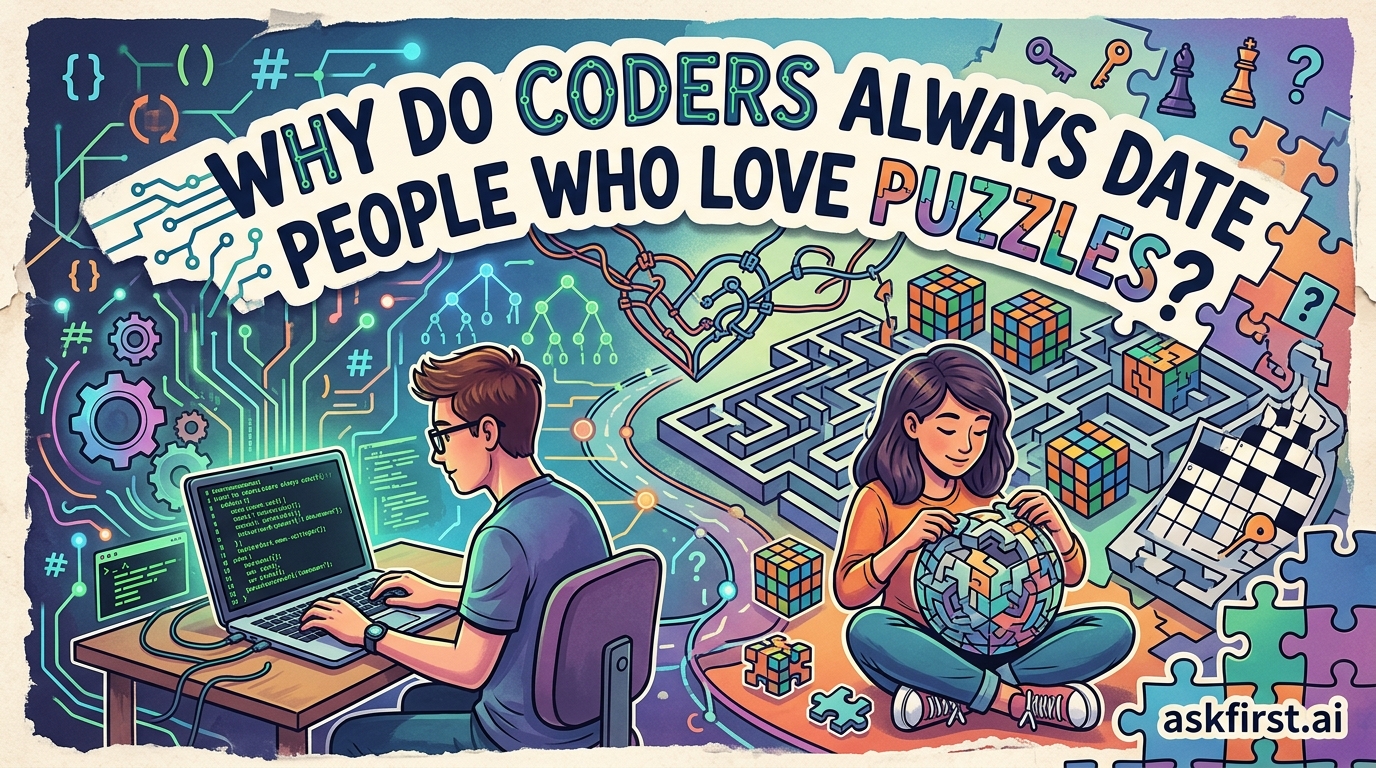
It is often observed that software developers and engineers gravitate toward partners who possess a deep-seated affinity for puzzles. While this phenomenon might seem like a mere quirk of dating preferences, there is a profound psychological and cognitive basis for this synergy. Coding is, at its core, a form of high-level abstract puzzle solving. When two individuals share a predilection for systems, logic, and iterative debugging, they establish a foundational compatibility that transcends superficial interests.
The Psychology of Systematic Thinking
Coders operate in a world defined by constraints, syntax, and logic. They are trained to break down massive problems into smaller, manageable sub-tasks. When a coder encounters a partner who loves puzzles, they find someone who understands the 'flow state'—the period of deep, uninterrupted concentration required to find a solution. This shared experience creates a unique form of domestic harmony. Instead of viewing a partner's need for isolation during a deep-work session as a sign of neglect, a puzzle-loving partner interprets this as a mutual necessity for cognitive focus.
- Shared Epistemic Values: Both groups value the pursuit of truth and the satisfaction of 'closing' an open loop. Whether the loop is a piece of broken code or a missing crossword clue, the dopamine rush associated with resolution is a powerful shared motivator.
- Communication Styles: The language of logic is universal. Those who enjoy puzzles tend to communicate with a preference for clarity and precision, which mirrors the needs of software engineering documentation and design patterns.
Debugging Relationships Like Code
Relationships are inherently complex systems. When a couple possesses the temperament of a solver, they treat emotional or logistical friction not as an insurmountable hurdle, but as a 'bug' to be categorized, analyzed, and mitigated. This diagnostic approach prevents the emotional escalation that plagues many relationships. Instead of blame, there is an objective, systematic assessment of the environment.
The Neurobiology of Reward Loops
There is compelling evidence to suggest that puzzle solvers and coders share a hyper-active engagement with the brain’s reward systems. The process of hypothesis testing—whether adjusting a line of Python code or fitting a jigsaw piece—activates the ventral striatum and the prefrontal cortex. When two people co-habit and share these intellectual pursuits, they validate each other's neurobiological needs. This mutual validation creates a stable psychological ecosystem. They essentially provide the intellectual stimulation that their brains naturally crave, which leads to higher levels of long-term satisfaction in the relationship.
The Role of Resilience and Patience
Persistence is the cornerstone of both coding and complex puzzle solving. The ability to sit with a problem that refuses to be solved is a rare trait. In a relationship, this translates into profound resilience. A couple that understands that failures are merely iterations is much less likely to dissolve under the pressure of external life events. They have spent years training their nervous systems to remain calm under the stress of unsolved logic, which makes them uniquely equipped to handle the unexpected turns of life.
Why This Trend Will Last
As the world becomes increasingly complex and automated, the value of the 'systems thinker' will continue to rise. Future generations will face challenges that require deep analytical rigor. The bond between the coder and the puzzle lover is an evolutionary adaptation to the Information Age. By pairing with someone who finds joy in the hunt for a solution, individuals secure a partner who does not just tolerate their analytical intensity but actively nourishes it.
- Mutual Growth: They challenge each other to think differently about patterns.
- Resource Management: They allocate their 'cognitive bandwidth' more efficiently.
- Conflict Resolution: They utilize deductive reasoning to navigate arguments.
Ultimately, the attraction is not a mystery of romance; it is a manifestation of cognitive resonance. When two minds are aligned in their pursuit of logical clarity, they create an intellectual partnership that is designed to endure, evolve, and solve whatever challenges the future may bring. Their shared language of logic serves as the bedrock for a relationship built on deep, sustainable mutual respect.