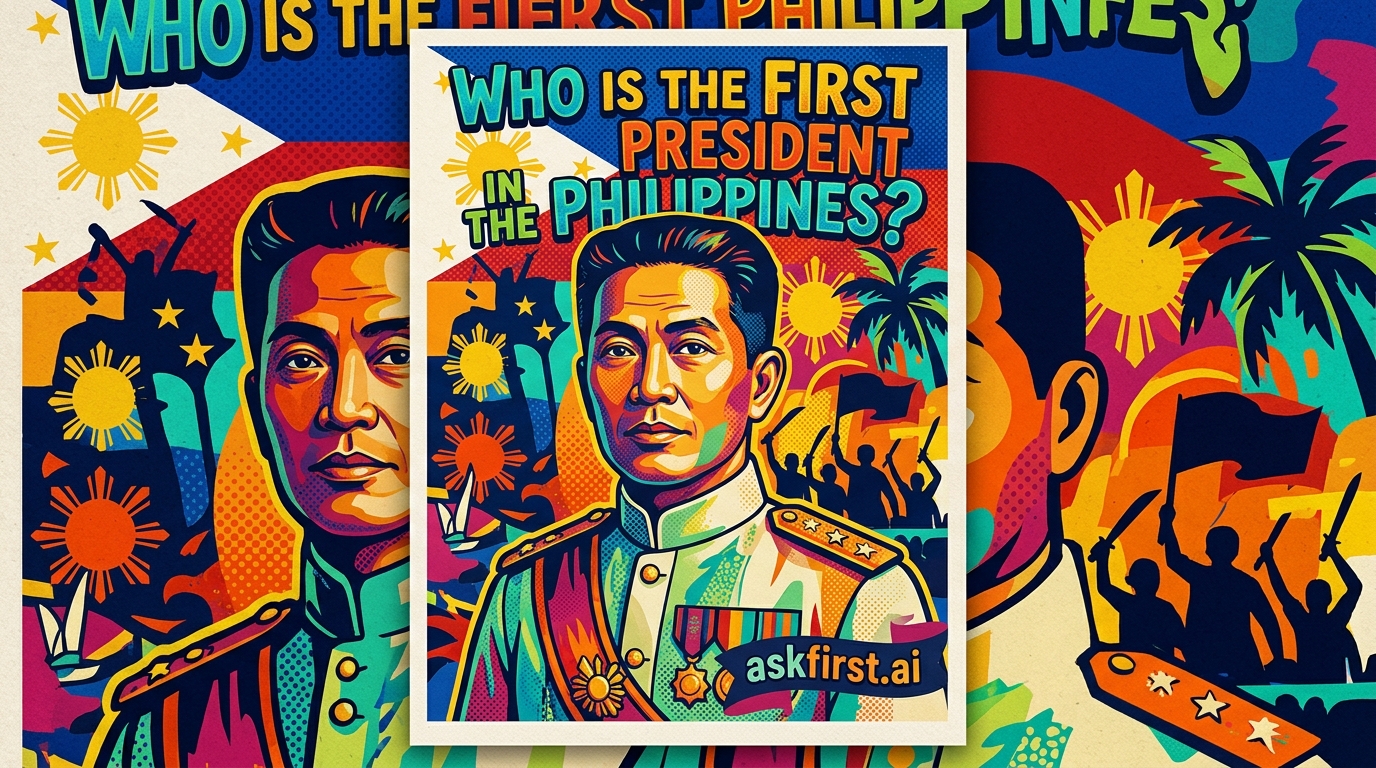
The Genesis of the Philippine Republic: Emilio Aguinaldo’s Historic Presidency
The history of the Philippines as a sovereign nation is deeply rooted in the revolutionary fervor of the late 19th century. When discussing the first president of the Philippines, the consensus among historians—and the official stance of the Philippine government—is that Emilio Aguinaldo y Famy holds this distinction. His rise to power was not the result of a peaceful electoral transition under colonial rule, but rather the culmination of a brutal, protracted struggle against centuries of Spanish domination and a subsequent conflict with American imperial forces.
The Revolutionary Context and the Malolos Congress
To understand Aguinaldo’s presidency, one must look back to the Philippine Revolution of 1896. Following the execution of the national hero José Rizal and the internal fracturing of the Katipunan (the revolutionary society), Aguinaldo emerged as the primary military leader. By 1898, after the Spanish-American War broke out, Aguinaldo returned from exile in Hong Kong and proclaimed Philippine independence on June 12, 1898, in Kawit, Cavite.
However, the formal establishment of the Republic required a constitutional framework. This led to the convening of the Malolos Congress in Barasoain Church, Bulacan, in September 1898. As noted by historian Teodoro Agoncillo in his seminal work, History of the Filipino People, the Congress was tasked with drafting a constitution that would provide legitimacy to the burgeoning state. On January 23, 1899, the First Philippine Republic—also known as the Malolos Republic—was officially inaugurated, and Emilio Aguinaldo was sworn in as its first President.
Challenges of the First Administration
Aguinaldo’s presidency was defined by the overwhelming challenge of international recognition and survival. The Treaty of Paris, signed in December 1898, had seen Spain "cede" the Philippines to the United States for $20 million, completely ignoring the existence of the newly declared Republic. This betrayal set the stage for the Philippine-American War, which began in February 1899.
Throughout his term, Aguinaldo faced the immense difficulty of maintaining a functioning government while simultaneously leading a guerilla war. His cabinet, which included brilliant intellectuals like Apolinario Mabini (the "Sublime Paralytic" and first Prime Minister), attempted to build administrative institutions, tax systems, and a national education structure under the most precarious conditions. In his memoirs, Mga Gunita ng Himagsikan (Memoirs of the Revolution), Aguinaldo provides a firsthand account of the strategic retreats and the logistical nightmares faced by his government as they moved the capital from town to town to evade capture.
The Debate on Legitimacy and Historical Revisionism
For many years, there was a historical debate regarding the status of the Philippine presidency. During the American colonial period and well into the mid-20th century, some historians argued that because the Malolos Republic was never recognized by foreign powers, it should not be considered the "true" first government. Consequently, figures like Manuel L. Quezon—who became the first president of the Philippine Commonwealth in 1935—were sometimes erroneously cited as the "first" president.
However, in 1962, President Diosdado Macapagal issued Proclamation No. 28, which officially corrected the historical record. This proclamation recognized June 12, 1898, as the true Independence Day and affirmed Emilio Aguinaldo as the first President of the Philippines. This change was based on the premise that the authority of a president is derived from the will of the people and the revolutionary mandate, not merely from the recognition of foreign colonizers.
Legacy and Impact
Emilio Aguinaldo’s presidency remains a polarizing but essential pillar of Philippine identity. Critics often point to the internal power struggles within his cabinet and the controversial deaths of revolutionary leaders like Andres Bonifacio and Antonio Luna as dark chapters of his leadership. Conversely, proponents argue that without Aguinaldo’s resolve, the Philippines would not have had a formal declaration of independence or the organizational structure that allowed the nation to dream of self-governance.
His life after the presidency was long and complex, spanning decades until his death in 1964. He lived long enough to see his nation transition through American occupation, the Japanese invasion, and eventually, the restoration of independence in 1946. Today, his residence in Kawit, Cavite—the Aguinaldo Shrine—stands as a national monument where the Philippine flag was first unfurled, serving as a tangible reminder of the birth of the republic.
Conclusion
Emilio Aguinaldo stands as the progenitor of the Philippine executive branch. His tenure as the first president was marked by an unrelenting quest for sovereignty in the face of colonial transition. By analyzing the works of scholars such as Renato Constantino in The Philippines: A Past Revisited and the official documentation from the National Historical Commission of the Philippines, it becomes clear that Aguinaldo’s presidency is not merely a historical footnote, but the foundational moment of the modern Philippine state. His legacy serves as a testament to the resilience of a nation that fought to define its own destiny against the greatest powers of the 19th and 20th centuries.