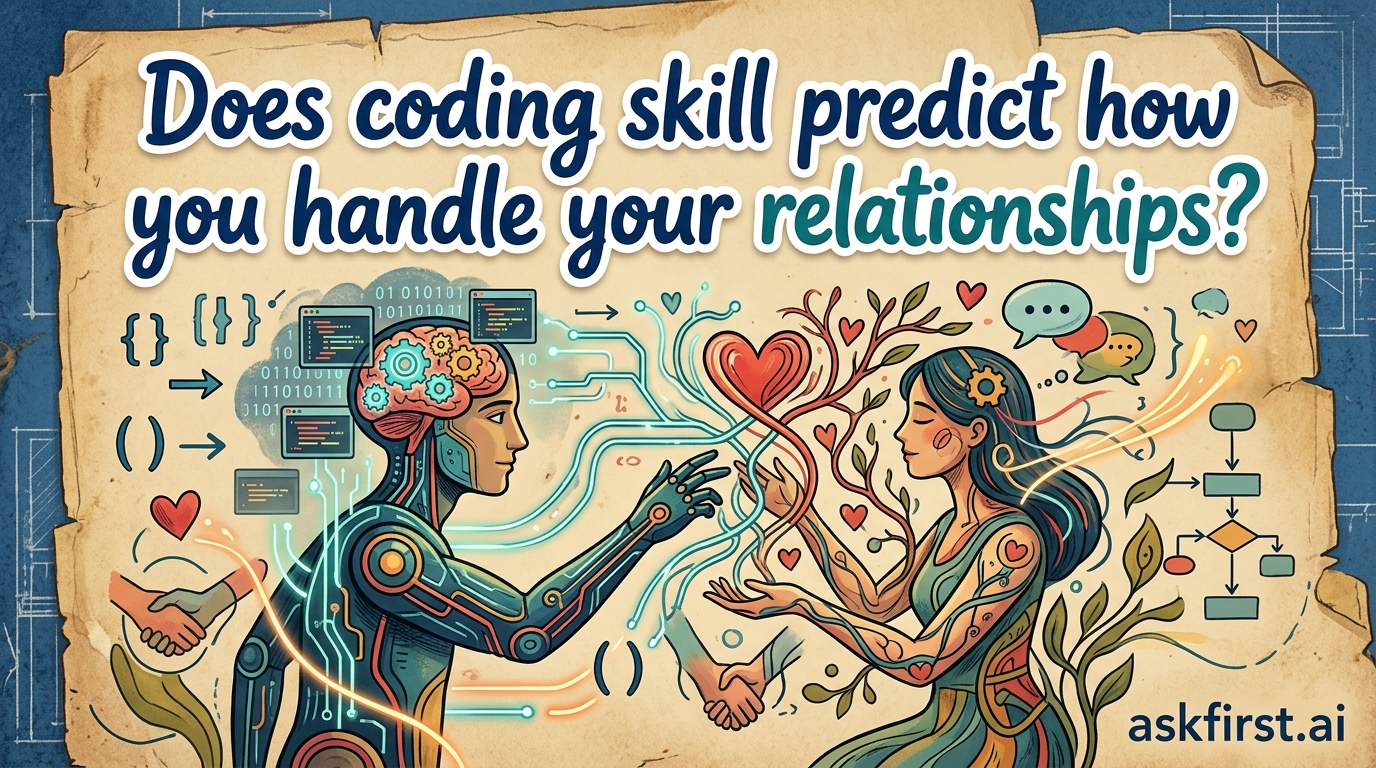
The Cognitive Intersection of Logic and Love
There exists a fascinating, albeit controversial, hypothesis suggesting that the way an individual approaches the intricacies of software development may serve as a mirror for their relational dynamics. While programming is often viewed as a strictly technical pursuit, the cognitive processes required to write robust code—abstraction, pattern recognition, and systematic troubleshooting—often spill over into the interpersonal domain. This article explores whether proficiency in coding acts as a predictor for interpersonal behavior, shedding light on the intersection of human connection and machine logic.
The Pattern Recognition of Human Interaction
Programmers are trained to seek patterns. When a bug emerges in a system, a developer analyzes the input, the environment, and the resulting error to identify the root cause. This methodology, when applied to relationships, can be both a superpower and a hindrance. High-level coders often excel at identifying behavioral patterns in others, recognizing when a partner or friend is exhibiting stress or dissatisfaction before it manifests into a full-blown argument. By applying 'debugging' mentalities to social discord, individuals can often address emotional 'exceptions' before the entire system crashes.
However, this focus on efficiency can lead to the trap of premature optimization. In engineering, premature optimization is the act of solving a problem that does not yet exist. In relationships, this might manifest as someone attempting to fix a partner's feelings instead of simply validating them. While the coder sees a problem to be solved, the partner often seeks a listener, not an architect.
Debugging vs. Empathetic Listening
The primary conflict between the 'coder mindset' and healthy relationships often stems from the difference between logical consistency and emotional validity. Code is binary and predictable; human emotion is iterative and frequently irrational. Research in cognitive psychology suggests that those who thrive in high-complexity environments, like distributed systems architecture, often struggle when the 'logical output' of a social situation is not immediately apparent.
- The Diagnostic Approach: Individuals with strong coding backgrounds tend to ask 'Why' questions to find the root cause of interpersonal issues.
- The Empathetic Approach: Healthy relationships thrive on 'How are you feeling' questions, which focus on current state rather than historical causality.
Modular Thinking in Long-Term Commitment
One significant advantage that skilled coders bring to relationships is the concept of modularity. In software, modularity allows for parts of a system to be updated, replaced, or scaled without destroying the underlying infrastructure. Applying this to relationships involves compartmentalizing issues and ensuring that one single conflict does not lead to a total 'system failure.' This skill allows people to address specific points of friction—a lack of chore distribution, for example—without questioning the entirety of the union or identity of the partner. It fosters a capacity for constructive feedback that is detached from personal ego, which is a hallmark of senior-level engineering practice.
The Refactoring of Relational Habits
'Refactoring' is the process of restructuring existing computer code without changing its external behavior. When applied to a relationship, refactoring implies the continuous improvement of the partnership's internal processes. A programmer who is consciously aware of their own cognitive tendencies can perform 'relational refactoring.' They can intentionally:
- Reduce Technical Debt: Address long-standing grievances rather than ignoring them until they become insurmountable.
- Optimize Communication Channels: Find the best medium (text, in-person, phone) for resolving specific types of emotional stressors.
- Implement Unit Testing: Regularly check in with a partner to ensure the relationship is functioning as intended, rather than assuming it is.
Conclusion: Is it a Predictor?
Does coding skill predict relationship success? Not in a direct, causal sense. Rather, coding acts as a training ground for the brain, developing specific faculties of logic, analysis, and system architecture that influence social strategies. The most successful 'coding' personalities in relationships are those who learn to distinguish between the 'machine' of the world—which requires logic—and the 'soul' of the partner, which requires patience. By tempering raw analytical prowess with emotional intelligence, the modern programmer can bring a sense of stability and structure to the complex, non-deterministic domain of human love.